



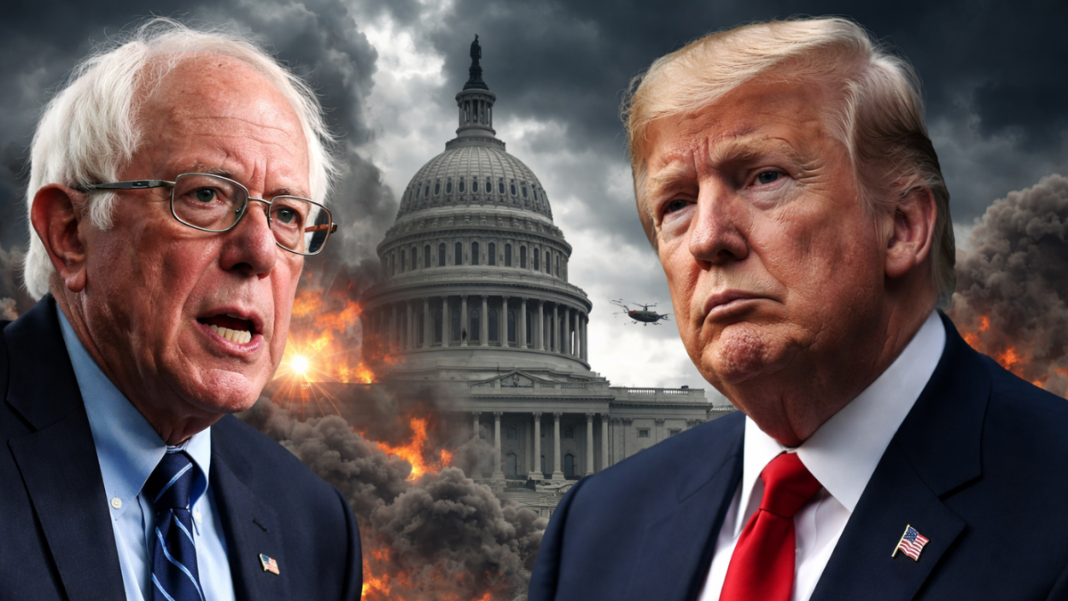


A renewed political debate has emerged in the United States after Senator Bernie Sanders raised objections to actions taken by President Donald Trump regarding Venezuela. According to Sanders, the controversy centers on constitutional authority, the role of Congress in decisions of war and peace, and the broader impact of U.S. actions on international law and domestic priorities. The dispute has drawn attention to whether the executive branch has exceeded its legal limits and what that means for democratic accountability.
Bernie Sanders has argued that the Constitution places clear limits on a president’s ability to initiate or sustain military action without congressional approval. Accordingly, any move toward military engagement in Venezuela without authorization from Congress is described as a serious breach of constitutional norms.
According to Sanders, allowing unilateral military decisions undermines the system of checks and balances designed to prevent the concentration of power. He has warned that such actions can weaken public trust and blur the lines between executive authority and legislative responsibility.
Congress and the Constitution Under Strain
The Constitution assigns Congress the authority to declare war, while the president serves as commander-in-chief within limits established by law. Sanders has pointed to this structure as a safeguard against unilateral decisions that could lead to prolonged or unnecessary conflicts.
Kevin OLeary slams Bernie Sanders’ AI data center pause, warns U.S. could hand China the future
Bernie Sanders has called on Congress to reclaim its constitutional powers. He believes that neglecting this responsibility allows the president’s power to grow too large. For him, this issue is crucial for the effectiveness of constitutional checks and balances.
Legal scholars and lawmakers who share concerns raised by Sanders warn that permitting military actions without congressional oversight could establish a lasting precedent. Once such authority becomes normalized, they argue, future administrations may face fewer constraints, reducing transparency and accountability in decisions involving the use of force.
Venezuela, International Law, and Global Implications
The controversy involves Venezuela, governed by President Maduro, whose leadership has faced widespread criticism for economic mismanagement and political repression. While acknowledging these conditions, Bernie Sanders maintains they do not justify U.S. military intervention or claims over Venezuela’s political future. He has stressed that international law is grounded in respect for national sovereignty.
According to Sanders, using force to influence another country’s government weakens global norms and risks encouraging similar behavior by other nations. He has pointed to Russia’s invasion of Ukraine as an example of how interventionist justifications can be used to excuse aggression. He has argued that U.S. actions must align with the standards it expects others to follow on the world stage.
Concerns raised by Bernie Sanders also include renewed references to the Monroe Doctrine, a policy historically used to justify U.S. dominance in the Western Hemisphere. He has warned that reviving this approach risks repeating past interventions in Latin America that resulted in long-term instability and mistrust. Statements regarding Venezuela’s oil reserves, among the largest globally, have further intensified criticism that economic interests may be shaping policy decisions.
Domestic Challenges and Public Scrutiny
As the debate over Venezuela continues, Sanders has drawn attention to mounting pressures faced by Americans at home. Rising living costs, limited access to affordable healthcare, housing shortages, and job uncertainty driven by artificial intelligence remain urgent concerns for many families. He has questioned why political focus and resources are being directed toward foreign military involvement while domestic challenges persist.
He has also contrasted current actions with Donald Trump’s earlier “America First” campaign promises to avoid costly foreign entanglements. According to Bernie Sanders, prioritizing domestic stability and constitutional governance should come before efforts to influence another nation’s affairs.
Public reaction reflects concerns echoed by Sanders, with many Americans questioning whether current policies align with constitutional principles and national priorities. The ongoing discussion involving Bernie Sanders, Donald Trump, Congress, Venezuela, Maduro, and references to Ukraine, Russia, and the Monroe Doctrine continues to underscore tensions over how the United States exercises power both at home and abroad.