



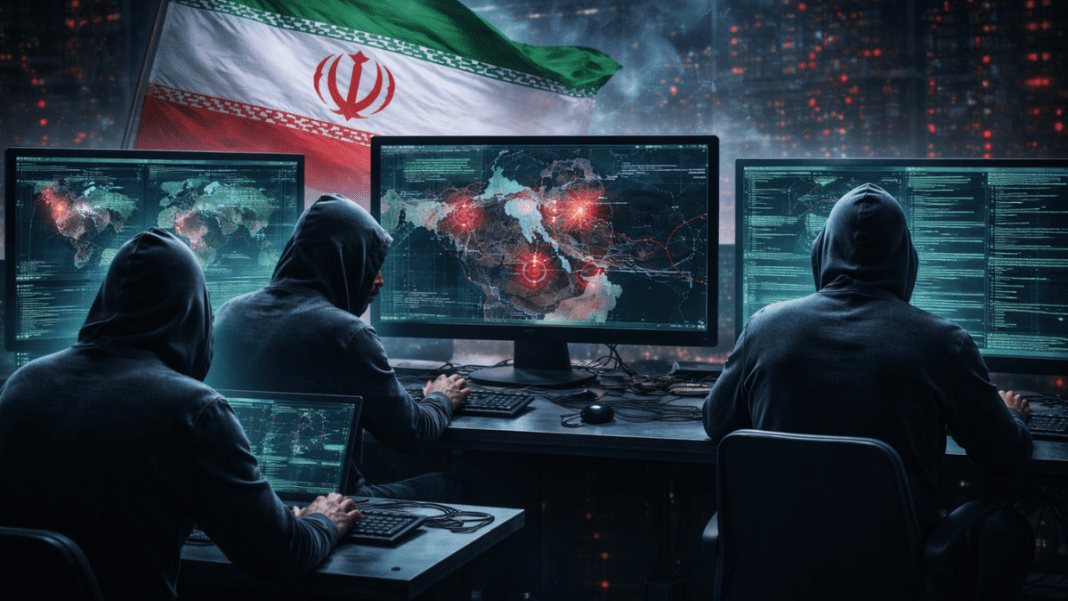


Iran has escalated its response to recent military strikes by launching a wide-ranging cyberwar campaign. The move follows missile attacks carried out by the United States and Israel, marking a sharp turn in the ongoing conflict. Instead of responding only with traditional military tools, Iran has expanded the battleground into cyberspace.
Cybersecurity experts report a surge in digital attacks linked to Iranian actors. These attacks include spying attempts, system probing, malware deployment, and distributed denial-of-service (DDoS) attacks. The targets are mainly Israel and several Persian Gulf nations, but concerns are rising that the impact could spread much wider.
Iran Expands Cyberwar Tactics Across the Region
The latest wave of cyberwar activity shows a clear shift in strategy. In the past, Iranian cyber operations were mostly covert. Now, analysts say the attacks are more visible and more aggressive.
Before the recent military strikes, Iranian-linked groups had already been preparing. Reports indicate that malware was staged inside regional networks. Digital tools were built to exploit weaknesses in infrastructure systems. These preparations suggest that the cyberwar campaign did not begin suddenly but was carefully planned.
One group that has resurfaced is known as Islamic Revolutionary Guard Corps-linked hackers, often referred to by security researchers as Cotton Sandstorm. This group has been associated with cyber operations in past regional conflicts. Their renewed activity signals a coordinated digital response.
In addition to spying missions, hackers have launched DDoS attacks. A DDoS attack overwhelms websites or online systems with massive amounts of fake traffic. When this happens, legitimate users cannot access services. Banks, government portals, and communication systems are common targets.
Security firms have also observed a rise in API probing attacks. These attacks test digital systems to find weak entry points. Once a vulnerability is discovered, hackers can use it to gain access or plant harmful software.
Malware, Ransomware, and Digital Espionage Increase
The cyberwar campaign has also included the deployment of advanced malware tools. One tool identified by researchers is a modular information-stealing program known as WezRat. It is designed to quietly collect data from infected systems.
The malware has reportedly been delivered through spear-phishing campaigns. Spear-phishing involves sending carefully crafted emails that appear legitimate. In several cases, these messages were disguised as urgent software updates. When recipients clicked the link, the malicious program was installed.
Once inside a system, the malware can collect passwords, internal communications, and sensitive documents. This type of cyber espionage allows attackers to gather intelligence before launching larger disruptions.
Iran TV Live sports feed abruptly cut as alleged hack airs Trump and Netanyahu
There have also been instances of ransomware being deployed. Reports indicate that certain attacks specifically targeted Israeli institutions. In some cases, intrusions were quickly followed by ransomware deployment, showing a rapid escalation from spying to disruption.
The threat landscape has changed noticeably since the military strikes. Israeli institutions have strengthened their defenses. Gulf Cooperation Council countries have raised alert levels. Organizations in the United States are closely monitoring for spillover effects.
While no direct large-scale attacks on U.S. infrastructure have been confirmed, experts warn that companies connected to Israeli technology or U.S. defense contracts may face elevated risks. Businesses are being urged to tighten cybersecurity protocols and review their digital hygiene practices.
Global Ripple Effects of the Iran Cyberwar Campaign
The Iran cyberwar campaign is not limited to one region. Its effects are being felt across global markets and industries. Countries including the United States, the United Kingdom, Canada, and Australia are assessing potential risks to their networks.
As tensions rise, cybersecurity teams worldwide are increasing monitoring efforts. Financial institutions, energy companies, and communication providers are on heightened alert. These sectors are often prime targets in cyberwar because they play critical roles in daily life.
Another concern is the use of disinformation. Iranian state-linked actors have previously used online platforms to spread misleading information. In times of conflict, such tactics can create confusion and fear. Digital propaganda can influence public opinion and amplify political tensions.
US and Israel deploy AI and low-cost Lucas drones in Iran strike as cyberattacks disrupt defenses
Local businesses may also become unintended victims. Companies that use Israeli technology platforms or have partnerships tied to defense sectors could face indirect exposure. Cyberwar does not always hit military targets directly. Sometimes, civilian systems are disrupted as collateral damage.
The cyberwar campaign underscores how modern conflicts extend beyond physical battlefields. Today, power grids, communication systems, and corporate servers are part of the war zone. A single digital breach can disrupt thousands of lives without a single shot being fired.