



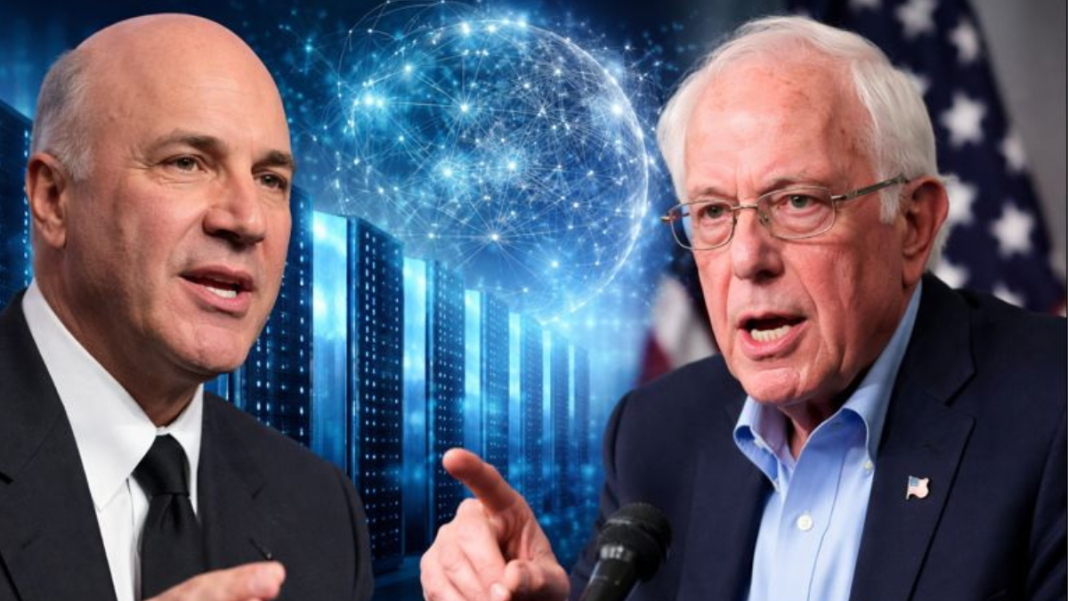


The growing debate over artificial intelligence infrastructure has triggered strong public reactions after Kevin OLeary , a well-known investor and television personality, openly criticized a proposal from U.S. Senator Bernie Sanders of Vermont to temporarily stop the construction of new AI data centers. OLeary’s remarks, posted on social media, quickly gained attention and sparked a broader discussion about technology growth, economic power, energy use, and international competition.
At the heart of the disagreement is a concern shared by many technology leaders: slowing AI development in the United States could weaken the nation’s global standing while allowing competitors — particularly China — to move ahead in the rapidly expanding AI race.
OLeary Praises the Message but Rejects the Policy
In his response, Kevin OLeary began by expressing personal respect for Senator Bernie Sanders’ communication skills. He described Sanders as extremely effective at connecting with ordinary Americans and building public support through short, emotional messages that spread quickly online and encourage grassroots fundraising.
However, OLeary strongly rejected Sanders’ call to pause AI data center development. He argued that slowing technological progress would not protect American workers or strengthen democracy. Instead, he said it would damage the country’s ability to compete in a fast-moving global technology race that is already reshaping economies, industries, and political influence.
OLeary emphasized that innovation does not wait for political debates to end. If the United States chooses to slow down, he warned, other nations will simply move faster. Investment capital, top engineers, and advanced research would shift to more supportive countries, leaving the U.S. at a competitive disadvantage.
According to OLeary, giving up leadership in advanced technologies such as artificial intelligence would weaken both the American economy and national security.
If the U.S. Slows, Others Will Surge Ahead
Much of OLeary’s warning focused on the pace of international competition, particularly with China. He noted that while American officials debate permits, environmental reviews, and regulations, China is rapidly expanding its AI infrastructure with far fewer delays.
Uzbekistan Airways hack exposes 300 GB data of passengers and U.S. government employees
OLeary framed the issue as one of strategic importance, not just business growth. Faster AI development can translate into advantages in defense systems, cybersecurity, automation, financial markets, healthcare, transportation, and even military technologies. Countries that control the most powerful computing resources, he said, gain influence across nearly every major sector of modern life.
At the core of this competition are massive data centers. These facilities process enormous volumes of information and make advanced AI systems possible. Nations that dominate this infrastructure shape the future of global technology leadership.
OLeary also dismissed the idea that the U.S. could pause development without consequences. In an increasingly competitive world, slowing down does not preserve stability — it creates opportunity for rivals to overtake.
Concerns Over Power, Profits, and Public Impact
Senator Bernie Sanders, the independent lawmaker from Vermont behind the proposal, has repeatedly warned that the rapid expansion of artificial intelligence could concentrate wealth and power in the hands of a small group of wealthy technology executives and corporations.
Sanders has argued that unchecked AI growth threatens jobs, democracy, and public resources. He has publicly criticized tech leaders such as Elon Musk, Jeff Bezos, Mark Zuckerberg, Peter Thiel, and Bill Gates, saying AI development is often driven by corporate profit rather than the needs of working families.
China Warns of Al Addiction as It Unveils Draft Rules for Human-Like Systems
Supporters of stronger oversight point to the massive energy demands created by data centers. Experts estimate these facilities already consume about five percent of total U.S. electricity, a figure expected to climb sharply as AI adoption accelerates. This puts pressure on power grids and raises serious environmental concerns that lawmakers are struggling to address.
Critics of slowing construction counter that energy challenges should be addressed through cleaner energy solutions and smarter regulations, not by surrendering technological leadership.
Industry leaders including Nvidia CEO Jensen Huang have also warned that U.S. data center projects face long approval timelines, sometimes taking years to complete, while China moves much faster. As of late 2025, the United States still hosts the largest number of data centers in the world, but China continues expanding at a rapid pace.
The ongoing disagreement over AI infrastructure reflects broader questions about how modern societies manage powerful new technologies. The debate touches nearly every major issue: economic growth, job security, environmental responsibility, national defense, and global competition.
For now, the discussion continues publicly, with sharply different views shaping how the United States approaches one of the most influential technologies of the modern era.