



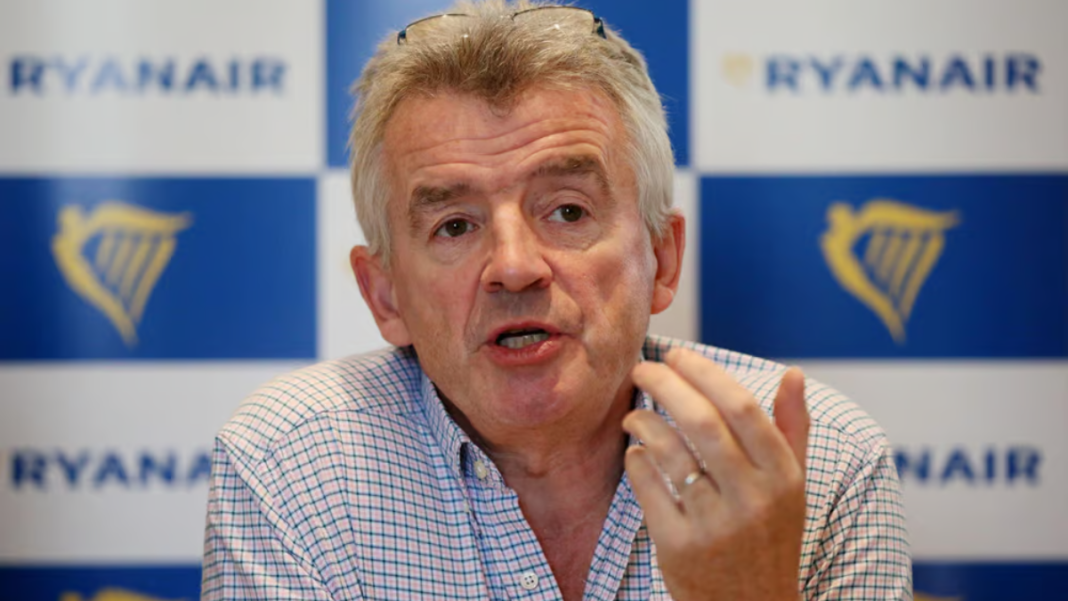


Ryanair, Europe’s largest airline by passenger volume, became the center of attention after its CEO, Michael O’Leary, publicly criticized Elon Musk and rejected the use of Starlink internet on Ryanair aircraft. The comments were made during a radio interview and quickly drew strong reactions because of their blunt language and the wider issues involved.
Michael O’Leary said he would pay “no attention whatsoever” to Elon Musk and described him as a “very wealthy idiot.” The remarks were made in response to discussion around Ryanair’s refusal to install Starlink, a satellite-based internet service operated by Musk’s company SpaceX.
Starlink has been expanding its presence in commercial aviation. Airlines such as Lufthansa and Scandinavian Airlines have already introduced free in-flight internet using the service. This has increased pressure on other airlines to follow the same path. Ryanair, however, has clearly decided not to.
The airline is widely known for its ultra-low-cost business model. It focuses on offering cheap base fares while charging extra for optional services. According to Michael O’Leary, installing Starlink does not align with this approach.
Kevin OLeary slams Bernie Sanders’ AI data center pause, warns U.S. could hand China the future
Cost and Fuel Concerns Behind the Decision
Michael O’Leary explained that adding Starlink would require installing an antenna on top of each aircraft. He said this would be expensive and estimated the annual cost at between $200 million and $250 million. Spread across Ryanair’s passengers, this would mean roughly an extra dollar per ticket.
While the amount sounds small, Ryanair operates on very tight margins. O’Leary said even small cost increases matter when flying millions of passengers each year. He also stated that Ryanair passengers are highly price-sensitive.
According to him, passengers may use the internet if it is free, but they are unlikely to pay even one euro for it. Since most Ryanair flights last about one hour, the airline believes internet access is not a priority for its customers.
Fuel efficiency was another key issue. O’Leary said that adding an antenna would increase weight and drag, leading to higher fuel consumption. He claimed this could result in a fuel penalty of around 2%, which would significantly raise operating costs.
He also dismissed Elon Musk’s understanding of aviation, saying Musk knows little about flight operations and aircraft drag.
Alexandria Ocasio-Cortez warns Musk’s rush to deploy AI left kids exposed to deepfake abuse
Musk’s Response and Ryanair’s Firm Stance
Elon Musk responded on X, the social media platform he owns, saying airlines without internet connectivity would lose customers to competitors that offer it. His comments suggested that in-flight internet is becoming an expected feature for travelers.
The debate continued when Michael Nicolls, Starlink’s vice president of engineering, challenged Ryanair’s fuel figures. He said SpaceX data shows that installing Starlink on a Boeing 737-800, which makes up most of Ryanair’s fleet, increases fuel use by only about 0.3%.
Musk replied by suggesting the impact could be reduced even further, possibly below 0.1%. Ryanair chose not to respond to these claims and declined further comment.
Michael O’Leary also criticized Musk’s activity on X, calling the platform a “cesspit.” He said he does not use social media and has no interest in engaging online. He also pointed out that Musk supported Donald Trump, the current President of the United States.
Ryanair’s position comes as the airline reports strong financial results. In its latest quarterly report, Ryanair posted after-tax profits of 1.72 billion euros, about $2 billion, a 20% increase from the previous year. The airline continues to focus on low fares and paid extras, choosing cost control over added features like in-flight Wi-Fi.