
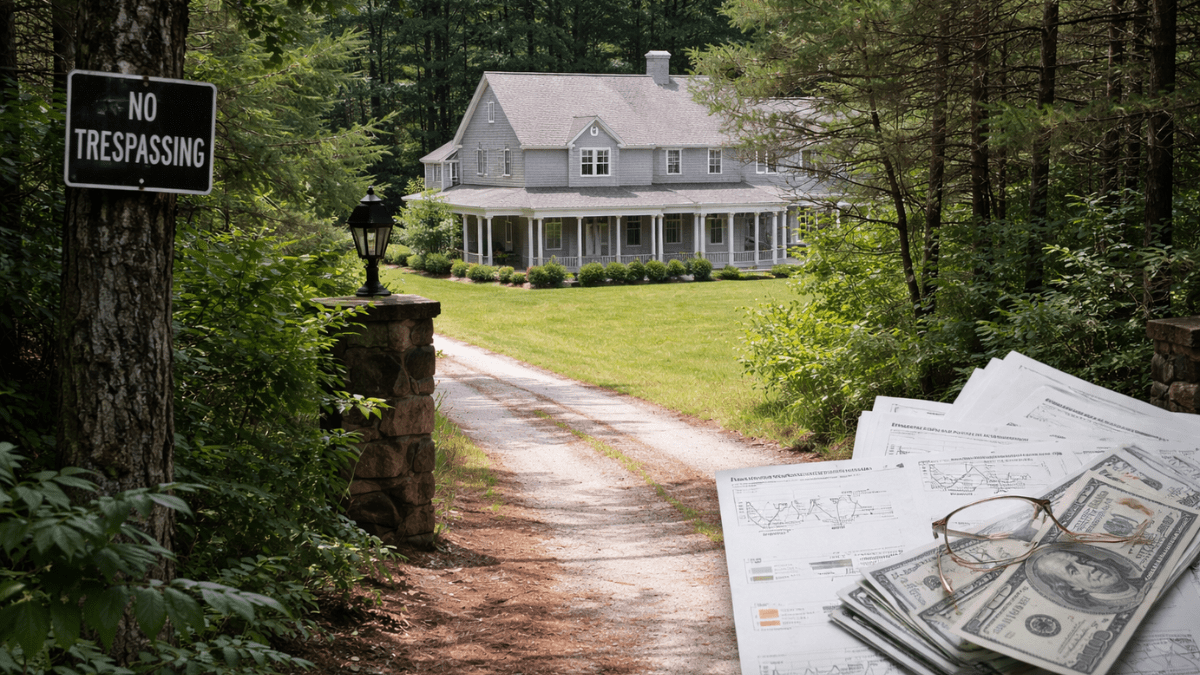
In a quiet rural town in New Hampshire, a secluded estate known as “Tucked Away” became the center of global attention after the arrest of Ghislaine Maxwell. The property, located in Bradford and spread across 156 acres, was purchased in December 2019 for around $1.1 million. At the time, Maxwell used the alias “Janet Marshall” and described herself as a journalist seeking privacy, allowing her to quietly complete the deal without raising suspicion.
The estate was designed for isolation and secrecy. It sat at the end of a long dirt driveway, surrounded by thick woods and marked with “No Trespassing” signs. The location made it difficult to access and easy to remain unnoticed. This purchase came at a time when Maxwell was already under increasing scrutiny due to her long-standing association with Jeffrey Epstein. However, the full story behind how the property was funded only became clear after investigators examined her financial records.
UBS Transfers and Financial Red Flags
Documents released by authorities revealed that UBS played a central role in handling Maxwell’s finances leading up to the purchase. In November 2019, UBS transferred nearly $8 million from an account linked to a trust connected to Maxwell. This money did not go directly toward the property. Instead, it moved through multiple financial channels, creating a layered trail that made it harder to track.
Epstein investigation jolted as Maxwell refuses questions, reigniting elite accountability debate
The timing of this transfer raised serious concerns among investigators. Just a few months earlier, on August 16, 2019, U.S. prosecutors had issued a grand jury subpoena to UBS. The request asked the bank to provide detailed records of Maxwell’s financial activities as part of an ongoing criminal investigation tied to Epstein. The subpoena was marked confidential, meaning the bank was instructed not to alert the client in a way that could interfere with the investigation.
Despite this, UBS processed the large transfer weeks later. Around the same period, the bank had informed Maxwell that it planned to end its business relationship with her within a month, though no public explanation was given. This sequence of events raised questions about how financial institutions respond when dealing with high-risk clients during active investigations.
The funds were transferred from UBS to an account at TD Ameritrade. Here, Scott Borgerson acted as the custodian of the account. The money was routed into a trust, which was then used to buy the New Hampshire estate.
Financial crime expert Tom Kirchmaier has noted that banks are required to monitor clients who may pose higher risks. They must report suspicious transactions and take action if there are warning signs. However, in practice, handling wealthy clients can be complicated. U.S. Senator Ron Wyden also pointed out that large financial institutions may sometimes hesitate to act strictly because wealthy individuals can easily move their funds to other banks.
Complex Wealth and Multiple Banking Links
Further investigation revealed that Maxwell controlled significant wealth, estimated at around $22.5 million as of 2020. A large portion of this money came from earlier financial activities, including the sale of a luxury townhouse in New York. The proceeds from that sale were deposited into UBS accounts and later distributed across various investments, trusts, and transactions.
UBS managed a substantial portion of her assets, including cash holdings, shares, and other investments. Over time, funds were moved between different UBS accounts and also transferred to other institutions. These movements created a complex financial network that made it difficult for investigators to immediately trace the origin and purpose of each transaction.
Another major financial institution, Barclays, also played a role in managing part of Maxwell’s money outside the United States. Records showed that funds were transferred between Barclays and UBS accounts, even after Epstein’s arrest in July 2019. These continued transactions added to concerns about oversight and monitoring during a sensitive period.
After Maxwell’s arrest in July 2020, banks filed suspicious activity reports related to her financial dealings. Some of these reports suggested that certain transactions, including those connected to the New Hampshire property, could be linked to illegal activities. UBS later filed reports covering more than $18 million in transfers associated with her accounts over several years.
Swedbank under review by Sweden’s financial regulator for money laundering procedures
When law enforcement officials finally located Maxwell at the Bradford property, they discovered a highly secure environment. The estate was guarded by personnel with military backgrounds, and efforts had been made to avoid detection. Investigators also found devices that appeared to be used to prevent electronic tracking, highlighting the extent of precautions taken.
Since the arrest, the property has changed ownership and is expected to be sold again. It is now being marketed as a private and peaceful retreat. However, its connection to a high-profile criminal case and the financial trail behind its purchase continue to draw attention and raise questions about the role of global banking systems in handling high-risk clients.