



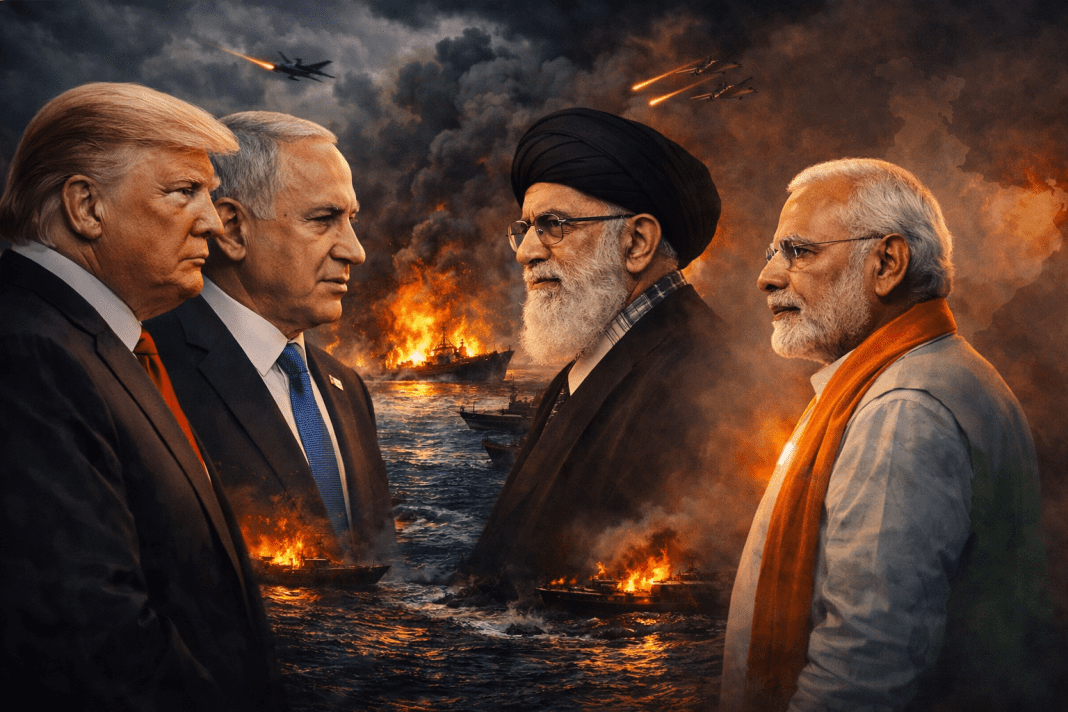


Why are India’s leading foreign policy experts and commentators upset with the state of India’s foreign policy, especially in the context of the Israel-US war on Iran?
On 17th March, India condemned Pakistan’s airstrikes on an hospital in Kabul and called it a “barbaric” and “cowardly” act of violence.
Responding to Taliban’s accusation that at least 400 people had been killed in the airstrike on a drug rehabilitation hospital in Kabul, India called it a cowardly and unconscionable act of violence.
The Ministry of External Affairs described the attack as “a blatant assault on Afghanistan’s sovereignty and a direct threat to regional peace and stability”.
Strangely, that same voice of condemnation– or even anguish—was missing when, barely a fortnight ago, a primary school was bombed in Southern Iran, killing more than 170 people, mostly school children. The attack was part of the US-Israeli war on Iran and the United Nations called it a grave violation of humanitarian and international law.
The voice of the Indian nation—the world’s largest democracy—and a prominent voice of the Global South was missing once again when the United States on March 4th bombed the Iranian Navy frigate IRIS Dena in the Indian Ocean. In this case, India was directly involved as the ship had participated in a naval exercise hosted by India and was returning home.
India also failed to issue a statement when the Iranian Supreme Leader Ayatollah Khamenei was assassinated on 28th February in an Israeli air attack.
Israel’s extreme enemity with Iran is understandable and India’s strategic ties with Israel and the US are justified. Having said that, India has always had her own voice in the international arena – the voice of a prominent leader of the Global South; the voice of Strategic Autonomy and the voice of the Non-Aligned Movement (NAM) in the past.
The loss of that voice during these crucial moments of the war on Iran, has brought India’s foreign policy under sharp scrutiny. It has likewise thrown the spotlight on India’s civilisational friendship with Iran.
This scrutiny began with Prime Minister Narendra Modi’s high profile visit to Israel on 26th February even as the War Clouds were gathering thick and fast over Iran and the Israel-US War on Iran was imminent. The war broke out barely 48 hours after PM Modi’s visit.
Why are India’s leading foreign policy experts and commentators such as former National Security Adviser Shiv Shankar Menon, West Asia expert, Ambassador Talmiz Ahmad; India’s former Ambassador to Iran, KC Singh, and the former Media Advisor to PM Manmohan Singh upset with the state of India’s foreign policy, especially in the context of Israel-US war on Iran?
All of them were critical of PM Modi’s visit to Israel just before the war; calling it “ill-timed.” They felt that the visit was badly timed; India had firmly aligned itself with Israel at the cost of her Strategic Autonomy and India had lost the Global South leadership by doing so.
As Dr Sanjaya Baru said during an online discussion: “We have identified ourselves completely with Israel and the United States which is inexplicable even from a purely Indian Interest point of view. I don’t think in the Global South people will look up to India any more.”
These are just some of the top Indian minds who have raised serious questions on the Indian position in this on-going war.
India’s seemingly unstinted support to Israel has been jarring especially as India seeks to be heard as a leader of the Global South; as a Vishwa Guru under Prime Minister Modi and express her independent point of view through the Strategic Autonomy principle which she cherishes.
Recall how India had admirably stood up to the United States and asserted her Strategic Autonomy while purchasing Russian Oil amidst threats of US sanctions.
Recently at the Munich Security Conference in February 2026 External Affairs Minister S. Jaishankar asserted that India is “very much wedded to Strategic Autonomy because it is a part of our history and our evolution.” He said it is “very deep and cuts across the political spectrum.”
Indeed, it was on the strength of her national interest and strategic autonomy that India stood up to the US and defended her ties with Russia. This assertion was India’s voice of self-respet and the voice of a prominent leader of the Global South.
Has that voice been silenced today in the wake of the Iran war, seemingly blind support to Israel and the threat of tariffs from the US?
This is the question being asked by a number of leading foreign policy experts.
As the former NSA Menon pointed out during an online discussion, in previous decades, India had successfully upheld her Strategic Autonomy and pursued her national interest while dealing with nations opposing one another— notably, Israel, Iran, and the Gulf states such as Iraq, Saudi Arabia and the UAE.
This time however, India has displayed an extreme tilt towards Israel at the cost of her voice in the Global South, her Strategic Autonomy and her civilisational friendship with Iran. In Ambassador Talmiz Ahmad’s view, “strategic ambiguity” would have been an appropriate approach in the current situation.
Jaishankar’s statement that Strategic Autonomy is “part of India’s history and evolution” comes from consistency and continuity in foreign policy over the decades. The Non-Aligned Movement established by India’s first Prime Minister Jawaharlal Nehru and other leaders was an important component of this as the newly independent and developing nations of the world did not want to be trapped in superpower rivalry. They wanted to maintain friendly ties with all nations and pursue developmental goals of their national interest.
Although NAM failed because of realpolitik compulsions as nations got pulled between the American and Soviet blocs, the principle continues in the form of India’s Strategic Autonomy and the collective efforts by the Global South.
During India’s G20 Presidency in 2023, Prime Minister Modi projected India as “the Mother of Democracy” and as a “Vishwa Guru” with the “fundamental principle of ‘Vasudhaiva Kutumbakam,’ – the world is one family.
This has been India’s civilisational message of global peace, harmony and cooperation among nations.
Over the centuries India has demonstrated its civilisational commitment to this principle by giving refuge to whosever needed it—Zoroastrians fleeing from Persia; Jews, Tibetans, Ahmadiya Muslism and others.
India’s identity as a multi-religious, multi-ethinic, multi-cultural society and its composite culture is nothing but a reflection of its Civilisational Message of Vasudaiva Kutumbakam.
The Islamic Republic of Iran has been a Civilisational Friend of India since ancient times, dating back to the Indus Valley Civilisation, more than 5,000 years ago.
This friendship has translated into economic, geo-strategic and cultural exchange and cooperation over the centuries, right to the present day.
The India-Iran collaboration on the geo-strategically important Chabahar Port—which stands suspended presently– is one shining example of this cooperation.
India’s External Affairs Minister has had four rounds of talks with his Iranian counterpart ever since the war began, and Iran has allowed the passage of ships from the Strait of Hormuz even though there was “no blanket agreement.” This is undoubtedly a reflection of the inherent trust, friendship, and long-term interests of India and Iran.
Finally, unpredictable and temperamental leaders like President Trump will come and go, but India and Iran will have an opportunity to restore and strengthen their ties in the future.
For this to happen, India needs to find its voice of self-respect again and make itself heard in the community of nations.
Views expressed are personal. The author is a journalist who has served as Director of the Pune International Centre public policy think tank and as Washington Correspondent at The Times of India.