






Financial regulation • compliance • governance
Jeffrey Epstein files and the compliance story behind the headlines
The Epstein files saga is widely discussed as a criminal and political scandal. In regulatory and financial terms, it also functions as a long-running case study in oversight practice, records management, redaction controls, institutional accountability, and bank compliance exposure across the United States.
Why this is a Regtech story, not only a scandal story
In modern financial systems, the most consequential risk is often not a single headline, but the operational chain beneath it: how institutions collect information, preserve it, redact it, release it, and respond to oversight when public pressure rises. The Epstein files are now linked to U.S. congressional action, Department of Justice document releases, court-linked records, civil settlement context in the U.S. Virgin Islands, and multiple bank-focused lawsuits. That combination turns the story into a governance and compliance map that touches the same controls banks and regulated entities depend on every day: audit trails, privacy protection, suspicious activity reporting, reputational risk management, and litigation readiness.
From a Regtech lens, this topic sits at the intersection of public-sector records governance and private-sector financial controls. When documents are released in bulk, the
quality of redaction is not a cosmetic detail. It becomes a privacy control, an evidence-handling control, and a trust control. When lawmakers subpoena private documents,
the targets of the subpoena become part of a compliance workflow. When lawsuits claim banks failed to detect or report suspicious activity, the public sees the backend of AML
and transaction monitoring in the harshest possible light.
This pillar page consolidates verified reporting from NewsInterpretation’s Epstein coverage and organizes it as a compliance and governance narrative for readers following
U.S. financial regulation, technology controls, and institutional accountability.
The 33,000-page release and the transparency problem
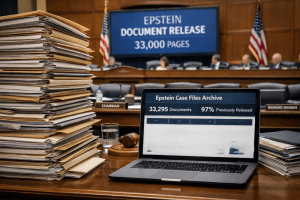
Newsinterpretation reported that the House Oversight Committee released a collection totaling 33,295 pages connected to the Epstein case and linked the files online for
public viewing. The reporting emphasized a key reality: the size of a release does not automatically equal new information. Committee reviewers described roughly 97% of the
release as already in the public domain, including court filings, trial materials, and previously circulated records. Only a smaller portion was described as fresh material,
with under 1,000 pages tied to flight locations from 2000 to 2014 and reentry-related forms connected to Customs and Border Protection records.
New Slice, Old Story: Committee says 070/0 of 33k Epstein pages were already on record
That mismatch—massive volume versus limited novelty—matters in compliance terms because it affects how stakeholders interpret “transparency.” A high-volume release can look like a governance breakthrough, while the underlying content can function as repackaging. In financial markets and regulated environments, transparency is measured by verifiability, completeness, and timeliness, not by file counts alone. A disclosure event that feels large can still leave critical questions in the same place: inside sealed
records, under redactions, or in private archives.
Newstnterpretation’s framing is important for readers tracking U.S. oversight processes because it highlights how disclosure campaigns can evolve into documentation management exercises: consolidating known materials into a single bundle, publishing searchable archives, and balancing public demand against victim privacy redactions.

New Slice, Old Story: Committee says 070/0 of 33k Epstein pages were already on record
The estate subpoena and what lawmakers asked for
Newsinterpretation reported that a U.S. House committee issued a formal subpoena to Epstein’s estate seeking private documents that lawmakers described as relevant to
uncovering more about his network, money, and connections. The subpoena request included contact books, financial records, legal agreements, and a “birthday book” tied to
Epstein’s 50th birthday that was described as containing notes from associates.
Bipartisan committee subpoenas Epstein estate touncover records tied to trafficking investigation
Subpoenas of this kind matter from a governance standpoint because they move oversight from public record review into private documentary systems. Contact books and financial
records are not merely narrative artifacts; they are data structures. They can be cross-referenced with travel logs, corporate entities, transaction flows, and litigation
timelines. They can also become contentious if privileges, privacy, and chain-of-custody questions emerge during production.
In a Regtech environment, the operational question is not simply “what is inside the documents,” but “how the documents are produced, validated, stored, and audited.”
When a subpoena demands categories like “financial records” and “legal agreements,” it implicitly demands structured record-keeping that can withstand scrutiny. It also
tests the capacity of institutions and estates to respond to high-intensity requests without compromising victim protections or contaminating evidentiary quality.
Redaction failures and records-handling risk
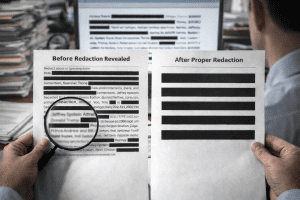
Newsinterpretation reported that DOJ-linked Epstein documents faced backlash after readers found redactions could be undone using basic methods such as highlighting text,
copying and pasting it, or adjusting contrast with simple tools. The reporting described the discovery as a sensitive handling problem because the governing framework for
the release permitted withholding information including victim identities and material that could affect active investigations.
Redacted Epstein files appear ‘restored’ as hidden text resurfaces in Justice Department release
In compliance terms, this is a textbook failure mode: a redaction that is visual rather than structural. A proper redaction removes the underlying text layer so that it is
not recoverable through selection or image manipulation. When recoverable text persists, the redaction becomes a “screen,” not a control. That distinction matters because
victim privacy is not an editorial preference; it is a governance requirement and, in many contexts, a legal obligation.
The reporting also described the documents as tied to civil proceedings involving Epstein’s estate. When redaction control fails inside litigation-linked releases, the risk
is amplified: the system can expose sensitive information at scale, trigger secondary dissemination on social platforms, and reduce confidence in the release mechanism. For
Regtech readers, the key point is that document governance is a technical discipline. It requires validated tooling, pre-release testing, and workflow controls that confirm
irreversible redaction before publication.
Maxwell appeal rejection and the sealed-records reality
Newsinterpretation reported that the U.S. Supreme Court declined to hear Ghislaine Maxwell’s final appeal, leaving her 20-year sentence intact and ending that legal route.
The report described the court’s refusal as customary in that the justices gave no explanation, and it summarized Maxwell’s argument that her prosecution conflicted with a
2007 non-prosecution agreement linked to Epstein, an argument that prior appellate review rejected.
Justice served or secrets buried? Supreme Courtrejects Maxwell appeal, keeping Epstein files sealed
For governance and transparency debates, this outcome highlights the structural reality of sealed records. Even as public attention concentrates on “file releases,” critical
materials can remain inaccessible due to court sealing, privacy protections, or procedural constraints. The tension is not theoretical: oversight pushes for disclosure while
legal frameworks preserve limitations around victims, evidence, and investigative integrity. Those limitations become part of the policy story because they shape what the
public can verify at any given time.
From a RegTech viewpoint, “sealed” is not simply a status; it is a classification outcome driven by rules. Classification and access control are the heart of compliance
systems. The same logic that governs access to sensitive bank customer data, sanctions screening inputs, or SAR narratives also governs sensitive case files: least privilege,
identity protection, and controlled release pathways.
Island visuals and evidentiary narratives
NewsInterpretation reported that Democratic lawmakers on the House Oversight Committee released new photos and videos from Epstein’s private island, Little St. James, which is located near St. Thomas in the U.S. Virgin Islands. The report described unsettling interiors, including a dentist’s chair surrounded by male masks and a phone with
first names written on speed-dial buttons. The piece also referenced that some images were previously mentioned in external reporting, but described this as a formal
committee release.
Visual releases function differently from document dumps. A photo does not create a complete record, but it can reshape how the public interprets a space tied to a case.
In compliance and governance settings, visuals can elevate pressure for deeper disclosure and documentation. At the same time, visuals can be context-poor: without full
metadata, chain-of-custody clarity, and timing, interpretation can diverge widely.
For RegTech readers, the operational point is that “evidence” exists on a spectrum. Photos and videos can be compelling, yet compliance-grade evidentiary narratives depend
on documented provenance: who captured the image, when, in what condition, and under what authority. In high-profile cases, these details matter because they influence
oversight confidence and public trust in the institutions managing the archive.

Estate photos and reputational governance
NewsInterpretation reported that the House Committee on Oversight and Government Reform released photos from Epstein’s estate that showed candid moments involving several well-known figures in social and professional settings. The report stated that the images did not include detailed information about when or where each was taken and noted that the photos themselves did not provide evidence of wrongdoing by those pictured. The reporting also described some material as disturbing and framed the release as part of an ongoing committee investigation, separate from DOJ-linked releases.
House committee releases photos from Jeffrey Epstein estate with candid and unsettling content
This is where reputational governance meets compliance reality. In regulated markets, reputation is not an abstract brand metric; it is a risk factor that affects counterparties, investor confidence, and institutional stability. Photo releases can expand reputational exposure without changing the underlying legal posture, because they widen the circle of public association while often providing limited context.
The compliance lesson is straightforward: when an oversight body releases “relationship-adjacent” materials, institutions and individuals connected to the images can face a governance test that is distinct from criminal liability. Disclosures of association can drive due-diligence questions, board-level reviews, and heightened media scrutiny even when the record does not allege wrongdoing. In financial journalism terms, that translates into market attention because trust and credibility are market variables.
Bank of America and BNY Mellon lawsuits as AML and compliance exposure
NewsInterpretation reported new lawsuits filed in federal court against Bank of America and Bank of New York Mellon (BNY Mellon), alleging the banks continued to serve Epstein and failed to report suspicious financial activity until after his death in 2019. The report framed the claims as an assertion that Epstein’s network relied on financial systems that allegedly enabled transactions that should have raised alarms.
New legal firestorm: Bank of America and BNY Mellon face claims of aiding Epstein’s secret empire
From a RegTech perspective, these bank-linked lawsuits represent the sharpest compliance angle in the Epstein story because they go directly to AML expectations: detection,
escalation, suspicious activity reporting, and the governance culture around high-risk clients. The allegations described in the report reflect a recurring compliance theme in financial services: whether a relationship receives “special treatment” that weakens ordinary controls, whether red flags are rationalized, and whether reporting occurs late rather than in a timely manner.
The article also referenced reporting and statements around large transaction figures tied to suspicious activity reporting timelines, describing them as part of renewed public anger about delayed detection and delayed reporting. For compliance teams, the underlying mechanics are familiar even when the story is extreme: transaction monitoring
thresholds, investigator workload, escalation quality, and the challenge of acting decisively on reputational and behavioral indicators that may not map neatly to rules.
New legal firestorm: Bank of America and BNY Mellon face claims of aiding Epstein’s secret empire
These cases also underscore why financial news outlets treat “compliance lawsuits” as market-relevant events. They sit at the intersection of legal exposure, regulatory
posture, operational controls, and brand trust. Even when claims remain allegations in filings, the risk narrative becomes part of how investors, counterparties, and
regulators evaluate institutions.
RegTech takeaway: the Epstein banking claims spotlight how transaction monitoring and SAR governance are judged in hindsight—especially when an institution’s client risk is
already widely known through public reporting and prior legal history.

What readers can verify directly from primary links
The strongest way to keep this topic factual and non-speculative is to anchor every major claim to a verifiable primary article URL on NewsInterpretation.com. Readers can
confirm the following categories of information directly from the source pages:
First, the scope and character of the 33,295-page release and the committee’s statement that most pages were already public domain, with a smaller portion described as new
flight and reentry material.
New Slice, Old Story: Committee says N970/0 of 33k Epstein pages were already on record
Second, the subpoena categories directed at Epstein’s estate, including contact books, financial records, legal agreements, and the “birthday book.”
Shocking Files Reveal Bill Clinton Letter in Epstein’s Infamous ‘Birthday Book’
Third, the redaction failure described as readable redactions in DOJ-linked releases and the basic methods used to reveal text.
Redacted Epstein files appear ‘restored’ as hidden text resurfaces in Justice Department release
Fourth, the Supreme Court action declining to hear Maxwell’s final appeal and the summary of the legal argument around the 2007 agreement.
Verify
Fifth, the committee-released visuals from Little St. James and the described contents of images and rooms.
House committee releases photos from Jeffrey Epstein estate with candid and unsettling content
Sixth, the estate photo release story describing public figures pictured, the lack of detailed timing/location context in the images, and the note that photos do not prove
wrongdoing.
Justice served or secrets buried? Supreme Court rejects Maxwell appeal, keeping Epstein files sealed
Seventh, the Bank of America and BNY Mellon lawsuit reporting describing allegations of continued services and delayed suspicious activity reporting.
New legal firestorm: Bank of America and BNY Mellon face claims of aiding Epstein’s secret empire
FAQ
What did the committee say about the value of the 33,000-page release?
NewsInterpretation reported that committee reviewers described about 97% of the released pages as already public and characterized the newest portion as under 1,000 pages related to flight locations and reentry records.
Source
Why does a redaction failure matter in a compliance context?
NewsInterpretation reported that some redactions were reversible with basic techniques like highlighting, copying/pasting, or contrast adjustment, raising concerns about how
sensitive information was handled under a framework that allowed withholding victim identities and certain investigative material.
Redacted Epstein files appear ‘restored’ as hidden text resurfaces in Justice Department release
What documents did lawmakers seek from the estate?
NewsInterpretation reported that the subpoena sought contact books, financial records, legal agreements, and a “birthday book.”
Bipartisan committee subpoenas Epstein estate to uncover records tied to trafficking investigation
What was the Supreme Court outcome in Maxwell’s final appeal?
NewsInterpretation reported that the Supreme Court declined to hear the appeal, leaving the sentence intact and ending that legal route.
Justice served or secrets buried? Supreme Court rejects Maxwell appeal, keeping Epstein files sealed
How do the bank lawsuits connect to RegTech and AML?
NewsInterpretation reported that lawsuits alleged Bank of America and BNY Mellon continued servicing Epstein and failed to report suspicious activity until after his death,
which places transaction monitoring, escalation discipline, and SAR governance at the center of the financial narrative.
New legal firestorm: Bank of America and BNY Mellon face claims of aiding Epstein’s secret empire
Source index
All links below point to NewsInterpretation.com pages used as primary inputs for this pillar page.
- New Slice, Old Story: Committee says ~97% of 33k Epstein pages were already on record —
https://newsinterpretation.com/house-oversight-committee-releases-33000-epstein-records-as-doj-continues-document-handover/ - Bipartisan committee subpoenas Epstein estate to uncover records tied to trafficking investigation —
https://newsinterpretation.com/house-committee-requests-epsteins-financial-files-and-birthday-book-in-probe-of-federal-case-management/ - Redacted Epstein files appear ‘restored’ as hidden text resurfaces in Justice Department release —
https://newsinterpretation.com/redacted-epstein-court-files-found-readable/ - Justice served or secrets buried? Supreme Court rejects Maxwell appeal, keeping Epstein files sealed —
https://newsinterpretation.com/supreme-court-rejects-final-maxwell-appeal/ - Why was there a dentist chair surrounded by male masks on Epstein’s island? Nothing about this makes sense —
https://newsinterpretation.com/epstein-footage-reveals-unsettling-scenes/ - House committee releases photos from Jeffrey Epstein estate with candid and unsettling content —
https://newsinterpretation.com/releases-photos-from-jeffrey-epstein-estate/ - New legal firestorm: Bank of America and BNY Mellon face claims of aiding Epstein’s secret empire —
https://newsinterpretation.com/legal-firestorm-bank-of-america-bny-mellon/