



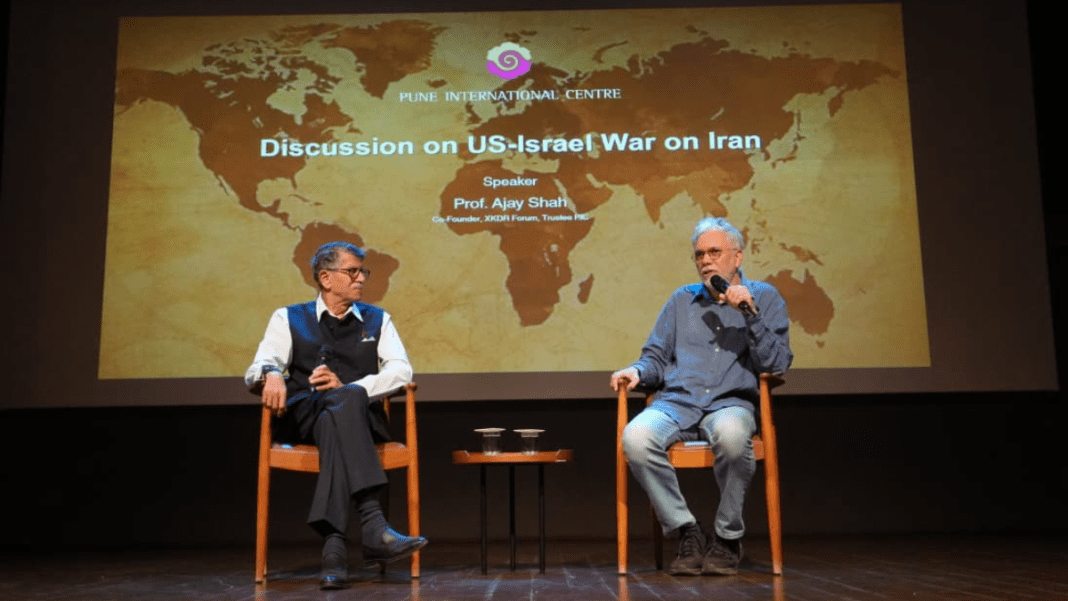


A thought-provoking discussion in Pune brought attention to the rising tensions in Iran and the wider West Asia region, along with the evolving nature of global conflicts. The session, organised by Pune International Centre, focused on understanding the deeper realities of modern warfare and the strategic position of India in such uncertain times.
Held under the Centre for National Security Studies (CNSS), the event featured insights from Prof. Ajay Shah, with the session introduced by Lt Gen Vinayak Patankar. The discussion explored how conflicts today go far beyond traditional battlefields and are shaped by technology, intelligence, and global power dynamics, especially in the context of Iran and its regional implications.
Changing Nature of War in a Complex World
Speaking during the session, Prof. Ajay Shah described war as a serious and complex reality, far removed from the dramatic and simplified versions often seen in films. He stressed that modern conflicts demand logical thinking and careful analysis rather than emotional reactions.
Sufism Concludes Pune International Centre’s Lecture Series on World Religions
He explained that traditional methods of warfare have largely been replaced by advanced technologies. Today, drones and satellites constantly monitor activities, making it nearly impossible for countries to hide their military movements. Precision-guided weapons have further changed the battlefield, allowing targeted strikes with high accuracy.
Prof. Shah highlighted that the world is currently experiencing a phase of uncertainty and instability. Conflicts are no longer isolated events but are interconnected with global politics, trade, and security concerns. He also raised questions about how major powers, including the United States, would handle potential future conflicts in regions like Taiwan.
Iran Conflict and the Human Perspective
Discussing Iran, Prof. Ajay Shah made a clear distinction between the Iranian government and its people. He pointed out that ordinary citizens often suffer due to political decisions made at the top level.
Iran, despite having vast oil resources, continues to face economic difficulties. International sanctions and internal challenges have affected its growth and stability. According to Prof. Shah, this has placed a heavy burden on the population, impacting their quality of life.
He also noted that Iranian society is culturally rich and intellectually strong. Many people within the country are aware of global developments and may not fully agree with the actions of their leadership. This creates a gap between the state’s policies and public sentiment.
The discussion emphasised that increased military spending in such situations can worsen economic conditions. When resources are diverted towards defence, essential sectors like healthcare, education, and employment may suffer.
India’s Position and Role in Global Dynamics
Prof. Ajay Shah highlighted that India holds a unique position in the current global environment. Its relationships with multiple countries allow it to maintain balance and engage with different sides in international matters.
He explained that modern global politics is driven more by national interests than by ideals. Countries often make decisions based on strategic benefits, even if it involves difficult trade-offs. This reflects the complex nature of international relations today.
A major focus of the discussion was intelligence warfare. Prof. Shah pointed out that artificial intelligence and advanced data systems are now being used to track movements and identify targets. This has made intelligence gathering a key part of modern conflicts.
He also observed that democratic nations may have an advantage in intelligence due to more open systems, where information can flow more freely. At the same time, such openness can also pose risks if sensitive data is exposed.
India, he noted, must remain aware of what other countries know about it. Understanding global intelligence activities is crucial for maintaining national security.
Trump imposes 50% tariffs on Iran’s arms suppliers amid ceasefire
The session also explored military developments in the Iran-related conflict. The role of air power was highlighted, especially in operations involving advanced aircraft and rescue missions. While some reports suggest Iran may have certain strengths, Prof. Shah pointed out that there is a significant economic gap between Iran and countries like the United States, which influences the overall balance.
The discussion organised by the Pune International Centre provided valuable insights into how modern wars are fought and how nations like India can navigate an increasingly complex global landscape.