
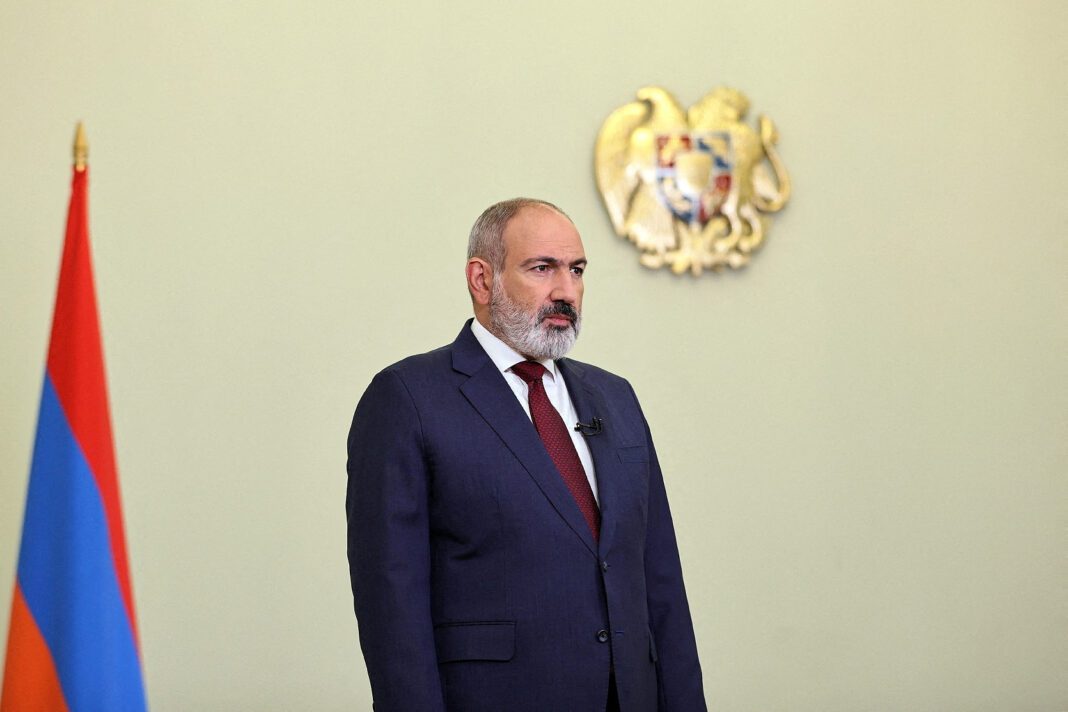

Prime Minister, Nikol Pashinyan of Armenia has announced to leave the Russian led security group. He claimed that the members of Collective Security Treaty Organisation (CSTO) are planning a war with Azerbaijan against his country.
Pashinyan has put in efforts to forge and strengthen relations with America and the European Union. In March Pashinyan mentioned that Armenia has traditionally been a close ally of Russia. Although he claimed that Armenia might not hesitate to leave the CSTO, if the bloc would not uphold the country’s security satisfactorily.
An Armenian news agency, Armepress reported that Pashinyan feels that no such commitment exists on CSTO’s side. Hence he is resolved to quit CSTO. He also emphasised about Armenia leaving the bloc and stressing that they won’t join it back.
Who is Nikol Pashinyan ?
Pashiyan was a journalist before entering politics. He came into power in the year 2018. Which marked the end of Russia-friendly politics in Armenia. Prime Minister Nikol Pashinyan of Armenia assumed office in May 2018 following peaceful protests, marking a significant moment in Armenian politics. Pashinyan, a former journalist and political activist, rose to prominence for his anti-corruption stance. With his commitment to democratic reforms. His tenure has been characterized by efforts to combat corruption, strengthen democratic institutions. Along with improving relations with neighbouring countries, particularly Azerbaijan and Turkey.
However, challenges persist, including the unresolved Nagorno-Karabakh conflict and economic difficulties. Pashinyan’s leadership is pivotal in navigating these complexities. While Armenia is striving to secure stability, prosperity, and place in the global community.
Decoding Collective Security Treaty Organisation (CSTO)
The Collective Security Treaty Organisation (CSTO) is an intergovernmental military alliance comprising post-Soviet states. It uses collective defense strategies to protect regional security. Armenia, Belarus, Kazakhstan, Kyrgyzstan, Russia, and Tajikistan are among the member states. It was founded in 1992 to act as a counterweight to NATO in the area.
The group helps its members share intelligence and conduct combined military drills. Dealing with common security challenges, including organized crime, terrorism, and extremism, is the main goal of CSTO. Although it encourages collaboration among its members, internal conflicts and disparities in military prowess have cast doubt on CSTO’s efficacy.
Doubts over CSTO
Protesters upset with what they see as unjustifiable land concessions made in an attempt to reach an elusive peace deal with Azerbaijan. They are putting pressure on Pashinyan, who stated on Wednesday that the deal was nearly finished despite one last issue.
The aftermath of Azerbaijan’s military action in retaking Nagorno-Karabakh has strained ties between Armenia and Russia. Prime Minister Nikol Pashinyan expressed disillusionment with Moscow’s role in Armenia’s security threat. Despite hosting Russian military facilities, Armenia’s relationship with its ally Russia has deteriorated since this attack.
Since the Collective Security Treaty Organization (CSTO) did nothing to stop Azerbaijan’s offensive. Therefore Pashinyan’s criticism of it grew more intense. He called into question the legitimacy of the partnership by accusing unidentified CSTO members of conspiring with Azerbaijan.
The recent withdrawal of Russian peacekeeping troops from Karabakh further underscores Armenia’s concerns. About its security and the efficacy of its partnership with Russia. Russia is concerned over Armenia’s open critiques of the CSTO. Hence, the Russian foreign ministry emphasized the significance of internal alliance discussions.
Conclusion
Armenia and Russia have tense relations, which highlights the instability in the region after Nagorno-Karabakh. Concerns over regional security cooperation are raised by doubts regarding the efficiency of CSTO. Addressing issues and promoting stability require communication and cooperation. The circumstance draws attention to the precarious balance of power dynamics in the South Caucasus. In the face of shifting geopolitical conditions, Armenia’s pursuit of security calls for cautious diplomatic engagement and strategic decision-making.