

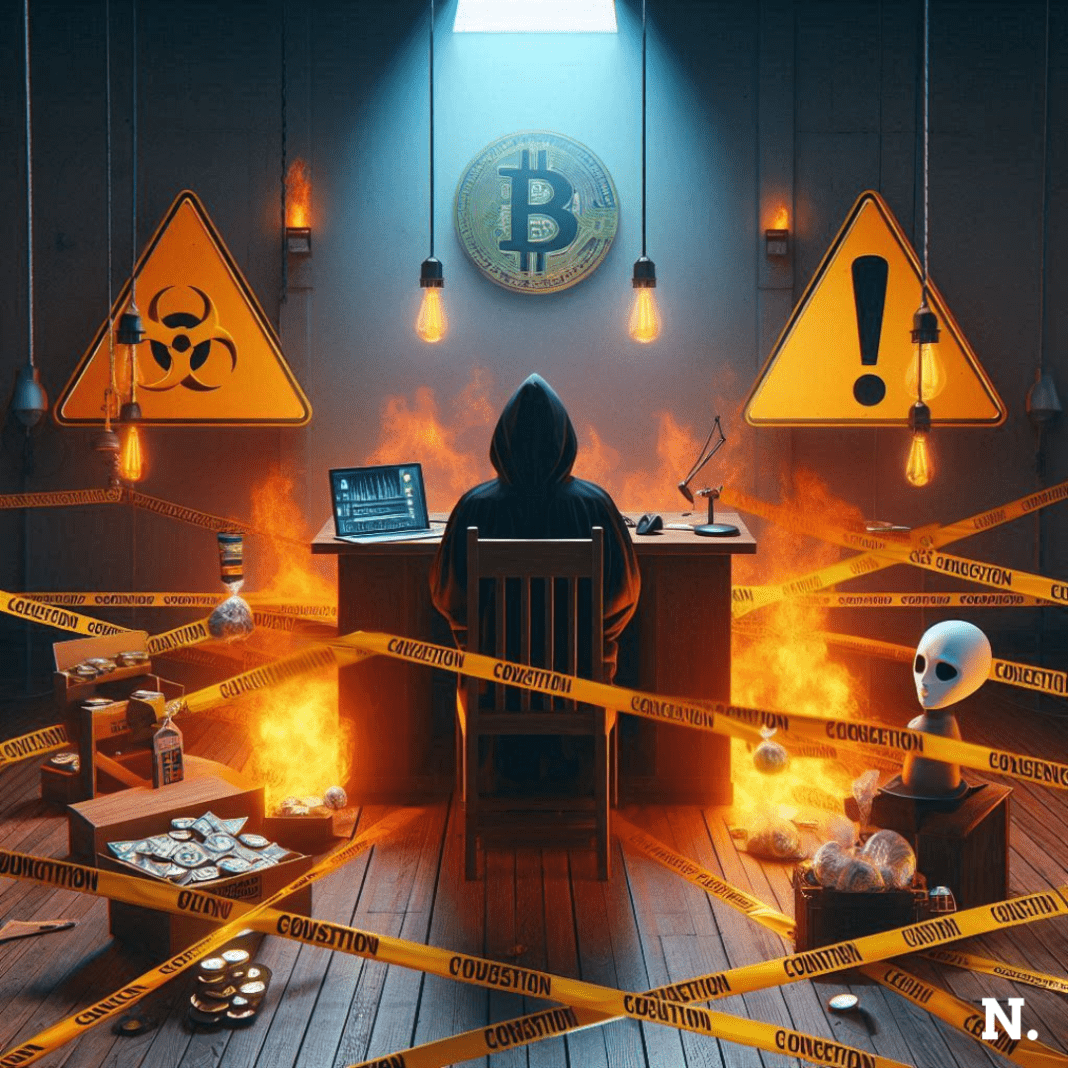
How a Software Enthusiast Helped North Korea to Evade Sanctions

Virgil Griffith attended one Tech Event in North Korea. In the event he gave a presentation on crypto currencies, which included technical advise on how cryptocurrencies and blockchains can be used to evade the sanctions. This act was considered as violation of sanction. The charge of violating International Emergency Economic Powers act was imposed on him. He was sentenced to 20 years of imprisonment.

The information provided by Griffith was very sensitive and could have been used by North Korea to launder money. Moreover, he tried transferring money between Korea and another countries.

Virgil Griffith

This case is becoming one of the most interesting in crypto history and the first of its kind in America. On Jan. 8, prosecutors charged Griffith with violating the International Emergency Economic Powers Act (IEEPA). It has mentioned an unnamed co-conspirator who will be charged later. So far, U.S. authorities have released many documents, showing that Griffith has violated two orders that restrict certain activities in North Korea. Although Griffith is well-known for his work on Ethereum, this case is more about national security than it is about crypto.

It is self-evident that any U.S. resident who goes to North Korea and advised DPRK authorities on the methods to evade sanctions would be in a quagmire whether or not crypto is included.

However, Griffith intentions were not wrong. After stating his side, the jury clearly understood that Griffith was just providing academic information. There is a huge difference between providing information to help the country evade sanctions and providing some academic information about the topic. Initially Griffith was arrested in California and then was transferred to New York’s southern district. Currently Griffith is out on a bail. He has been residing with his parents at their residence in Alabama. This is a perfect example which tells what happens when we showcase or use our knowledge in a wrong place at wrong time.

Role of Crypto Currency

Cryptocurrency is an internet based digital currency or and exchange medium which uses strong cryptographic hash function to conduct financial transactions. Cryptocurrencies simply make use of private and public keys for transactions. These transactions are then entered into a blockchain. This helps in tracking the transaction data. This makes the transactions simple and secure.

Since a very long time many fraudsters are making use cryptocurrencies to launder money. Money laundering is an activity in which a huge amount of money circulates through various bank accounts to confuse the auditors. This breaks the link between the money and its source with no trail left behind. Thus, the fraudster converts black money or dirty money into clean money. Money laundering is a serious crime and has some serious repercussions. Most of the times several financial institutions are also the party to Money Laundering. The process of laundering fiat money and cryptocurrencies is exactly same.

Many experts of crypto currency ended up using their knowledge about the domain in wrong way resulting in severe consequences. One such individual is Virgil Griffith. Virgil Griffith was a programmer from America. He created an indexing tool for Wikipedia known as Wikiscanner. There are many papers on subjects like Artificial life and integrated information theory published by Virgil. His main focus of study was Ethereum Crypto currency platform. Virgil was arrested in 2019 because of his involvement in issues related to cryptocurrency.

Conclusion

North Korea has many sanctions against itself by various countries and also by the united nations. North Korea often hacks various financial institutions. Their hacker units perform illegal practices which usually targets banks, bitcoin exchanges, cash machines etc. for laundering money. Inspite of this, the nation laundered $2 billion through cyber crimes. The country still conducts various programs related to crypto currencies. United Nations watches such programs. It is also illegal to attend such conferences and programs.
Sai
Sai
I am a college student whose research interests are primarily in financial frauds & Forensic accounting.

TOP 10 TRENDING ON NEWSINTERPRETATION

Cyber Attacks on Space Infrastructure: Satellites, GPS and the Ground Systems Behind Them

From the Viasat KA-SAT hack to GPS jamming over the Baltic, a research guide to how attackers target satellites, navigation signals and ground stations, and why it matters on Earth.

How AI Agents Are Used in Cyber Attacks: From Assisted Hacking to AI-Orchestrated Espionage

Attackers now use AI agents to scan networks, write exploits and run extortion campaigns. A research guide to documented cases, including the first reported AI-orchestrated espionage campaign, and what defenders should do.

Cyber Attacks on AI and LLMs: How Attackers Target Large Language Models

Prompt injection, data poisoning, model theft and jailbreaks: a research guide to how attackers target AI systems and large language models, with real cases and defences.

French Supermarket Refrigeration Cyberattack: How Hacking the Cold Chain Can Endanger Lives

In October 2026 attackers heated refrigeration cabinets in hundreds of French supermarkets to as much as 50°C. No one was hurt, but the attack shows how hacking the cold chain can endanger lives through fire, food poisoning and spoiled medicines.

Cyberattacks on Nuclear Facilities: Stuxnet, Kudankulam and the Limits of Air Gaps

Stuxnet, the Davis-Besse worm and malware at India’s Kudankulam plant: what they show about cyber risk at nuclear facilities and the limits of air gaps.

Triton: When Hackers Target the Safety Systems That Prevent Industrial Disasters

The 2017 Triton attack targeted the safety systems that prevent industrial disasters. What happened, who was charged, and how plants protect their last line of defence.

Cybersecurity Risks in Smart Cities: When Connected Infrastructure Fails

How connecting traffic control, emergency alerts and utilities concentrates cyber risk in cities, what the Dallas and Atlanta incidents showed, and what governments recommend.

Weaponized Drones: Hijacking, GPS Spoofing and Emerging Cyber Warfare Risks

How drones can be hijacked, jammed or misled by GPS spoofing, what researchers have demonstrated, and why governments treat drone fleets as a security risk.

Ransomware Attacks on Hospitals: How Healthcare Cyberattacks Put Patients at Risk

How ransomware against hospitals and their suppliers delays care and endangers patients, what the Düsseldorf and WannaCry cases show, and what research says about deaths.

Operational blunder exposes massive Russian cyber espionage attack on Ukrainian prosecutors

A major cyberattack has compromised the email accounts of...

Cyber Attacks on Space Infrastructure: Satellites, GPS and the Ground Systems Behind Them

From the Viasat KA-SAT hack to GPS jamming over the Baltic, a research guide to how attackers target satellites, navigation signals and ground stations, and why it matters on Earth.

French Supermarket Refrigeration Cyberattack: How Hacking the Cold Chain Can Endanger Lives

In October 2026 attackers heated refrigeration cabinets in hundreds of French supermarkets to as much as 50°C. No one was hurt, but the attack shows how hacking the cold chain can endanger lives through fire, food poisoning and spoiled medicines.

Cyberattacks on Nuclear Facilities: Stuxnet, Kudankulam and the Limits of Air Gaps

Stuxnet, the Davis-Besse worm and malware at India’s Kudankulam plant: what they show about cyber risk at nuclear facilities and the limits of air gaps.

Triton: When Hackers Target the Safety Systems That Prevent Industrial Disasters

The 2017 Triton attack targeted the safety systems that prevent industrial disasters. What happened, who was charged, and how plants protect their last line of defence.

Cybersecurity Risks in Smart Cities: When Connected Infrastructure Fails

How connecting traffic control, emergency alerts and utilities concentrates cyber risk in cities, what the Dallas and Atlanta incidents showed, and what governments recommend.

Ransomware Attacks on Hospitals: How Healthcare Cyberattacks Put Patients at Risk

How ransomware against hospitals and their suppliers delays care and endangers patients, what the Düsseldorf and WannaCry cases show, and what research says about deaths.

FBI warns of AVrecon malware targeting outdated routers linked to proxy based cybercrime

A serious cybersecurity warning has been issued regarding commonly...

Related Articles

Popular Categories
