

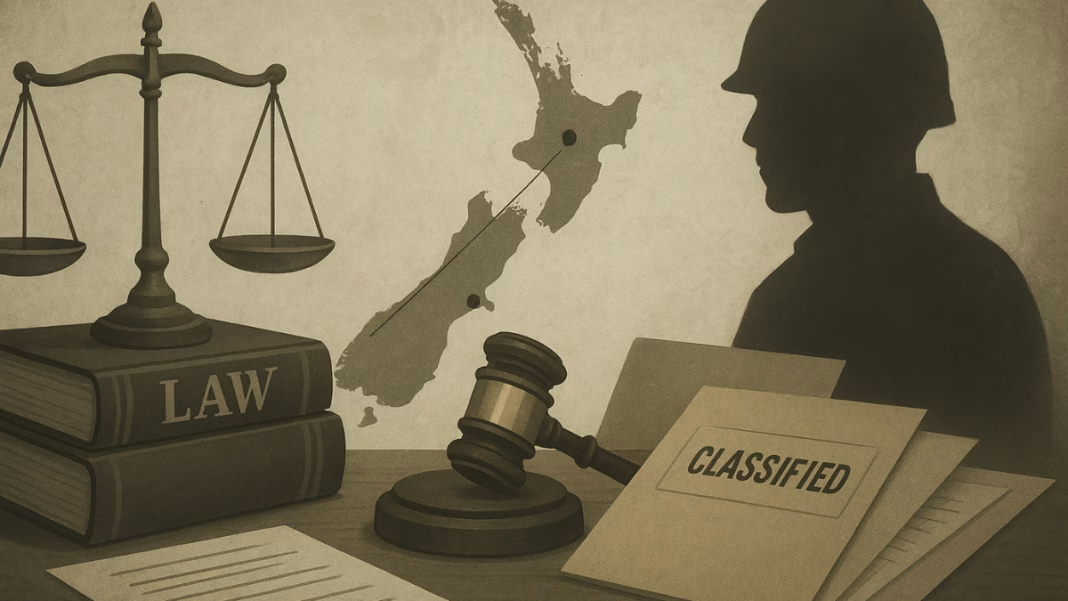
🇳🇿 Espionage scandal unfolds in New Zealand’s army – first ever case of its kind

A soldier has admitted trying to spy for a foreign country, making it one of the most unusual court martial cases in New Zealand’s history.

Soldier Faces Rare Espionage Charges in New Zealand

The man, whose name cannot be published due to suppression orders, appeared at Linton Military Camp. He is the first person in New Zealand’s military history to face a charge of espionage.

The case has been surrounded by secrecy since it began in 2020. At that time, the soldier was facing 17 charges linked to espionage. Later, these were reduced to three charges: attempted espionage, accessing a computer for dishonest purposes, and possessing objectionable material.

In March this year, he admitted his guilt in a judge-alone hearing. On Monday, he repeated his guilty pleas in front of a military panel, which then found him guilty. The decision followed closed-door hearings, which examined sensitive details of his actions.

According to the court, the soldier’s crimes took place in December 2019. He tried to provide maps and directories of military bases and attempted to share login details for the Defence Force’s computer systems. These actions could have harmed New Zealand’s security.

Undercover Police Sting Reveals Shocking Acts

The case came to light after police began monitoring individuals linked to far-right groups following the Christchurch mosque attack. The soldier was identified as a person of interest during this time.

When police spoke to him about his involvement with these groups, he dismissed the concerns, describing them as community-focused. Soon after, an undercover police officer made contact, pretending to represent a foreign country.

How Cyber Attacks on Industrial Control Systems Can Endanger Lives ?

The soldier agreed to help. In one of their first meetings, he handed over a handwritten note outlining how he could provide useful information. A few days later, he gave the officer a black bag. Inside were documents related to army courses and a light infantry handbook, which he had found at his military housing property.

He went further by offering to supply mapping data and even suggested the possibility of smuggling a covert device into the camp. In another meeting, he delivered an aerial map of the Defence Armament Depot at Kauri Point and a letter pointing out security weaknesses at Linton Military Camp.

These documents were considered highly sensitive and were seen as material that could weaken the security of the country.

Links to Far-Right Groups and Possession of Banned Material

The soldier also faced charges for holding banned content. Police searched his home and found a hard drive. On it was the livestream of the Christchurch mosque attack. The drive also had the shooter’s manifesto. In New Zealand, keeping such material is against the law.

At the time of his arrest in 2020, the soldier was 27 years old and already known to have connections with far-right groups, including Action Zealandia. These associations had placed him under the radar of police investigators.

Cyberattack Catastrophe: How Hackers Can Endanger Human Lives ?

The identity of the foreign country he attempted to supply information to has been permanently suppressed by the court. Arguments over whether his own name should remain permanently hidden are still being considered.

Judge Kevin Riordon led the court martial. He said the soldier’s actions put the country’s security at risk. The case is serious because it involved secret military information.

This court martial is rare in New Zealand. It is one of the few times a serving soldier has been linked to spying. Many details cannot be shared because of suppression orders. But the case has already made history as the first of its kind in the Defence Force.


Renuka Bangale
Renuka Bangale
Renuka is a distinguished Chartered Accountant and a Certified Digital Threats Analyst from Riskpro, renowned for her expertise in cybersecurity. With a deep understanding of cybercrimes, malware, cyber warfare, and espionage, she has established herself as an authority in the field. Renuka combines her financial acumen with advanced knowledge of digital threats to provide unparalleled insights into the evolving landscape of information security. Her analytical prowess enables her to dissect complex cyber incidents, offering clarity on risks and mitigation strategies. As a key contributor to Newsinterpretation’s information security category, Renuka delivers authoritative articles that educate and inform readers about emerging threats and best practices.

TOP 10 TRENDING ON NEWSINTERPRETATION

Cyber Attacks on Space Infrastructure: Satellites, GPS and the Ground Systems Behind Them

From the Viasat KA-SAT hack to GPS jamming over the Baltic, a research guide to how attackers target satellites, navigation signals and ground stations, and why it matters on Earth.

How AI Agents Are Used in Cyber Attacks: From Assisted Hacking to AI-Orchestrated Espionage

Attackers now use AI agents to scan networks, write exploits and run extortion campaigns. A research guide to documented cases, including the first reported AI-orchestrated espionage campaign, and what defenders should do.

Cyber Attacks on AI and LLMs: How Attackers Target Large Language Models

Prompt injection, data poisoning, model theft and jailbreaks: a research guide to how attackers target AI systems and large language models, with real cases and defences.

French Supermarket Refrigeration Cyberattack: How Hacking the Cold Chain Can Endanger Lives

In October 2026 attackers heated refrigeration cabinets in hundreds of French supermarkets to as much as 50°C. No one was hurt, but the attack shows how hacking the cold chain can endanger lives through fire, food poisoning and spoiled medicines.

Cyberattacks on Nuclear Facilities: Stuxnet, Kudankulam and the Limits of Air Gaps

Stuxnet, the Davis-Besse worm and malware at India’s Kudankulam plant: what they show about cyber risk at nuclear facilities and the limits of air gaps.

Triton: When Hackers Target the Safety Systems That Prevent Industrial Disasters

The 2017 Triton attack targeted the safety systems that prevent industrial disasters. What happened, who was charged, and how plants protect their last line of defence.

Cybersecurity Risks in Smart Cities: When Connected Infrastructure Fails

How connecting traffic control, emergency alerts and utilities concentrates cyber risk in cities, what the Dallas and Atlanta incidents showed, and what governments recommend.

Weaponized Drones: Hijacking, GPS Spoofing and Emerging Cyber Warfare Risks

How drones can be hijacked, jammed or misled by GPS spoofing, what researchers have demonstrated, and why governments treat drone fleets as a security risk.

Ransomware Attacks on Hospitals: How Healthcare Cyberattacks Put Patients at Risk

How ransomware against hospitals and their suppliers delays care and endangers patients, what the Düsseldorf and WannaCry cases show, and what research says about deaths.

Operational blunder exposes massive Russian cyber espionage attack on Ukrainian prosecutors

A major cyberattack has compromised the email accounts of...

Cyber Attacks on Space Infrastructure: Satellites, GPS and the Ground Systems Behind Them

From the Viasat KA-SAT hack to GPS jamming over the Baltic, a research guide to how attackers target satellites, navigation signals and ground stations, and why it matters on Earth.

French Supermarket Refrigeration Cyberattack: How Hacking the Cold Chain Can Endanger Lives

In October 2026 attackers heated refrigeration cabinets in hundreds of French supermarkets to as much as 50°C. No one was hurt, but the attack shows how hacking the cold chain can endanger lives through fire, food poisoning and spoiled medicines.

Cyberattacks on Nuclear Facilities: Stuxnet, Kudankulam and the Limits of Air Gaps

Stuxnet, the Davis-Besse worm and malware at India’s Kudankulam plant: what they show about cyber risk at nuclear facilities and the limits of air gaps.

Triton: When Hackers Target the Safety Systems That Prevent Industrial Disasters

The 2017 Triton attack targeted the safety systems that prevent industrial disasters. What happened, who was charged, and how plants protect their last line of defence.

Cybersecurity Risks in Smart Cities: When Connected Infrastructure Fails

How connecting traffic control, emergency alerts and utilities concentrates cyber risk in cities, what the Dallas and Atlanta incidents showed, and what governments recommend.

Ransomware Attacks on Hospitals: How Healthcare Cyberattacks Put Patients at Risk

How ransomware against hospitals and their suppliers delays care and endangers patients, what the Düsseldorf and WannaCry cases show, and what research says about deaths.

FBI warns of AVrecon malware targeting outdated routers linked to proxy based cybercrime

A serious cybersecurity warning has been issued regarding commonly...

Related Articles

Popular Categories
