For years, immigration debates in the United States have revolved around policy details—border numbers, asylum law, detention capacity, and court backlogs. This week, that debate exploded into public view in a far more symbolic way: through a coat.
A public clash between California Governor Gavin Newsom and Border Patrol commander Gregory Bovino—now closely associated with President Donald Trump’s immigration enforcement—has turned a piece of clothing into a national flashpoint. Critics say Bovino’s long black trench coat evokes authoritarian imagery. Supporters insist it is standard issue. Newsom has framed it as something darker: a symbol of how power is being exercised in modern America.
What began as an online insult has grown into a broader argument about optics, authority, and whether aggressive federal enforcement is sliding toward the normalization of paramilitary governance.
This is no longer just about fashion. It is about how power looks—and how it is felt.
How a coat ignited a political firestorm
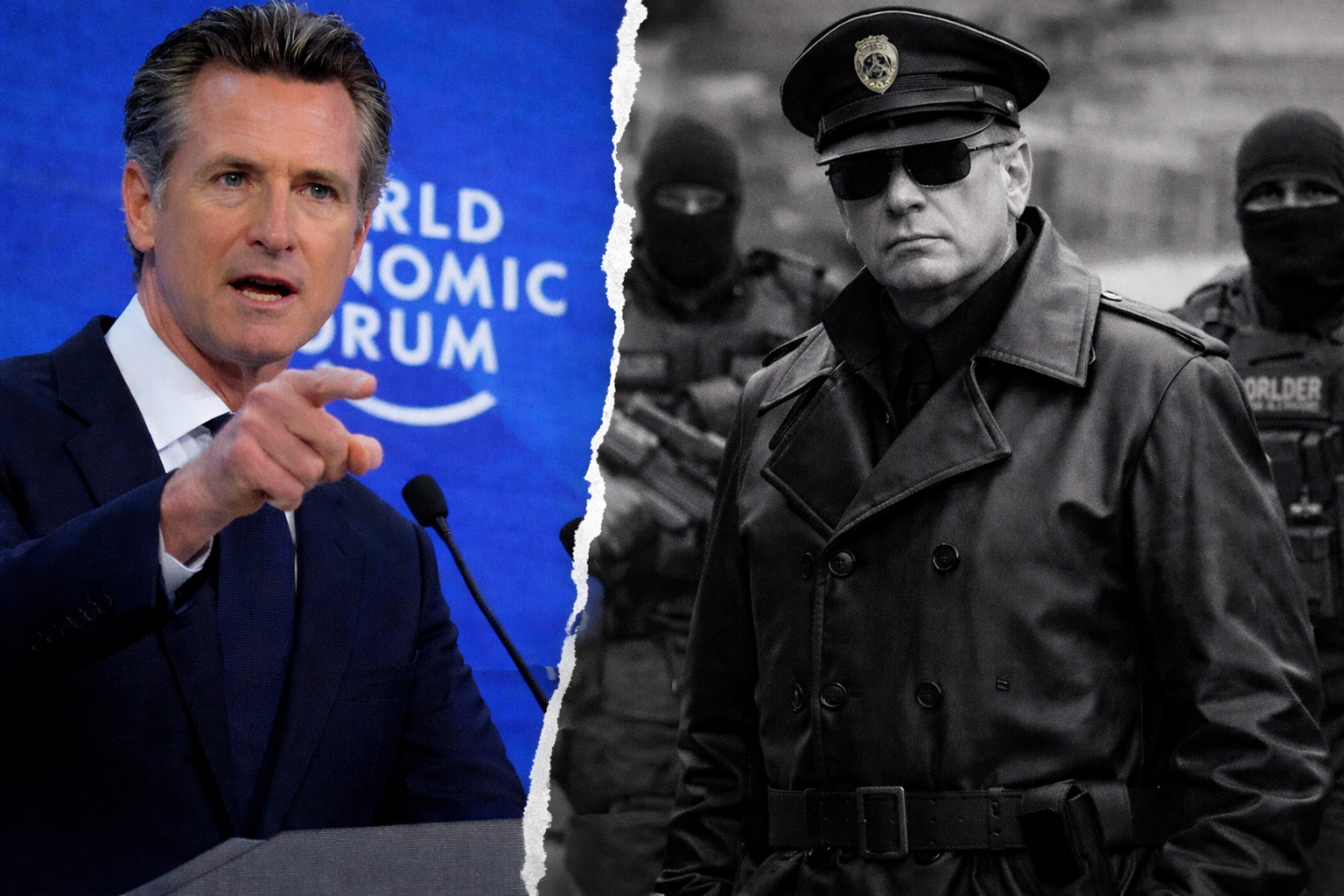
The controversy gained momentum after images circulated online showing Gregory Bovino wearing a long, dark trench coat during immigration operations and public appearances. The photos—often shared in high-contrast black-and-white—spread rapidly on social platforms, where users drew comparisons to historical authoritarian uniforms.
Donald Trump and Gavin Newsom clash in Switzerland as California fraud probe claims draw focus
Gavin Newsom amplified those comparisons during remarks at the World Economic Forum in Davos, Switzerland, where he positioned himself as a vocal counterweight to the Trump administration. Speaking to an international audience, Newsom said Bovino appeared to have dressed “as if he literally went on eBay and purchased SS garb,” and warned that the United States risked drifting toward “secret police” tactics marked by masked agents and the erosion of due process.
The remarks triggered a direct exchange on X. Bovino accused Newsom of “coat envy.” Newsom responded with a personal jab and added, “I’m not a wanna-be Nazi.”
The exchange went viral not because of policy nuance, but because it distilled a larger anxiety into a single, easily shared symbol.
Bovino’s defense: uniform, not ideology
Gregory Bovino has rejected the accusations. In television interviews, including on NewsNation, he stated that the coat is official Border Patrol issue and that he has owned it since 1999. He argued that he wore the same coat under previous administrations, including Democratic ones, without controversy.
From Bovino’s perspective, the backlash reflects partisan politics rather than substance. His defense centers on intent and continuity: the coat, he says, is practical, not ideological.
Critics counter that symbolism in politics does not depend solely on intent. In moments of heightened fear and polarization, appearance can take on meaning independent of explanation—especially when paired with aggressive enforcement tactics.
Immigration enforcement as a theatre of power
Under the current Trump administration, immigration enforcement has become more visible and confrontational. Large-scale operations in major cities, the use of tactical gear, masked officers, and rapid interstate transfers of detainees have drawn sustained criticism from civil-liberties groups.
After years of turbulence, Newsom promises steady school funding in $248 billion budget
Many advocates argue these tactics blur the line between civilian law enforcement and political intimidation. Comparisons to historical authoritarian practices—while controversial—have increasingly surfaced in public discourse as enforcement actions grow more theatrical and opaque.
Some critics also point to Department of Homeland Security promotional materials, which feature stylized footage of operations and senior officials rallying agents. Observers argue that this messaging emphasizes dominance and spectacle rather than transparency, unintentionally reinforcing fears about the direction of federal power.
Why Newsom is leaning into the fight
Newsom’s aggressive posture is deliberate. As governor of the nation’s largest state and a frequent antagonist of Trump, he has increasingly framed himself as a national opposition figure willing to articulate what many Democratic leaders avoid saying directly.
By attacking Bovino’s appearance rather than debating technical policy, Newsom is tapping into a deeper public concern: the aesthetics of authority. His argument is not simply about immigration law, but about whether Americans are being conditioned to accept a more militarized vision of governance.
This framing resonates strongly online, particularly on Reddit, where users are primed to interrogate symbolism, challenge institutional power, and draw historical parallels. In that ecosystem, the coat functions as shorthand—a visual metaphor for fears about where enforcement ends and intimidation begins.
Optics, authority, and public trust
Trust is the currency of effective governance. Law enforcement agencies rely on public legitimacy to operate safely and lawfully. When senior officials appear to embrace imagery associated—fairly or not—with repression, that legitimacy erodes.
Critics argue that the issue is cumulative. No single uniform, raid, or video changes the system on its own. But repeated normalization of exceptional measures can shift public expectations over time.
This concern extends beyond immigration. Scholars and rights groups warn that when governments grow comfortable with secrecy, speed, and spectacle, democratic norms weaken—even if laws remain formally intact.
Why this story goes beyond a viral insult
It would be easy to dismiss the Newsom–Bovino feud as social-media theater. That would be a mistake.
The story persists because it concentrates multiple anxieties into one conflict: fears of unchecked executive power, the politicization of law enforcement, historical memory, and the fragility of democratic norms under stress.
Online discussions have quickly expanded beyond the individuals involved. Reddit threads dissect precedent, compare international cases, and debate whether symbolism alone can reshape reality—or whether it merely reflects changes already underway.
The larger meaning of a loaded symbol
Whether Gregory Bovino intended to project authority, intimidation, or simply wear a warm coat is ultimately beside the point. In a polarized political climate, symbols acquire lives of their own.
Gavin Newsom understands this. By focusing on imagery rather than procedural minutiae, he has turned a Border Patrol commander into a stand-in for a much larger argument about the future of American governance.
That is why a black trench coat has become one of the most discussed political objects of the week.
Not because of what it is—but because of what many people believe it represents.