

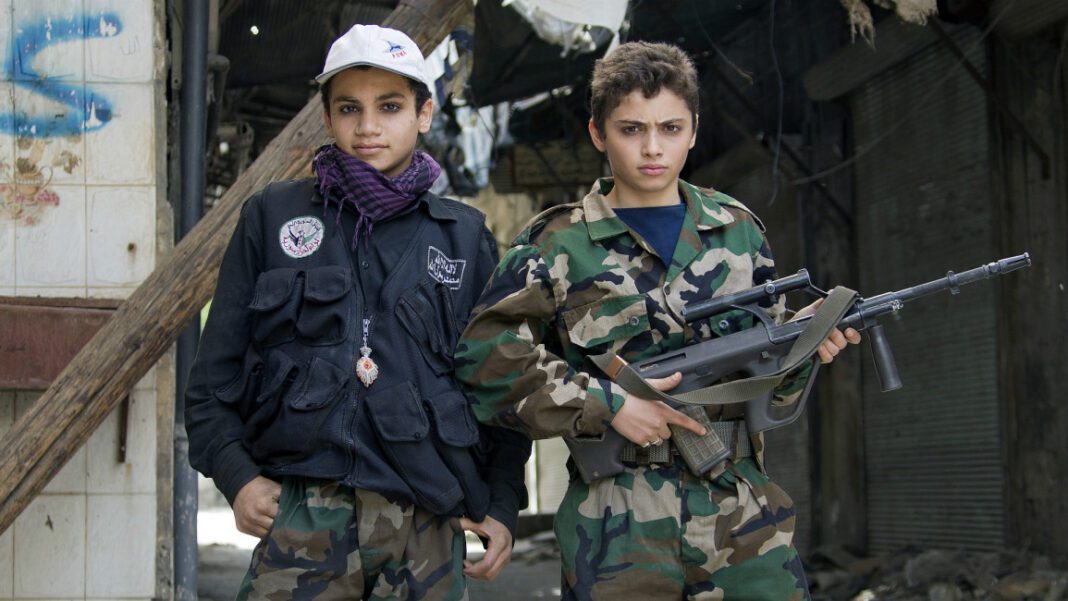
UN Report: Kurdish Militias Still Recruiting Child Soldiers in Syria

The US has acknowledged that its allied Kurdish militias in Syria are still recruiting and using child soldiers. Despite years of warnings and rebukes, the practice continues. The US State Department’s 2024 Trafficking in Persons Report, out Monday, notes this ongoing problem.

Kurdish Militias and Child Soldiers

The Kurdish militias in north-east Syria, supported by the US military, are under the umbrella of the Syrian Democratic Forces (SDF). They are still recruiting and using children as soldiers in their areas. The report says an international organization reported SDF-affiliated groups recruited and used children in 2022 and 2023.

The Syrian Conflict

The conflict in Syria began in 2011 during Arab Spring protests. It quickly escalated thereafter. This turned into brutal civil war. The main fight is between President Bashar al-Assad’s government and various rebel groups. Assad’s forces have support of Russia and Iran. Rebel groups are backed by countries like the United States Turkey and Gulf states. The conflict is complex as many sides are fighting for control.

Islamic State of Iraq and Syria (ISIS) a Sunni jihadist group emerged during the war. It captured large areas of Syria and Iraq. Kurdish forces mainly the Syrian Democratic Forces (SDF) fought against ISIS with the U.S. support. They now control parts of northern and eastern Syria. Turkey opposes the Kurdish forces due to links with Kurdish militants in Turkey. This has led to further clashes and instability in the region always remains high.

The war has caused immense suffering. Over 500,000 people have died and millions have fled their homes. Many Syrians live in refugee camps in neighboring countries. Some have sought asylum in Europe. The infrastructure in Syria is destroyed. This has led to shortages of food water and medical care. Despite reduced fighting peace remains elusive. International efforts to end the conflict have yet to succeed.

Failure to Implement UN Plan

Despite the militias agreeing to implement the UN Security Council’s plan, they have not stopped the recruitment and use of children. The plan is to demobilize children in SDF ranks but the practice continues. This shows the difficulty of enforcing international agreements in conflict areas.

Kurdish forces training in Qandil Mountains

According to international and non-governmental organisations, children recruited by Kurdish forces have been trained in the Qandil Mountains of Iraq, the State Department report says. This is part of the systematic use of child soldiers by these groups.

The report also mentions the Patriotic Revolutionary Youth Movement (YDG-H). This youth wing of the Kurdistan Workers Party (PKK) is still recruiting and training children as young as 12 years old. They are active in north-west Syria and recruit children through fake ads for educational courses in north-east Syria.

UN Report on Forced Integration

The US government’s report comes after a UN report last month. The UN report said Kurdish militias in Syria and their affiliated fighters forced 231 children into their ranks in 2023. This is a huge number and shows the child soldier recruitment continues.

International Response and Measures

US-backed militias using child soldiers raises big ethical and legal questions. The international community, including the US, has repeatedly condemned child soldiers. Although this report shows more efforts to be done to address the issue.

The State Department report says stronger measures are needed to prevent child soldier recruitment and use. That means more monitoring and enforcement. And support for former child soldiers rehabilitation and reintegration programs.

Addressing Kurdish Militias’ Recruitment of Child Soldiers

The recruitment and use of child soldiers by US-backed militias in Syria is a grave concern. In spite of international agreements and repeated warnings yet the practice continues. The US and the international community must take stronger actions to end this illegal practice and protect the rights and futures of these children. The latest reports underscore the urgent need for effective interventions and long-term solutions to address the exploitation of children in conflict zones.


Rajlaxmi Deshmukh
Rajlaxmi Deshmukh
Rajlaxmi Deshmukh is a Political Science Expert with Keen Interest in Geopolitics. She was working with a Think Tank Based in Pune before she joined News Interpretation in the capacity of Geo Political Editor.

TOP 10 TRENDING ON NEWSINTERPRETATION

Cyber Attacks on Space Infrastructure: Satellites, GPS and the Ground Systems Behind Them

From the Viasat KA-SAT hack to GPS jamming over the Baltic, a research guide to how attackers target satellites, navigation signals and ground stations, and why it matters on Earth.

How AI Agents Are Used in Cyber Attacks: From Assisted Hacking to AI-Orchestrated Espionage

Attackers now use AI agents to scan networks, write exploits and run extortion campaigns. A research guide to documented cases, including the first reported AI-orchestrated espionage campaign, and what defenders should do.

Cyber Attacks on AI and LLMs: How Attackers Target Large Language Models

Prompt injection, data poisoning, model theft and jailbreaks: a research guide to how attackers target AI systems and large language models, with real cases and defences.

French Supermarket Refrigeration Cyberattack: How Hacking the Cold Chain Can Endanger Lives

In October 2026 attackers heated refrigeration cabinets in hundreds of French supermarkets to as much as 50°C. No one was hurt, but the attack shows how hacking the cold chain can endanger lives through fire, food poisoning and spoiled medicines.

Cyberattacks on Nuclear Facilities: Stuxnet, Kudankulam and the Limits of Air Gaps

Stuxnet, the Davis-Besse worm and malware at India’s Kudankulam plant: what they show about cyber risk at nuclear facilities and the limits of air gaps.

Triton: When Hackers Target the Safety Systems That Prevent Industrial Disasters

The 2017 Triton attack targeted the safety systems that prevent industrial disasters. What happened, who was charged, and how plants protect their last line of defence.

Cybersecurity Risks in Smart Cities: When Connected Infrastructure Fails

How connecting traffic control, emergency alerts and utilities concentrates cyber risk in cities, what the Dallas and Atlanta incidents showed, and what governments recommend.

Weaponized Drones: Hijacking, GPS Spoofing and Emerging Cyber Warfare Risks

How drones can be hijacked, jammed or misled by GPS spoofing, what researchers have demonstrated, and why governments treat drone fleets as a security risk.

Ransomware Attacks on Hospitals: How Healthcare Cyberattacks Put Patients at Risk

How ransomware against hospitals and their suppliers delays care and endangers patients, what the Düsseldorf and WannaCry cases show, and what research says about deaths.

Operational blunder exposes massive Russian cyber espionage attack on Ukrainian prosecutors

A major cyberattack has compromised the email accounts of...

Cyber Attacks on Space Infrastructure: Satellites, GPS and the Ground Systems Behind Them

From the Viasat KA-SAT hack to GPS jamming over the Baltic, a research guide to how attackers target satellites, navigation signals and ground stations, and why it matters on Earth.

French Supermarket Refrigeration Cyberattack: How Hacking the Cold Chain Can Endanger Lives

In October 2026 attackers heated refrigeration cabinets in hundreds of French supermarkets to as much as 50°C. No one was hurt, but the attack shows how hacking the cold chain can endanger lives through fire, food poisoning and spoiled medicines.

Cyberattacks on Nuclear Facilities: Stuxnet, Kudankulam and the Limits of Air Gaps

Stuxnet, the Davis-Besse worm and malware at India’s Kudankulam plant: what they show about cyber risk at nuclear facilities and the limits of air gaps.

Triton: When Hackers Target the Safety Systems That Prevent Industrial Disasters

The 2017 Triton attack targeted the safety systems that prevent industrial disasters. What happened, who was charged, and how plants protect their last line of defence.

Cybersecurity Risks in Smart Cities: When Connected Infrastructure Fails

How connecting traffic control, emergency alerts and utilities concentrates cyber risk in cities, what the Dallas and Atlanta incidents showed, and what governments recommend.

Ransomware Attacks on Hospitals: How Healthcare Cyberattacks Put Patients at Risk

How ransomware against hospitals and their suppliers delays care and endangers patients, what the Düsseldorf and WannaCry cases show, and what research says about deaths.

FBI warns of AVrecon malware targeting outdated routers linked to proxy based cybercrime

A serious cybersecurity warning has been issued regarding commonly...

Related Articles

Popular Categories
