

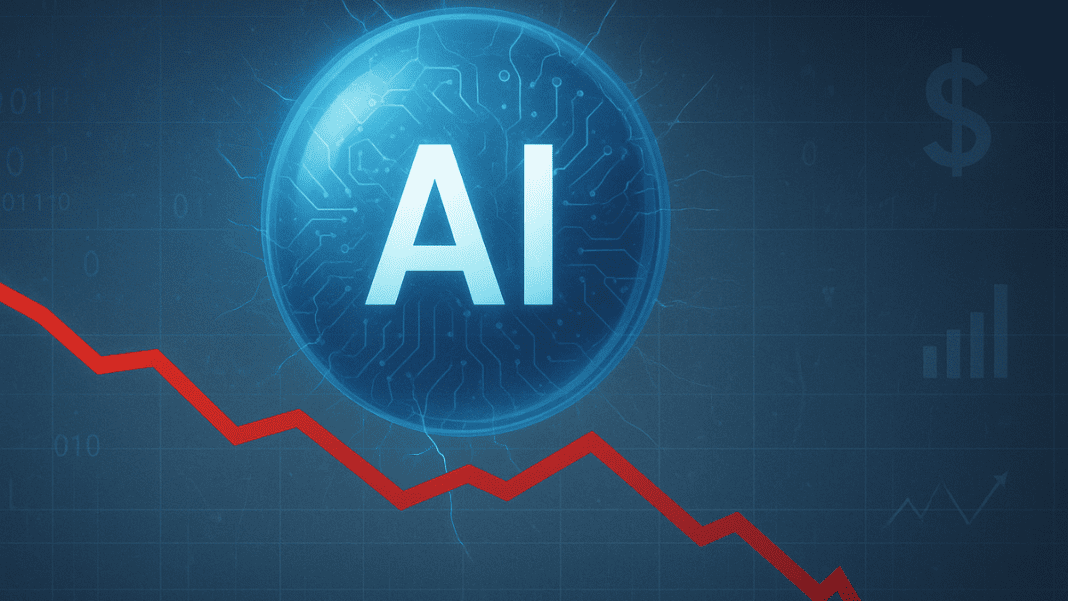
AI Investment Nightmare? 95% of Companies See Zero Returns, Tech Stocks Plummet After MIT Report

A sudden shock in tech markets

The world of artificial intelligence has been moving at lightning speed. Over the past few years, companies have spent billions of dollars to build and buy AI tools, hoping they would change the way businesses work. But this week, a sharp fall in major tech stocks has raised fresh fears that the AI boom could be heading toward a painful collapse.

A new study has found that most businesses investing in AI are not making money from it. In fact, the researchers from Massachusetts Institute of Technology (MIT) said that 95 percent of companies saw “zero return” on their AI projects, even though global spending on AI tools has been in the range of $30 to $40 billion.

The news sent a chill through financial markets. Shares of some of the biggest names in technology dropped suddenly. A major chipmaker “Nvidia” that has been powering much of the AI craze fell by more than 3 percent. A data analytics company “Palantir”, often linked with AI contracts, lost almost 9 percent in value in just one day.

Alarming findings from business surveys

The survey was carried out across hundreds of businesses and employees. The results showed that only a tiny fraction of companies are actually seeing value from AI. Just 5 percent of projects have managed to create real profits. The rest have either failed, stalled, or made no difference to company accounts.

The study highlighted that almost half of all AI projects launched inside businesses never even reach the production stage. Many get abandoned halfway. Out of the total companies that tried AI, only 20 percent got to a pilot stage, and only 5 percent moved forward to a proper launch.

How Cyber Attacks on Industrial Control Systems Can Endanger Lives ?

The research also showed that employees are not waiting for their companies to act. Many workers are already using free or low-cost AI chatbots on their own. Instead of relying on slow, complex, or expensive company-approved AI systems, they are turning to consumer tools they can access instantly. This means AI is being used widely, but often outside official business channels.

The report further revealed that half of all AI projects in companies ended in outright failure. While many leaders promised huge cost savings and productivity boosts, these gains have not materialized in most cases. For many businesses, AI has become a heavy expense rather than a money-maker.

Billions at risk in the AI race

The findings come at a delicate moment for the technology world. In just a few years, the promise of AI has driven some of the biggest stock market gains in history. Investors poured trillions into companies building artificial intelligence chips, data centers, and software tools.

Banks have predicted that trillions of dollars will be invested into data centers alone over the next three years. Most of that investment is linked to expected growth in Artificial Intelligence usage. Some forecasts also claimed that artificial intelligence could add trillions to the economy by helping companies cut costs and reduce jobs.

Cyberattack Catastrophe: How Hackers Can Endanger Human Lives ?

But with so many projects failing and with most businesses not seeing returns, those bold promises are now being questioned. Some technology companies are already reorganizing their AI teams and cutting staff. Even highly promoted new Artificial Intelligence models have left many users disappointed, with only small improvements compared to earlier versions.

The fear now is that if companies and investors realize the returns are not matching the hype, the Artificial Intelligence market could face the same fate as the internet boom more than two decades ago. Back then, share prices soared on promises of a new digital future. But when the bubble burst, trillions in value were wiped out almost overnight.

This week’s drop in tech stocks has not yet turned into a full crash. But the warning signs are clear. With so much money at stake and so many projects failing to deliver, many are starting to listen for the same sound that marked the end of the dot-com era: the sharp pop of a bursting bubble.


Renuka Bangale
Renuka Bangale
Renuka is a distinguished Chartered Accountant and a Certified Digital Threats Analyst from Riskpro, renowned for her expertise in cybersecurity. With a deep understanding of cybercrimes, malware, cyber warfare, and espionage, she has established herself as an authority in the field. Renuka combines her financial acumen with advanced knowledge of digital threats to provide unparalleled insights into the evolving landscape of information security. Her analytical prowess enables her to dissect complex cyber incidents, offering clarity on risks and mitigation strategies. As a key contributor to Newsinterpretation’s information security category, Renuka delivers authoritative articles that educate and inform readers about emerging threats and best practices.

TOP 10 TRENDING ON NEWSINTERPRETATION

Cyber Attacks on Space Infrastructure: Satellites, GPS and the Ground Systems Behind Them

From the Viasat KA-SAT hack to GPS jamming over the Baltic, a research guide to how attackers target satellites, navigation signals and ground stations, and why it matters on Earth.

How AI Agents Are Used in Cyber Attacks: From Assisted Hacking to AI-Orchestrated Espionage

Attackers now use AI agents to scan networks, write exploits and run extortion campaigns. A research guide to documented cases, including the first reported AI-orchestrated espionage campaign, and what defenders should do.

Cyber Attacks on AI and LLMs: How Attackers Target Large Language Models

Prompt injection, data poisoning, model theft and jailbreaks: a research guide to how attackers target AI systems and large language models, with real cases and defences.

French Supermarket Refrigeration Cyberattack: How Hacking the Cold Chain Can Endanger Lives

In October 2026 attackers heated refrigeration cabinets in hundreds of French supermarkets to as much as 50°C. No one was hurt, but the attack shows how hacking the cold chain can endanger lives through fire, food poisoning and spoiled medicines.

Cyberattacks on Nuclear Facilities: Stuxnet, Kudankulam and the Limits of Air Gaps

Stuxnet, the Davis-Besse worm and malware at India’s Kudankulam plant: what they show about cyber risk at nuclear facilities and the limits of air gaps.

Triton: When Hackers Target the Safety Systems That Prevent Industrial Disasters

The 2017 Triton attack targeted the safety systems that prevent industrial disasters. What happened, who was charged, and how plants protect their last line of defence.

Cybersecurity Risks in Smart Cities: When Connected Infrastructure Fails

How connecting traffic control, emergency alerts and utilities concentrates cyber risk in cities, what the Dallas and Atlanta incidents showed, and what governments recommend.

Weaponized Drones: Hijacking, GPS Spoofing and Emerging Cyber Warfare Risks

How drones can be hijacked, jammed or misled by GPS spoofing, what researchers have demonstrated, and why governments treat drone fleets as a security risk.

Ransomware Attacks on Hospitals: How Healthcare Cyberattacks Put Patients at Risk

How ransomware against hospitals and their suppliers delays care and endangers patients, what the Düsseldorf and WannaCry cases show, and what research says about deaths.

Operational blunder exposes massive Russian cyber espionage attack on Ukrainian prosecutors

A major cyberattack has compromised the email accounts of...

Cyber Attacks on Space Infrastructure: Satellites, GPS and the Ground Systems Behind Them

From the Viasat KA-SAT hack to GPS jamming over the Baltic, a research guide to how attackers target satellites, navigation signals and ground stations, and why it matters on Earth.

French Supermarket Refrigeration Cyberattack: How Hacking the Cold Chain Can Endanger Lives

In October 2026 attackers heated refrigeration cabinets in hundreds of French supermarkets to as much as 50°C. No one was hurt, but the attack shows how hacking the cold chain can endanger lives through fire, food poisoning and spoiled medicines.

Cyberattacks on Nuclear Facilities: Stuxnet, Kudankulam and the Limits of Air Gaps

Stuxnet, the Davis-Besse worm and malware at India’s Kudankulam plant: what they show about cyber risk at nuclear facilities and the limits of air gaps.

Triton: When Hackers Target the Safety Systems That Prevent Industrial Disasters

The 2017 Triton attack targeted the safety systems that prevent industrial disasters. What happened, who was charged, and how plants protect their last line of defence.

Cybersecurity Risks in Smart Cities: When Connected Infrastructure Fails

How connecting traffic control, emergency alerts and utilities concentrates cyber risk in cities, what the Dallas and Atlanta incidents showed, and what governments recommend.

Ransomware Attacks on Hospitals: How Healthcare Cyberattacks Put Patients at Risk

How ransomware against hospitals and their suppliers delays care and endangers patients, what the Düsseldorf and WannaCry cases show, and what research says about deaths.

FBI warns of AVrecon malware targeting outdated routers linked to proxy based cybercrime

A serious cybersecurity warning has been issued regarding commonly...

Related Articles

Popular Categories
