

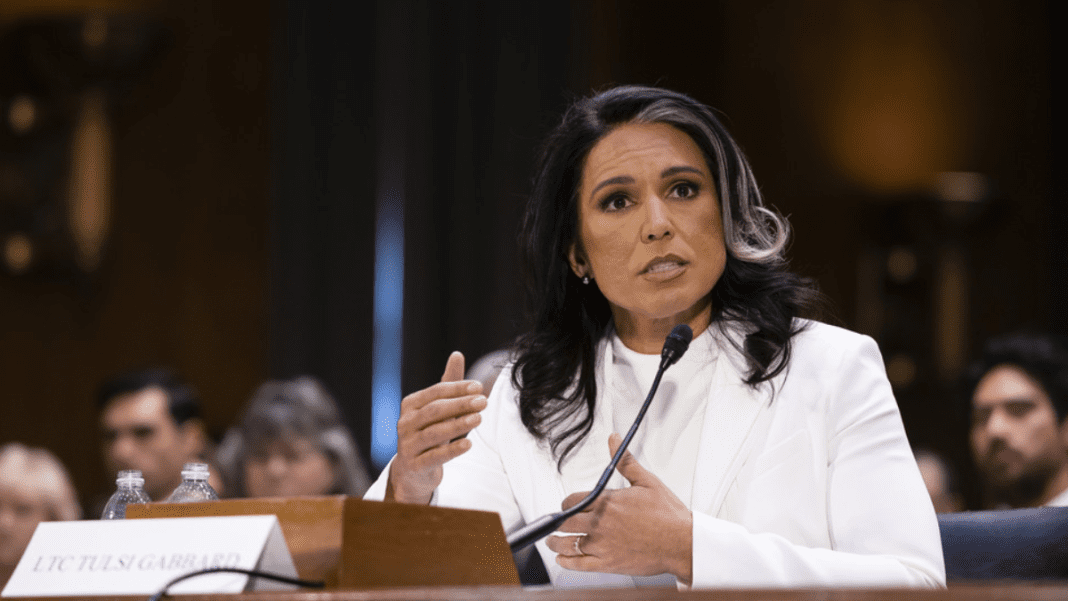
Gabbard-created intel group accused of mishandling classified tip leading to explosive—totally false—pipe-bomber claim

A disturbing series of events began when Paul McNamara, an aide working under Tulsi Gabbard at the Office of the Director of National Intelligence (ODNI), received a tip naming Shauni Kerkhoff as the still-unidentified person who planted two pipe bombs near the Democratic National Committee and Republican National Committee on the night before January 6.

Kerkhoff is a former U.S. Capitol Police officer who now works in the intelligence community. On January 6, she served in the Capitol Police Civil Disturbance Unit and fought off rioters during the attack. She later testified publicly about the violence she witnessed.

The tip did not come through usual law-enforcement channels. CBS News reported that it originated with a member of the media, an unusual move since tips about federal crimes are normally sent directly to the FBI, which was already leading the pipe bomber investigation.

Instead of forwarding the information to investigators, McNamara began looking into it himself. He worked inside the Director’s Initiatives Group, a unit created by Gabbard to focus on issues tied to political concerns, such as claims about “weaponization” of intelligence agencies.

Trump defends Susie Wiles as MAGA base accuses her of sabotaging the ‘America First’ agenda

This decision set the stage for a serious lapse that turned a routine lead into a public smear.

A Leaked Memo and a Rapid Spread of False Claims

Sources told CBS that McNamara accessed confidential files, retrieved Kerkhoff’s Social Security number, and assembled a classified memo describing the allegations. The memo was unsigned, unfinished, and had not been reviewed by ODNI leadership. It was meant to be an internal document, but it was circulated inside intelligence agencies before it was ready.

The ODNI later said the memo was still in early drafting stages when an unknown person leaked it outside proper channels.

After the leak, the conservative outlet The Blaze, owned by Glenn Beck, published Kerkhoff’s name and framed her as the pipe bomber. The article relied heavily on “gait analysis,” claiming her walk resembled the figure seen in security footage.

The story spread quickly. High-profile political figures such as Kari Lake, Barry Loudermilk, and Thomas Massie echoed the claims, giving them even more reach. According to CBS, the allegation even reached Donald Trump, though it is not clear when he learned of it.

For Kerkhoff, the fallout was immediate. A woman who had defended the Capitol during the attack was suddenly accused of planting bombs the night before. Her lawyer, Steve Bunnell, called the allegations “recklessly false, absurd, and defamatory.”

AOC sparks firestorm with claim MAGA base could flip socialist — Lara Trump hits back hard

FBI Intervention and ODNI’s Explanation

The FBI quickly pushed back. Deputy Director Dan Bongino said that reports naming past “persons of interest” were “grossly inaccurate” and misled the public. Three sources told CBS that Kerkhoff had been fully ruled out as a suspect.

Kerkhoff provided the FBI with a solid alibi: a video showing her at home playing with her puppies at the exact time the real bomber was placing the devices. Investigators verified the footage and confirmed she could not have been involved.

The ODNI then attempted to clarify what had happened. Spokesperson Olivia Coleman said the agency followed its obligation to notify Kerkhoff’s employer once the tip arrived. She explained that the memo drew no conclusions and was created with legal guidance. She also said a “deep state actor” was responsible for leaking the unfinished document.

The Daily Beast reported that the leak blindsided both the ODNI and the FBI. It also confirmed that the memo had not been approved by the intelligence chief or senior leadership. The Blaze was contacted for comment but did not respond.

T U Deshmukh
T U Deshmukh
T U Deshmukh is the leading voice on the subject of Jobs, AI, Data and layoffs and she regularly contributes a column on Jobs for Newsinterpretation.

TOP 10 TRENDING ON NEWSINTERPRETATION

Cyber Attacks on Space Infrastructure: Satellites, GPS and the Ground Systems Behind Them

From the Viasat KA-SAT hack to GPS jamming over the Baltic, a research guide to how attackers target satellites, navigation signals and ground stations, and why it matters on Earth.

How AI Agents Are Used in Cyber Attacks: From Assisted Hacking to AI-Orchestrated Espionage

Attackers now use AI agents to scan networks, write exploits and run extortion campaigns. A research guide to documented cases, including the first reported AI-orchestrated espionage campaign, and what defenders should do.

Cyber Attacks on AI and LLMs: How Attackers Target Large Language Models

Prompt injection, data poisoning, model theft and jailbreaks: a research guide to how attackers target AI systems and large language models, with real cases and defences.

French Supermarket Refrigeration Cyberattack: How Hacking the Cold Chain Can Endanger Lives

In October 2026 attackers heated refrigeration cabinets in hundreds of French supermarkets to as much as 50°C. No one was hurt, but the attack shows how hacking the cold chain can endanger lives through fire, food poisoning and spoiled medicines.

Cyberattacks on Nuclear Facilities: Stuxnet, Kudankulam and the Limits of Air Gaps

Stuxnet, the Davis-Besse worm and malware at India’s Kudankulam plant: what they show about cyber risk at nuclear facilities and the limits of air gaps.

Triton: When Hackers Target the Safety Systems That Prevent Industrial Disasters

The 2017 Triton attack targeted the safety systems that prevent industrial disasters. What happened, who was charged, and how plants protect their last line of defence.

Cybersecurity Risks in Smart Cities: When Connected Infrastructure Fails

How connecting traffic control, emergency alerts and utilities concentrates cyber risk in cities, what the Dallas and Atlanta incidents showed, and what governments recommend.

Weaponized Drones: Hijacking, GPS Spoofing and Emerging Cyber Warfare Risks

How drones can be hijacked, jammed or misled by GPS spoofing, what researchers have demonstrated, and why governments treat drone fleets as a security risk.

Ransomware Attacks on Hospitals: How Healthcare Cyberattacks Put Patients at Risk

How ransomware against hospitals and their suppliers delays care and endangers patients, what the Düsseldorf and WannaCry cases show, and what research says about deaths.

Operational blunder exposes massive Russian cyber espionage attack on Ukrainian prosecutors

A major cyberattack has compromised the email accounts of...

Cyber Attacks on Space Infrastructure: Satellites, GPS and the Ground Systems Behind Them

From the Viasat KA-SAT hack to GPS jamming over the Baltic, a research guide to how attackers target satellites, navigation signals and ground stations, and why it matters on Earth.

French Supermarket Refrigeration Cyberattack: How Hacking the Cold Chain Can Endanger Lives

In October 2026 attackers heated refrigeration cabinets in hundreds of French supermarkets to as much as 50°C. No one was hurt, but the attack shows how hacking the cold chain can endanger lives through fire, food poisoning and spoiled medicines.

Cyberattacks on Nuclear Facilities: Stuxnet, Kudankulam and the Limits of Air Gaps

Stuxnet, the Davis-Besse worm and malware at India’s Kudankulam plant: what they show about cyber risk at nuclear facilities and the limits of air gaps.

Triton: When Hackers Target the Safety Systems That Prevent Industrial Disasters

The 2017 Triton attack targeted the safety systems that prevent industrial disasters. What happened, who was charged, and how plants protect their last line of defence.

Cybersecurity Risks in Smart Cities: When Connected Infrastructure Fails

How connecting traffic control, emergency alerts and utilities concentrates cyber risk in cities, what the Dallas and Atlanta incidents showed, and what governments recommend.

Ransomware Attacks on Hospitals: How Healthcare Cyberattacks Put Patients at Risk

How ransomware against hospitals and their suppliers delays care and endangers patients, what the Düsseldorf and WannaCry cases show, and what research says about deaths.

FBI warns of AVrecon malware targeting outdated routers linked to proxy based cybercrime

A serious cybersecurity warning has been issued regarding commonly...

Related Articles

Popular Categories
