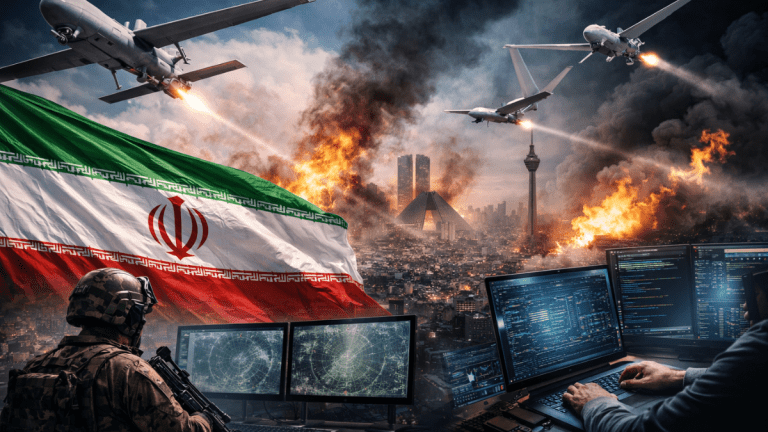
A dramatic joint military operation by the United States and Israel has drawn global attention after advanced technologies were used in a coordinated strike inside Iran. The attack reportedly resulted in the killing of Iran’s Supreme Leader, Ayatollah Ali Khamenei, along with several senior commanders.
Officials say the mission relied not only on traditional weapons but also on artificial intelligence, cyber tools, electronic warfare systems, and low-cost drones. The operation combined digital precision with physical force in a synchronized plan.
Intelligence Tracking and AI at the Core
According to reports, the operation involved close coordination between American and Israeli intelligence agencies, with support from U.S. Central Command. The New York Times reported that the CIA, working with Israeli counterparts, had tracked Ayatollah Ali Khamenei’s movements for months before the strike.
Shin Bet and cyber directorate block mass Iranian phishing offensive targeting Israel’s elite
U.S. President Donald Trump stated on Truth Social that highly sophisticated tracking systems were used to locate Iranian leadership figures. These systems reportedly analyzed satellite imagery, intercepted communications, and electronic signals to confirm the meeting of senior officials in Tehran.
Artificial intelligence played a central role in processing large volumes of data. The U.S. military uses AI-based platforms from Palantir Technologies Inc. to build digital models of real-world locations. These systems allow planners to simulate operations and analyze possible outcomes before action is taken.
Reports from The Wall Street Journal and Axios indicated that Anthropic PBC’s large language model Claude was also used during the operation. Anthropic had earlier deployed its models across the Defense Department’s classified network. OpenAI later announced a deal with the Pentagon to deploy advanced AI systems in secure environments.
General Dan Caine, chairman of the Joint Chiefs of Staff, has previously explained how the U.S. Space Force and U.S. Cyber Command assist by suppressing enemy defenses. Similar digital coordination was reportedly part of this strike.
Low-Cost LUCAS Drones Enter Combat
A key development was the use of LUCAS drones during the joint U.S.-Israel operation. U.S. Central Command confirmed it employed low-cost one-way attack drones for the first time in combat.
The LUCAS drones are produced by Spektreworks Inc., based in Phoenix. Each unit costs about $35,000 and is modeled after Iran’s Shahed-136 drones, which have been used in Ukraine and in regional attacks.
Newly released US documents expose Jeffrey Epstein’s role in Israel–Ivory Coast security talks
These drones are designed to strike targets directly and are considered expendable. Because they are affordable compared to fighter jets and missile systems, they can be deployed in larger numbers to overwhelm radar and air defense systems.
Lorin Selby, a retired U.S. Navy rear admiral, described the use of such drones as a turning point. Defense technology entrepreneur Eliot Pence, chief executive of Dominion Dynamics, said low-cost drones provide an effective way to disable radar and anti-aircraft systems. He explained that combining affordable drones with high-end military hardware reflects a new tactical approach used by the United States and Israel.
The development of the LUCAS system followed calls by U.S. Defense Secretary Pete Hegseth to strengthen drone capabilities and increase dominance in this area of warfare.
Cyberattacks and Digital Disruption
Alongside the physical strike, cyberattacks disrupted systems inside Iran. Reuters reported that news websites were hacked, and a religious calendar app called BadeSaba displayed unexpected messages urging armed forces to surrender weapons. Iran also experienced a near-total internet blackout during the operation.
Cyber tools are often used in military actions to disrupt communication and create confusion. By targeting communication networks and digital infrastructure, defense responses can be delayed.
Electronic warfare systems were also reportedly used. Aircraft such as EA-18G Growlers are capable of jamming radar and communication signals. Disrupting command and control systems makes it more difficult for missile defenses to operate effectively.
U.S. targets Iran’s ‘shadow fleet’ with new sanctions as tensions rise during Oman
talks
Ken Nickerson, a technology adviser with the Creative Destruction Lab, noted that disabling command systems is critical during such operations. Israel has also developed AI-based targeting systems such as Habsora, used by the Israel Defense Forces to generate targets based on intelligence data.
Together, artificial intelligence, cyber operations, electronic warfare tools, and low-cost drones formed a coordinated strategy that relied heavily on digital systems as well as traditional military assets.