

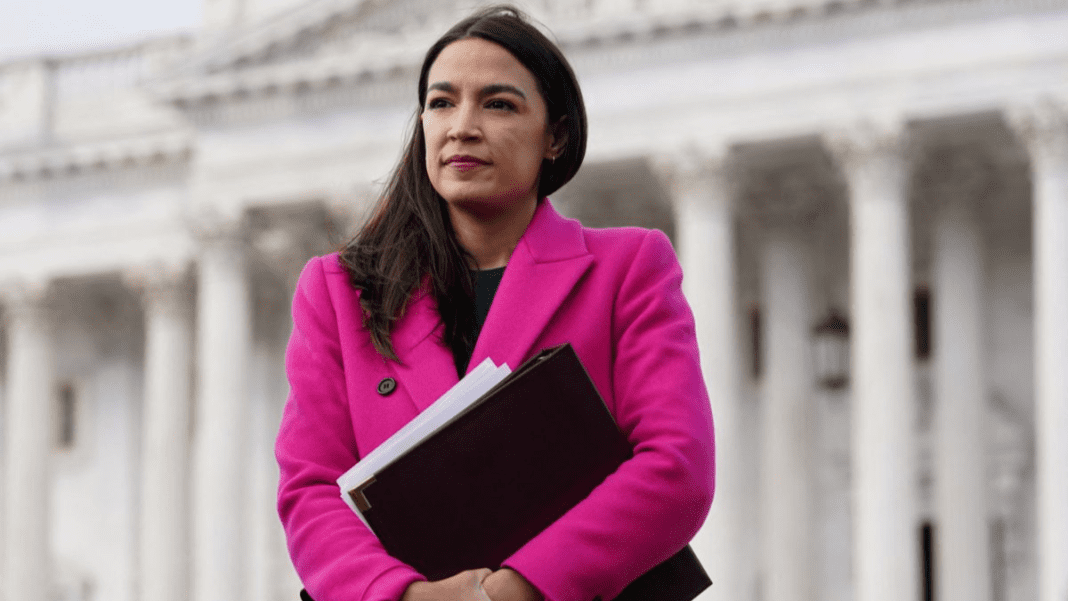
This could be 2008 all over again’: AOC warns Wall Street’s AI obsession may trigger catastrophic crash

During a House hearing on AI chatbots, U.S. Representative Alexandria Ocasio-Cortez (AOC) warned that the United States may already be inside a large economic bubble driven by artificial intelligence companies. She said that major tech firms such as Microsoft, Google, Amazon, and Meta have been responsible for a big share of recent stock market and economic growth. Because of this, she believes the American economy may now be heavily exposed to the success or failure of these companies.

She described the situation as a “massive economic bubble” and said that its size could pose a threat similar to the 2008 financial crisis. That crisis caused major losses, business failures, and long-lasting damage. By making this comparison, she suggested that the risks connected to the AI industry are serious and should not be ignored.

Ocasio-Cortez explained that if AI companies fail to meet expectations, or if their investments do not turn into real profits, the effects could spread well beyond the tech industry. She said that the current level of dependence on AI companies might deepen the impact of any sudden downturn. Her comments come at a time when many people are watching for signs of weakness in the industry, especially as companies like Nvidia, which builds chips for AI systems, prepare to report earnings.

AOC sparks firestorm with claim MAGA base could flip socialist — Lara Trump hits back hard

A Firm Stand Against Any Federal Bailouts for AI Firms

Ocasio-Cortez also stated that if an AI bubble does burst, the federal government should not step in to bail out AI companies. She said that public funds should not be used to rescue large corporations while many Americans struggle to access healthcare, food assistance, and other basic needs. She explained that some citizens even turn to AI chatbots for emotional support, showing how serious their challenges are.

Her comments follow public attention created when Sarah Friar, Chief Financial Officer of OpenAI, suggested that the company might need a federal “backstop” to support expensive infrastructure development. Friar later walked back the statement, and Sam Altman, CEO of OpenAI, clarified that the company is not seeking any government guarantees. Even so, the discussion raised questions about whether AI companies expect financial help if their risks become too large.

Ocasio-Cortez said that federal bailouts should not be considered for technology firms developing AI systems, no matter how influential they become. She made clear that financial rescue should not be offered to companies that take on huge investments without being prepared to handle losses on their own.

2028 Watch: Ocasio-Cortez Gains Momentum as Schumer’s Base Weakens After Shutdown Compromise

Warnings About Spending, Pressure, and Use of Personal Data

Ocasio-Cortez also highlighted why fears of an AI bubble are growing. Many concerns come from the heavy spending inside the tech sector, where companies invest large sums into computing power, advanced chips, and giant data centers. Much of this spending happens between the same small group of companies, raising doubts about whether the money being poured into AI will lead to long-term profits.

She also said that companies feel pressure to make profits quickly. Because of this, she warned that some AI chatbots may be designed in ways that collect and use very personal information from users. She said that people’s fears, secrets, relationships, and emotional struggles can be taken and used to help companies profit, which she described as an “empty promise” to users seeking help.

Ocasio-Cortez is one of the first members of Congress to publicly raise the issue of a possible AI bubble. Her statements have added to ongoing debates about the risks tied to the rapid expansion of artificial intelligence and the companies leading its growth.


T U Deshmukh
T U Deshmukh
T U Deshmukh is the leading voice on the subject of Jobs, AI, Data and layoffs and she regularly contributes a column on Jobs for Newsinterpretation.

TOP 10 TRENDING ON NEWSINTERPRETATION

Cyber Attacks on Space Infrastructure: Satellites, GPS and the Ground Systems Behind Them

From the Viasat KA-SAT hack to GPS jamming over the Baltic, a research guide to how attackers target satellites, navigation signals and ground stations, and why it matters on Earth.

How AI Agents Are Used in Cyber Attacks: From Assisted Hacking to AI-Orchestrated Espionage

Attackers now use AI agents to scan networks, write exploits and run extortion campaigns. A research guide to documented cases, including the first reported AI-orchestrated espionage campaign, and what defenders should do.

Cyber Attacks on AI and LLMs: How Attackers Target Large Language Models

Prompt injection, data poisoning, model theft and jailbreaks: a research guide to how attackers target AI systems and large language models, with real cases and defences.

French Supermarket Refrigeration Cyberattack: How Hacking the Cold Chain Can Endanger Lives

In October 2026 attackers heated refrigeration cabinets in hundreds of French supermarkets to as much as 50°C. No one was hurt, but the attack shows how hacking the cold chain can endanger lives through fire, food poisoning and spoiled medicines.

Cyberattacks on Nuclear Facilities: Stuxnet, Kudankulam and the Limits of Air Gaps

Stuxnet, the Davis-Besse worm and malware at India’s Kudankulam plant: what they show about cyber risk at nuclear facilities and the limits of air gaps.

Triton: When Hackers Target the Safety Systems That Prevent Industrial Disasters

The 2017 Triton attack targeted the safety systems that prevent industrial disasters. What happened, who was charged, and how plants protect their last line of defence.

Cybersecurity Risks in Smart Cities: When Connected Infrastructure Fails

How connecting traffic control, emergency alerts and utilities concentrates cyber risk in cities, what the Dallas and Atlanta incidents showed, and what governments recommend.

Weaponized Drones: Hijacking, GPS Spoofing and Emerging Cyber Warfare Risks

How drones can be hijacked, jammed or misled by GPS spoofing, what researchers have demonstrated, and why governments treat drone fleets as a security risk.

Ransomware Attacks on Hospitals: How Healthcare Cyberattacks Put Patients at Risk

How ransomware against hospitals and their suppliers delays care and endangers patients, what the Düsseldorf and WannaCry cases show, and what research says about deaths.

Operational blunder exposes massive Russian cyber espionage attack on Ukrainian prosecutors

A major cyberattack has compromised the email accounts of...

Cyber Attacks on Space Infrastructure: Satellites, GPS and the Ground Systems Behind Them

From the Viasat KA-SAT hack to GPS jamming over the Baltic, a research guide to how attackers target satellites, navigation signals and ground stations, and why it matters on Earth.

French Supermarket Refrigeration Cyberattack: How Hacking the Cold Chain Can Endanger Lives

In October 2026 attackers heated refrigeration cabinets in hundreds of French supermarkets to as much as 50°C. No one was hurt, but the attack shows how hacking the cold chain can endanger lives through fire, food poisoning and spoiled medicines.

Cyberattacks on Nuclear Facilities: Stuxnet, Kudankulam and the Limits of Air Gaps

Stuxnet, the Davis-Besse worm and malware at India’s Kudankulam plant: what they show about cyber risk at nuclear facilities and the limits of air gaps.

Triton: When Hackers Target the Safety Systems That Prevent Industrial Disasters

The 2017 Triton attack targeted the safety systems that prevent industrial disasters. What happened, who was charged, and how plants protect their last line of defence.

Cybersecurity Risks in Smart Cities: When Connected Infrastructure Fails

How connecting traffic control, emergency alerts and utilities concentrates cyber risk in cities, what the Dallas and Atlanta incidents showed, and what governments recommend.

Ransomware Attacks on Hospitals: How Healthcare Cyberattacks Put Patients at Risk

How ransomware against hospitals and their suppliers delays care and endangers patients, what the Düsseldorf and WannaCry cases show, and what research says about deaths.

FBI warns of AVrecon malware targeting outdated routers linked to proxy based cybercrime

A serious cybersecurity warning has been issued regarding commonly...

Related Articles

Popular Categories
