

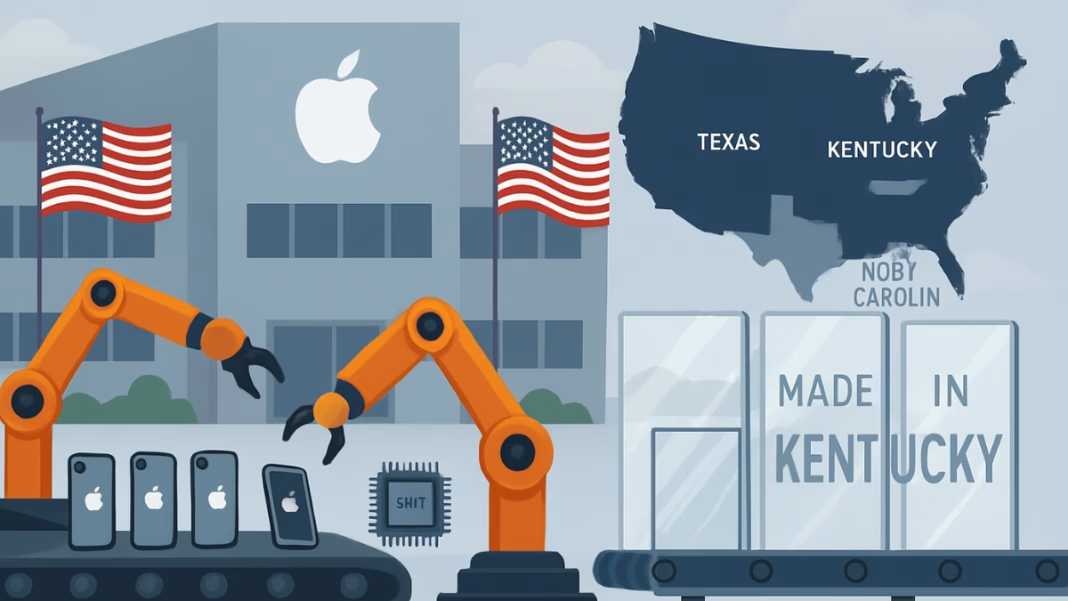
Apple makes $100 billion U.S. manufacturing move in response to rising trade tariffs

Apple responds to tariff threats with major U.S. investment

Apple has announced a massive $100 billion plan to expand manufacturing in the United States. This major decision comes after growing pressure from U.S. government leaders to bring more of its production back home. The company had earlier planned to invest $500 billion in the U.S. over the next four years. This new announcement adds to that plan, with a clear focus on making more Apple products and components in the U.S.

The tech giant has introduced a new American Manufacturing Program. Apple launched this initiative to strengthen its supply chain and advanced manufacturing within the U.S. The company says the move will help reduce its dependency on other countries and increase its manufacturing footprint across several U.S. states.

Working more closely with Corning, its longtime collaborator, is a key component of this strategy. Apple has agreed to make 100% of the cover glass for iPhones and Apple Watches in Kentucky. This glass is what protects the front of the devices, making this move an important part of the production process.

Another big update involves chip production. Apple will work with Samsung at a facility in Austin, Texas. Apple and Samsung will use a new and advanced technology to make chips a process Apple says has never been used anywhere else in the world.

New factories, training programs, and partnerships in the U.S.

Along with increasing its U.S. manufacturing, Apple is also opening new facilities and expanding current ones. Apple expects a new server factory in Houston, Texas, to begin mass production in 2026. Servers are powerful computers that help Apple’s services and apps run smoothly for users around the world.

Additionally, Apple plans to expand its Maiden, North Carolina, data center. Data centers store and manage large amounts of information, so this step will help support Apple’s growing services like iCloud, Apple Music, and more.

India is building the next global AI powerhouse with massive investment of $12.7 billion from AWS

Last month, Apple also revealed it would open a manufacturing academy in Michigan. The goal of this academy is to train U.S.-based companies and workers in advanced manufacturing techniques. Apple expects this training to help more American businesses join its supply chain in the future.

These steps are seen as a direct response to the recent rise in trade tensions. In recent years, Apple has moved some of its manufacturing operations to countries like Vietnam and India. This was done to reduce the risk of tariffs and supply chain delays. However, U.S. leaders have expressed concerns and pushed for Apple to bring those operations back to the U.S.

Tariffs and costs continue to rise for Apple

One of the major reasons behind Apple’s recent decision is the increasing cost of tariffs. The company revealed that new tariffs may add an extra $1.1 billion in costs during the September quarter. This would be on top of the $800 million Apple has already spent on these taxes.

The U.S. is applying tariffs to products and parts coming from several countries, including Vietnam and India. Manufacturers in Vietnam currently produce many Apple products like Macs, iPads, and Watches. In India, factories make the majority of iPhones for the U.S. market, which now face new 25% tariffs.

In the past, Apple had faced similar issues and tried to avoid high tariffs by manufacturing some products in the U.S.

The company’s latest manufacturing push is being presented as a way to build a complete chip production system in the U.S. This includes everything from design to equipment, wafer production, fabrication, and packaging. Apple says it will continue to work with U.S. suppliers to move more high-tech production to the country.

This large-scale shift is seen as a strong move to meet the rising costs and political pressure. Apple is aiming to protect its product pricing, supply chain, and business operations by making more of its devices in America.


Renuka Bangale
Renuka Bangale
Renuka is a distinguished Chartered Accountant and a Certified Digital Threats Analyst from Riskpro, renowned for her expertise in cybersecurity. With a deep understanding of cybercrimes, malware, cyber warfare, and espionage, she has established herself as an authority in the field. Renuka combines her financial acumen with advanced knowledge of digital threats to provide unparalleled insights into the evolving landscape of information security. Her analytical prowess enables her to dissect complex cyber incidents, offering clarity on risks and mitigation strategies. As a key contributor to Newsinterpretation’s information security category, Renuka delivers authoritative articles that educate and inform readers about emerging threats and best practices.

TOP 10 TRENDING ON NEWSINTERPRETATION

Cyber Attacks on Space Infrastructure: Satellites, GPS and the Ground Systems Behind Them

From the Viasat KA-SAT hack to GPS jamming over the Baltic, a research guide to how attackers target satellites, navigation signals and ground stations, and why it matters on Earth.

How AI Agents Are Used in Cyber Attacks: From Assisted Hacking to AI-Orchestrated Espionage

Attackers now use AI agents to scan networks, write exploits and run extortion campaigns. A research guide to documented cases, including the first reported AI-orchestrated espionage campaign, and what defenders should do.

Cyber Attacks on AI and LLMs: How Attackers Target Large Language Models

Prompt injection, data poisoning, model theft and jailbreaks: a research guide to how attackers target AI systems and large language models, with real cases and defences.

French Supermarket Refrigeration Cyberattack: How Hacking the Cold Chain Can Endanger Lives

In October 2026 attackers heated refrigeration cabinets in hundreds of French supermarkets to as much as 50°C. No one was hurt, but the attack shows how hacking the cold chain can endanger lives through fire, food poisoning and spoiled medicines.

Cyberattacks on Nuclear Facilities: Stuxnet, Kudankulam and the Limits of Air Gaps

Stuxnet, the Davis-Besse worm and malware at India’s Kudankulam plant: what they show about cyber risk at nuclear facilities and the limits of air gaps.

Triton: When Hackers Target the Safety Systems That Prevent Industrial Disasters

The 2017 Triton attack targeted the safety systems that prevent industrial disasters. What happened, who was charged, and how plants protect their last line of defence.

Cybersecurity Risks in Smart Cities: When Connected Infrastructure Fails

How connecting traffic control, emergency alerts and utilities concentrates cyber risk in cities, what the Dallas and Atlanta incidents showed, and what governments recommend.

Weaponized Drones: Hijacking, GPS Spoofing and Emerging Cyber Warfare Risks

How drones can be hijacked, jammed or misled by GPS spoofing, what researchers have demonstrated, and why governments treat drone fleets as a security risk.

Ransomware Attacks on Hospitals: How Healthcare Cyberattacks Put Patients at Risk

How ransomware against hospitals and their suppliers delays care and endangers patients, what the Düsseldorf and WannaCry cases show, and what research says about deaths.

Operational blunder exposes massive Russian cyber espionage attack on Ukrainian prosecutors

A major cyberattack has compromised the email accounts of...

Cyber Attacks on Space Infrastructure: Satellites, GPS and the Ground Systems Behind Them

From the Viasat KA-SAT hack to GPS jamming over the Baltic, a research guide to how attackers target satellites, navigation signals and ground stations, and why it matters on Earth.

French Supermarket Refrigeration Cyberattack: How Hacking the Cold Chain Can Endanger Lives

In October 2026 attackers heated refrigeration cabinets in hundreds of French supermarkets to as much as 50°C. No one was hurt, but the attack shows how hacking the cold chain can endanger lives through fire, food poisoning and spoiled medicines.

Cyberattacks on Nuclear Facilities: Stuxnet, Kudankulam and the Limits of Air Gaps

Stuxnet, the Davis-Besse worm and malware at India’s Kudankulam plant: what they show about cyber risk at nuclear facilities and the limits of air gaps.

Triton: When Hackers Target the Safety Systems That Prevent Industrial Disasters

The 2017 Triton attack targeted the safety systems that prevent industrial disasters. What happened, who was charged, and how plants protect their last line of defence.

Cybersecurity Risks in Smart Cities: When Connected Infrastructure Fails

How connecting traffic control, emergency alerts and utilities concentrates cyber risk in cities, what the Dallas and Atlanta incidents showed, and what governments recommend.

Ransomware Attacks on Hospitals: How Healthcare Cyberattacks Put Patients at Risk

How ransomware against hospitals and their suppliers delays care and endangers patients, what the Düsseldorf and WannaCry cases show, and what research says about deaths.

FBI warns of AVrecon malware targeting outdated routers linked to proxy based cybercrime

A serious cybersecurity warning has been issued regarding commonly...

Related Articles

Popular Categories
