

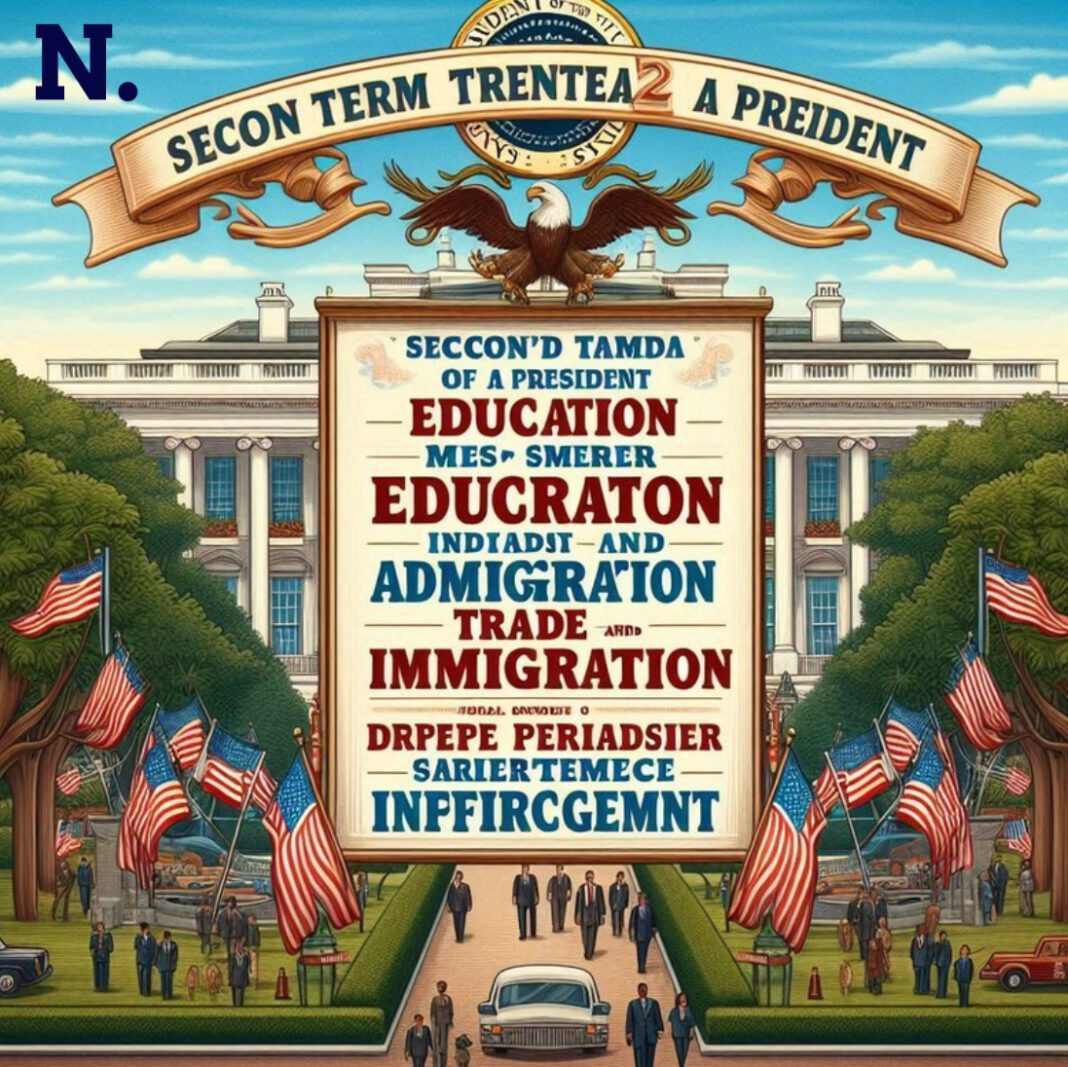
Donald Trump’s Agenda for a Potential Second Term

Former President Donald Trump has outlined an ambitious agenda for his potential second term in the White House. From reshaping global trade to reforming education, Trump’s proposals reflect his “America-first” philosophy. Below are the key areas he plans to address if elected in November 2024.

Tariffs and Trade

Trump aims to impose significant tariffs on imported goods. He recommends imposing minimum tariffs of 10 percent on all imports. This move, he believes, will eliminate trade deficits and protect American industries. Trump has consistently argued that such tariffs will level the playing field for U.S. manufacturers and reduce dependence on foreign goods.

Energy Policies

Trump plans to boost domestic energy production. He promises to lower fuel costs by expanding drilling and mining activities. His agenda includes eliminating the Green New Deal, which he claims hampers economic growth. Trump also supports drilling in the Arctic National Wildlife Refuge, aiming to increase fossil fuel production. According to the U.S. Energy Information Administration, fossil fuels accounted for 81% of U.S. energy production in 2022. Trump’s energy policy seeks to maintain and expand this dominance.

 Immigration Reforms

Immigration remains a cornerstone of Trump’s agenda. He plans to reinstate many first-term immigration policies. This includes limiting asylum access at the U.S.-Mexico border and eliminating birthright citizenship for children born to immigrant parents. Trump also intends to deputise the National Guard and local law enforcement to remove migrants without documents,  gang members and criminals swiftly. He advocates for a merit-based immigration system, emphasizing skills and economic contributions over family ties.

Trump also proposes a total naval embargo on cartel ships. He wants the U.S. Department of Defense to target cartel leadership and operations aggressively. Designating cartels as Foreign Terrorist Organizations is a priority for Trump. He urges other governments to follow suit and expose the corruption enabling these criminal networks.

 Law Enforcement and Crime

Trump pledges to grant record funding for hiring police officers. He criticizes the Biden administration and the “radical left” for defunding police departments. Trump claims that murder rates have increased in Democratic cities since he left office. The Pew Research Center reports that U.S. murder rates surged by 30 percent in 2020. Although preliminary data suggests a decrease in 2023, Trump insists on more robust law enforcement measures to ensure public safety.

 Educational Reforms

Trump plans to overhaul the U.S. education system. He wants to remove what he calls “Biden’s radical left ideology” from schools and the military. He proposes cutting federal funding for programs that promote critical race theory, gender ideology, and other leftist ideals. Project 2025, initiated by The Heritage Foundation, aligns with Trump’s vision. This project aims to eliminate the U.S. Department of Education.

In place of current policies, Trump supports rewarding schools that abolish tenure for K-12 teachers. He advocates for a Parental Bill of Rights, reducing the number of administrators, and electing school principals by parents. Trump also champions protecting the constitutional right to prayer in public schools. While the U.S. Department of Education allows private prayer, it prohibits prescribed prayers by school officials. Trump seeks to emphasize religious freedom within educational settings.

 Free Speech and Judicial Appointments

Restoring free speech is a significant part of Trump’s agenda. He aims to limit social media platforms’ ability to censor or restrict users’ First Amendment rights. Trump argues that these platforms have become overly partisan and suppress conservative viewpoints.

He also pledges to continue appointing judges and justices who enforce the law impartially. Trump emphasizes that judicial appointments should not reflect personal political agendas. Instead, they should uphold the Constitution and existing laws.

 Conclusion

Donald Trump’s proposed policies for a second term reflect his commitment to an “America-first” approach. His agenda includes significant changes in trade, energy, immigration, law enforcement, education, and free speech. Trump’s plans are ambitious, aiming to reshape the U.S. domestic and international landscape. If elected, his policies will likely spark intense debate and significant shifts in American governance and society.

Rajlaxmi Deshmukh
Rajlaxmi Deshmukh
Rajlaxmi Deshmukh is a Political Science Expert with Keen Interest in Geopolitics. She was working with a Think Tank Based in Pune before she joined News Interpretation in the capacity of Geo Political Editor.

TOP 10 TRENDING ON NEWSINTERPRETATION

Cyber Attacks on Space Infrastructure: Satellites, GPS and the Ground Systems Behind Them

From the Viasat KA-SAT hack to GPS jamming over the Baltic, a research guide to how attackers target satellites, navigation signals and ground stations, and why it matters on Earth.

How AI Agents Are Used in Cyber Attacks: From Assisted Hacking to AI-Orchestrated Espionage

Attackers now use AI agents to scan networks, write exploits and run extortion campaigns. A research guide to documented cases, including the first reported AI-orchestrated espionage campaign, and what defenders should do.

Cyber Attacks on AI and LLMs: How Attackers Target Large Language Models

Prompt injection, data poisoning, model theft and jailbreaks: a research guide to how attackers target AI systems and large language models, with real cases and defences.

French Supermarket Refrigeration Cyberattack: How Hacking the Cold Chain Can Endanger Lives

In October 2026 attackers heated refrigeration cabinets in hundreds of French supermarkets to as much as 50°C. No one was hurt, but the attack shows how hacking the cold chain can endanger lives through fire, food poisoning and spoiled medicines.

Cyberattacks on Nuclear Facilities: Stuxnet, Kudankulam and the Limits of Air Gaps

Stuxnet, the Davis-Besse worm and malware at India’s Kudankulam plant: what they show about cyber risk at nuclear facilities and the limits of air gaps.

Triton: When Hackers Target the Safety Systems That Prevent Industrial Disasters

The 2017 Triton attack targeted the safety systems that prevent industrial disasters. What happened, who was charged, and how plants protect their last line of defence.

Cybersecurity Risks in Smart Cities: When Connected Infrastructure Fails

How connecting traffic control, emergency alerts and utilities concentrates cyber risk in cities, what the Dallas and Atlanta incidents showed, and what governments recommend.

Weaponized Drones: Hijacking, GPS Spoofing and Emerging Cyber Warfare Risks

How drones can be hijacked, jammed or misled by GPS spoofing, what researchers have demonstrated, and why governments treat drone fleets as a security risk.

Ransomware Attacks on Hospitals: How Healthcare Cyberattacks Put Patients at Risk

How ransomware against hospitals and their suppliers delays care and endangers patients, what the Düsseldorf and WannaCry cases show, and what research says about deaths.

Operational blunder exposes massive Russian cyber espionage attack on Ukrainian prosecutors

A major cyberattack has compromised the email accounts of...

Cyber Attacks on Space Infrastructure: Satellites, GPS and the Ground Systems Behind Them

From the Viasat KA-SAT hack to GPS jamming over the Baltic, a research guide to how attackers target satellites, navigation signals and ground stations, and why it matters on Earth.

French Supermarket Refrigeration Cyberattack: How Hacking the Cold Chain Can Endanger Lives

In October 2026 attackers heated refrigeration cabinets in hundreds of French supermarkets to as much as 50°C. No one was hurt, but the attack shows how hacking the cold chain can endanger lives through fire, food poisoning and spoiled medicines.

Cyberattacks on Nuclear Facilities: Stuxnet, Kudankulam and the Limits of Air Gaps

Stuxnet, the Davis-Besse worm and malware at India’s Kudankulam plant: what they show about cyber risk at nuclear facilities and the limits of air gaps.

Triton: When Hackers Target the Safety Systems That Prevent Industrial Disasters

The 2017 Triton attack targeted the safety systems that prevent industrial disasters. What happened, who was charged, and how plants protect their last line of defence.

Cybersecurity Risks in Smart Cities: When Connected Infrastructure Fails

How connecting traffic control, emergency alerts and utilities concentrates cyber risk in cities, what the Dallas and Atlanta incidents showed, and what governments recommend.

Ransomware Attacks on Hospitals: How Healthcare Cyberattacks Put Patients at Risk

How ransomware against hospitals and their suppliers delays care and endangers patients, what the Düsseldorf and WannaCry cases show, and what research says about deaths.

FBI warns of AVrecon malware targeting outdated routers linked to proxy based cybercrime

A serious cybersecurity warning has been issued regarding commonly...

Related Articles

Popular Categories
