
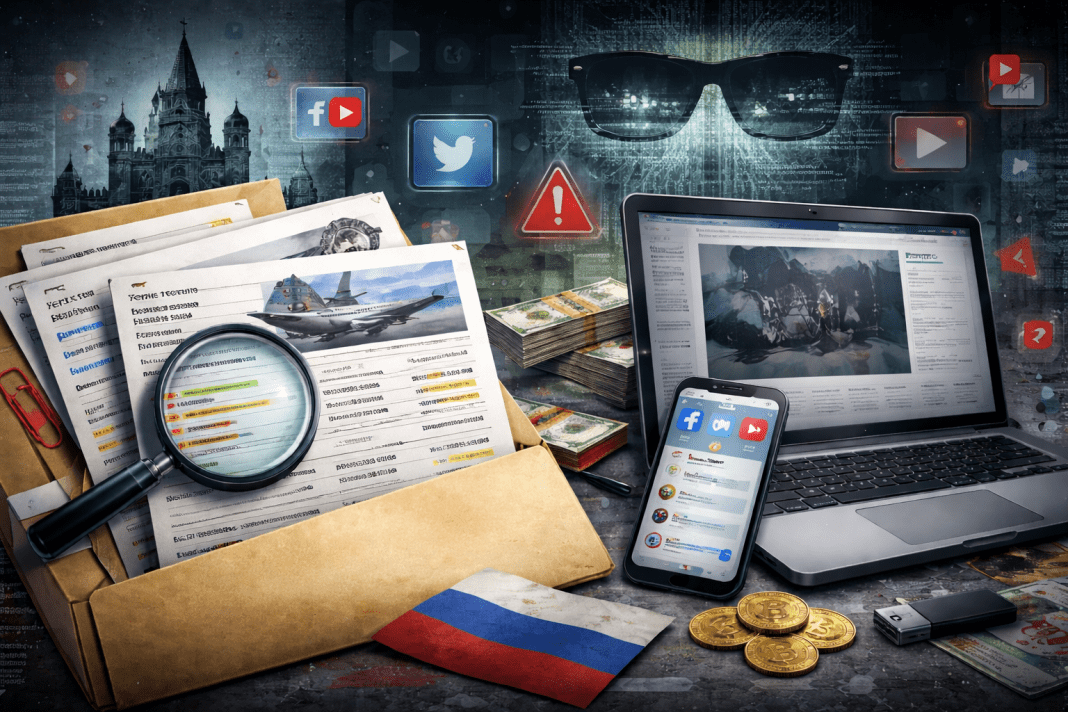

A fresh wave of disinformation has surfaced during the election campaign, focusing on damaging the credibility of opposition figures. One of the most striking claims falsely links Ágnes Forsthoffer, vice president of the Tisza Party, to the network of Jeffrey Epstein.
The claim appeared in an article and video shared on a website that looked like a legitimate news platform. It presented emails and financial documents as supposed proof of her involvement. However, closer examination showed that the documents were manipulated.
The files themselves were real and taken from known Epstein-related records. But key details were altered. In one case, the word “Hungarian” was inserted before a name, even though the original document clearly mentioned “New York.” This simple change created a false connection.
Such tactics are especially misleading because they mix real and fake information. This makes the content appear credible at first glance and increases the chances of people believing it.
Russian disinformation networks and fake news platforms
Investigations into the campaign suggest links to Russian disinformation efforts. The Gnida Project, which tracks such activities, identified patterns connecting the operation to a group known as Storm-1516.
The content was not shared randomly. It was published on websites designed to mimic real news portals. These sites often have professional layouts and convincing headlines, making it difficult for readers to distinguish them from legitimate media outlets.
In addition, the stories were promoted using social media tools such as paid advertisements. This allowed the false claims to reach a wider audience quickly.
This is not the first time such tactics have been used. Earlier, similar disinformation targeted Romulusz Ruszin-Szendi, another opposition politician from the Tisza Party, with false claims about recruiting Hungarian soldiers.
These repeated efforts show a clear pattern of targeting political figures through coordinated campaigns.
Valeria Chomsky admits grave mistake and says Jeffrey Epstein was a Trojan horse for the couple
Misleading narratives about Ukraine and political statements
Another major concern during the campaign has been the way certain statements are presented in the media. Comments made by Ukrainian officials have often been taken out of context and portrayed as direct threats to Hungary.
For example, remarks by Sándor Fegyir about possible Russian interference in the elections were reported as if they were threats of physical violence. In reality, the comments were warnings about potential risks, not threats.
This pattern has been observed multiple times since 2024. Statements are shortened, edited, or reframed in a way that changes their meaning.
Such reporting can influence how people view international relations and ongoing political tensions. It can also create unnecessary fear or misunderstanding among the public.
The Russian navy activates air defenses in Novorossiysk as drones reach a key warship
Statistical distortions and the rise of cheapfakes
Disinformation during the campaign is not limited to fake documents and misleading statements. It also includes the use of distorted statistics and “cheapfakes.”
In several speeches, Viktor Orbán claimed that there are more than 1 million additional jobs compared to 2010. However, data shows the increase is closer to around 800,000.
Similarly, remarks by János Lázár about the Roma community and later statements about their economic progress presented a more positive picture than what available data supports.
There have also been cases where political proposals were misrepresented. An article claimed that Tisza politician István Kapitány wanted citizens to bear the cost of an energy transition plan. In reality, he was discussing infrastructure development using an example from the United Kingdom.
Alongside these distortions, “cheapfakes” have become more common. These include edited documents, misleading visuals, and altered headlines. Unlike advanced deepfakes, cheapfakes rely on simple edits but can still have a strong impact.
Together, these tactics create a complex information environment. Voters are exposed to a mix of real facts, altered content, and misleading narratives, making it harder to separate truth from falsehood during the election period.