
New claims involving Donald Trump have resurfaced after former intelligence official Alnur Mussayev alleged that security services in Russia and Kazakhstan may hold compromising material linked to Trump’s 2013 visit to Moscow for the Miss Universe pageant. Speaking in a televised interview, Mussayev claimed that Russia’s Federal Security Service recorded surveillance footage during Trump’s stay at the Ritz-Carlton Moscow, and that Kazakhstan’s intelligence services later obtained access to the same material through business and political connections. The allegations have not been independently verified and have been denied in the past by Trump and Russian officials, but they have renewed debate over long-running claims about Trump’s historical ties to Moscow.
The former intelligence leader, Alnur Mussayev, made these claims during an interview on Ukraine’s Espreso TV program “Studia Zakhid.” He has previously spoken publicly about similar allegations and has now repeated and expanded them by stating that both Russian and Kazakh intelligence structures may possess compromising recordings related to Trump’s visit to Moscow in 2013.
Claims About Surveillance During Moscow Visit
Alnur Mussayev stated that Russia’s Federal Security Service, commonly known as the FSB, allegedly collected compromising video recordings during Donald Trump’s stay at Moscow’s Ritz-Carlton hotel in 2013. Trump visited Moscow at that time to attend the Miss Universe pageant. Mussayev claimed that surveillance cameras were used inside hotel rooms during the visit and that intelligence agencies recorded sensitive footage.
💻 Kremlin’s cyber deception – Russian hackers pose as Kaspersky to infiltrate foreign embassies
Mussayev further claimed that Kazakhstan’s National Security Committee, known as the KNB, also gained access to the same material. He explained that the Ritz-Carlton hotel was allegedly connected to Kazakh businessman Bulat Temuratov, who was reportedly close to Kazakhstan’s former president, Nursultan Nazarbayev. According to Mussayev, this business connection allowed Kazakhstan’s intelligence services to obtain copies of the recorded footage.
He also mentioned that the Miss Universe event involved Russian oligarch Aras Agalarov, who helped organize the pageant. Mussayev suggested that both Crocus City, a venue linked to Agalarov, and the Ritz-Carlton hotel were part of the event’s activities, which allegedly allowed intelligence agencies to gather information during Trump’s stay in Moscow.
Allegations About Diplomatic Use of Compromising Material
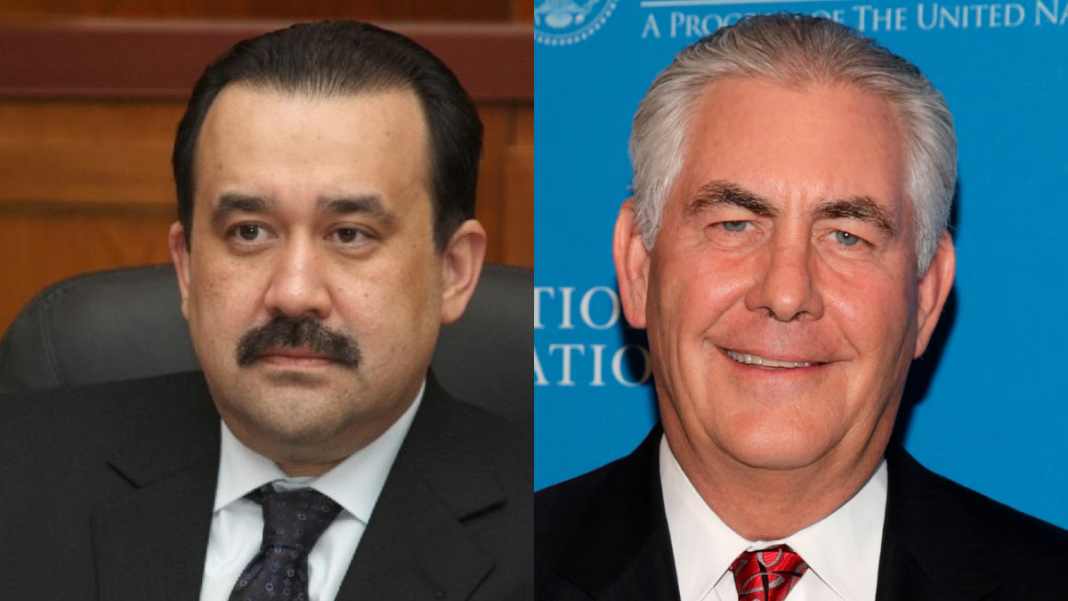
Mussayev further claimed that Kazakhstan attempted to use the alleged compromising material during diplomatic discussions with the United States government. He specifically mentioned Karim Massimov, who served as chairman of Kazakhstan’s National Security Committee. Mussayev alleged that Massimov referred to the material during a meeting with former United States Secretary of State Rex Tillerson in October 2017.
Trump administration faces more than 600 lawsuits as courts test legality of second-term policies
According to Mussayev, the attempt to use such material did not improve diplomatic relations as expected. Instead, he linked the situation to political instability that later developed within Kazakhstan. He referred to nationwide protests in 2022, which were triggered by rising living costs and worsening economic conditions. The protests caused major damage to government buildings and led to violent clashes in several cities.
Mussayev claimed that the unrest intensified political tensions between former president Nursultan Nazarbayev and current president Kassym-Jomart Tokayev. He further alleged that Karim Massimov was blamed for the crisis and later faced legal action. Mussayev also suggested that Russian President Vladimir Putin played a strong role in shaping political developments during that period, though these claims have not been officially confirmed.
Earlier Recruitment Allegations and International Reactions
Mussayev has made controversial claims about Donald Trump before. In earlier public statements and social media posts, he alleged that Soviet intelligence agencies targeted Western business leaders during the Cold War era. He claimed that Trump was allegedly approached in 1987 and recruited as a potential intelligence asset under the code name “Krasnov.” Mussayev stated that he worked in the KGB’s Sixth Directorate at that time, which focused on recruiting foreign business figures.
Trump threatens higher tariffs on South Korea, says trade pact still not enforced
Similar accusations were included in a report prepared by former British intelligence officer Christopher Steele. The report, often referred to as the Steele dossier, contained allegations about compromising footage involving Trump during his 2013 Moscow visit. The dossier gained widespread global attention during Trump’s first presidential term.
Donald Trump and his supporters have repeatedly denied all such allegations. They have described the Steele dossier and similar claims as fabricated and politically motivated. Russian authorities have also dismissed accusations that their intelligence agencies possess compromising material involving Trump. Kazakhstan’s government officials have not publicly confirmed the specific allegations made by Mussayev.