

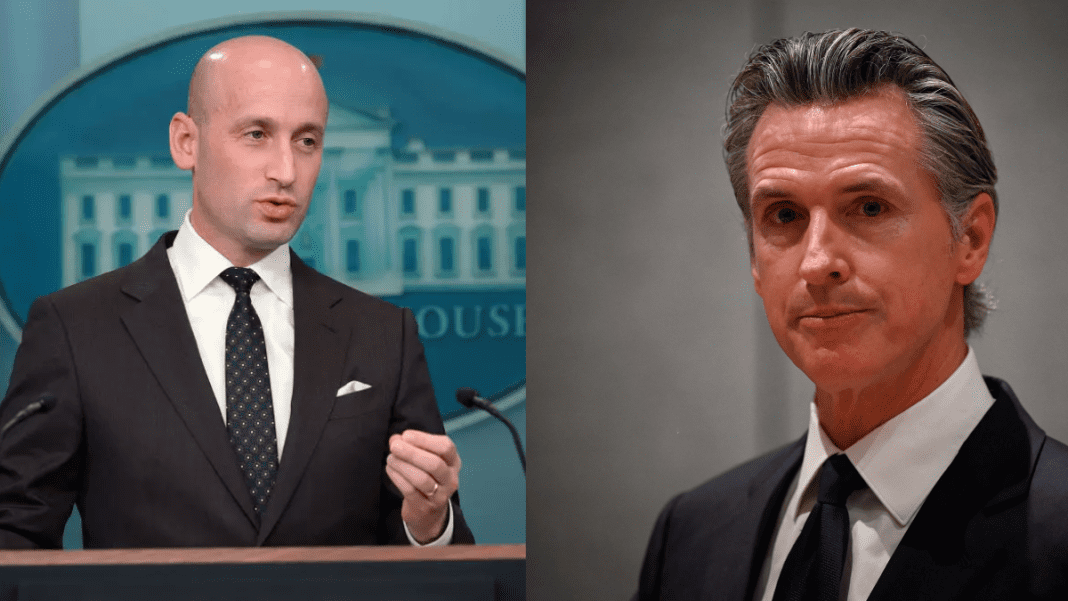
Political firestorm erupts as Newsom warns Stephen Miller is weaponizing tragedy to attack democracy

California Governor Gavin Newsom has issued a sharp warning about what he sees as a dangerous plan by the Trump administration. He believes White House Deputy Chief of Staff Stephen Miller is trying to use the tragic killing of conservative figure Charlie Kirk as a reason to attack democratic institutions.

Newsom Warns of Political Weaponization

On Monday, Miller appeared on the show once hosted by Kirk. He pledged to Vice President JD Vance that the administration would channel public anger into what he called a fight against “domestic terror networks.” He listed organized online doxxing campaigns, riots, street violence, and even groups sharing home addresses as proof of what he described as a vast threat to America’s safety.

Miller said the government will use every tool it has. He named the Justice Department, Homeland Security, and other agencies. Then, he promised they would find and break apart these networks. Finally, he said the goal is to make America safe again. Miller added it would all be done in Charlie’s name.

Newsom condemned Kirk’s death and shared sympathy with his family. But he spoke firmly about Miller’s words. In a post on X, he said this was not about fighting crime. He warned it was about attacking democracy. “Wake up, America,” he wrote. Newsom said Miller had already called the Democratic Party a terrorist group. He warned that political violence must not be used to scare millions of Americans.

Stephen Miller’s Rhetoric

Miller’s statement was made during a Fox News appearance. In that interview, he referred to the Democratic Party as “not a political party” but a “domestic extremist organization.” He accused the left of spreading messaging that incites violence and claimed that their tactics had escalated to terrorism.

By linking Kirk’s killing to what he describes as an organized extremist effort, Miller framed the administration’s planned response as a mission to eliminate these groups. His words suggested an expansion of federal resources to confront what he considers a domestic terror movement.

Newsom draws Megyn Kelly’s ire after sharing old Trump clips to boost online trolling campaign

Miller has long been a central figure in Trump’s policy circle, particularly on immigration and crime. His sharp language and promises of sweeping government action are consistent with his earlier role in shaping hardline policies. This time, however, his statements carry the weight of connecting a national tragedy to political objectives.

Newsom’s response aimed to show the danger in this framing. By pointing out that Miller had already branded Democrats as terrorists, the governor warned that the administration might use crime-fighting language as a way to attack millions of Americans who disagree with them politically.

Trump’s Response After Kirk’s Killing

President Donald Trump also weighed in after the killing of Charlie Kirk. In a video message released by the White House, Trump claimed that “radical left lunatics” were responsible for creating the climate of violence in the United States. He argued that rhetoric from the left was “directly responsible for the terrorism that we’re seeing in our country today.”

Stansbury accuses Trump and GOP of blocking full Epstein file release in Congress

In his remarks, Trump also came to the defense of right-wing extremists. He suggested their actions stemmed from a desire to prevent crime rather than to create chaos. His comments aligned with Miller’s framing of the issue, suggesting that both men see Kirk’s death as a rallying point for broader government action.

While Newsom warned about threats to democracy, the White House stayed silent. Reporters asked for a comment on Miller’s remarks, but none was given. Newsom’s warning and Miller’s promises show a sharp divide. Both sides see the tragedy in very different ways and disagree on what should happen next.


Renuka Bangale
Renuka Bangale
Renuka is a distinguished Chartered Accountant and a Certified Digital Threats Analyst from Riskpro, renowned for her expertise in cybersecurity. With a deep understanding of cybercrimes, malware, cyber warfare, and espionage, she has established herself as an authority in the field. Renuka combines her financial acumen with advanced knowledge of digital threats to provide unparalleled insights into the evolving landscape of information security. Her analytical prowess enables her to dissect complex cyber incidents, offering clarity on risks and mitigation strategies. As a key contributor to Newsinterpretation’s information security category, Renuka delivers authoritative articles that educate and inform readers about emerging threats and best practices.

TOP 10 TRENDING ON NEWSINTERPRETATION

Cyber Attacks on Space Infrastructure: Satellites, GPS and the Ground Systems Behind Them

From the Viasat KA-SAT hack to GPS jamming over the Baltic, a research guide to how attackers target satellites, navigation signals and ground stations, and why it matters on Earth.

How AI Agents Are Used in Cyber Attacks: From Assisted Hacking to AI-Orchestrated Espionage

Attackers now use AI agents to scan networks, write exploits and run extortion campaigns. A research guide to documented cases, including the first reported AI-orchestrated espionage campaign, and what defenders should do.

Cyber Attacks on AI and LLMs: How Attackers Target Large Language Models

Prompt injection, data poisoning, model theft and jailbreaks: a research guide to how attackers target AI systems and large language models, with real cases and defences.

French Supermarket Refrigeration Cyberattack: How Hacking the Cold Chain Can Endanger Lives

In October 2026 attackers heated refrigeration cabinets in hundreds of French supermarkets to as much as 50°C. No one was hurt, but the attack shows how hacking the cold chain can endanger lives through fire, food poisoning and spoiled medicines.

Cyberattacks on Nuclear Facilities: Stuxnet, Kudankulam and the Limits of Air Gaps

Stuxnet, the Davis-Besse worm and malware at India’s Kudankulam plant: what they show about cyber risk at nuclear facilities and the limits of air gaps.

Triton: When Hackers Target the Safety Systems That Prevent Industrial Disasters

The 2017 Triton attack targeted the safety systems that prevent industrial disasters. What happened, who was charged, and how plants protect their last line of defence.

Cybersecurity Risks in Smart Cities: When Connected Infrastructure Fails

How connecting traffic control, emergency alerts and utilities concentrates cyber risk in cities, what the Dallas and Atlanta incidents showed, and what governments recommend.

Weaponized Drones: Hijacking, GPS Spoofing and Emerging Cyber Warfare Risks

How drones can be hijacked, jammed or misled by GPS spoofing, what researchers have demonstrated, and why governments treat drone fleets as a security risk.

Ransomware Attacks on Hospitals: How Healthcare Cyberattacks Put Patients at Risk

How ransomware against hospitals and their suppliers delays care and endangers patients, what the Düsseldorf and WannaCry cases show, and what research says about deaths.

Operational blunder exposes massive Russian cyber espionage attack on Ukrainian prosecutors

A major cyberattack has compromised the email accounts of...

Cyber Attacks on Space Infrastructure: Satellites, GPS and the Ground Systems Behind Them

From the Viasat KA-SAT hack to GPS jamming over the Baltic, a research guide to how attackers target satellites, navigation signals and ground stations, and why it matters on Earth.

French Supermarket Refrigeration Cyberattack: How Hacking the Cold Chain Can Endanger Lives

In October 2026 attackers heated refrigeration cabinets in hundreds of French supermarkets to as much as 50°C. No one was hurt, but the attack shows how hacking the cold chain can endanger lives through fire, food poisoning and spoiled medicines.

Cyberattacks on Nuclear Facilities: Stuxnet, Kudankulam and the Limits of Air Gaps

Stuxnet, the Davis-Besse worm and malware at India’s Kudankulam plant: what they show about cyber risk at nuclear facilities and the limits of air gaps.

Triton: When Hackers Target the Safety Systems That Prevent Industrial Disasters

The 2017 Triton attack targeted the safety systems that prevent industrial disasters. What happened, who was charged, and how plants protect their last line of defence.

Cybersecurity Risks in Smart Cities: When Connected Infrastructure Fails

How connecting traffic control, emergency alerts and utilities concentrates cyber risk in cities, what the Dallas and Atlanta incidents showed, and what governments recommend.

Ransomware Attacks on Hospitals: How Healthcare Cyberattacks Put Patients at Risk

How ransomware against hospitals and their suppliers delays care and endangers patients, what the Düsseldorf and WannaCry cases show, and what research says about deaths.

FBI warns of AVrecon malware targeting outdated routers linked to proxy based cybercrime

A serious cybersecurity warning has been issued regarding commonly...

Related Articles

Popular Categories
