

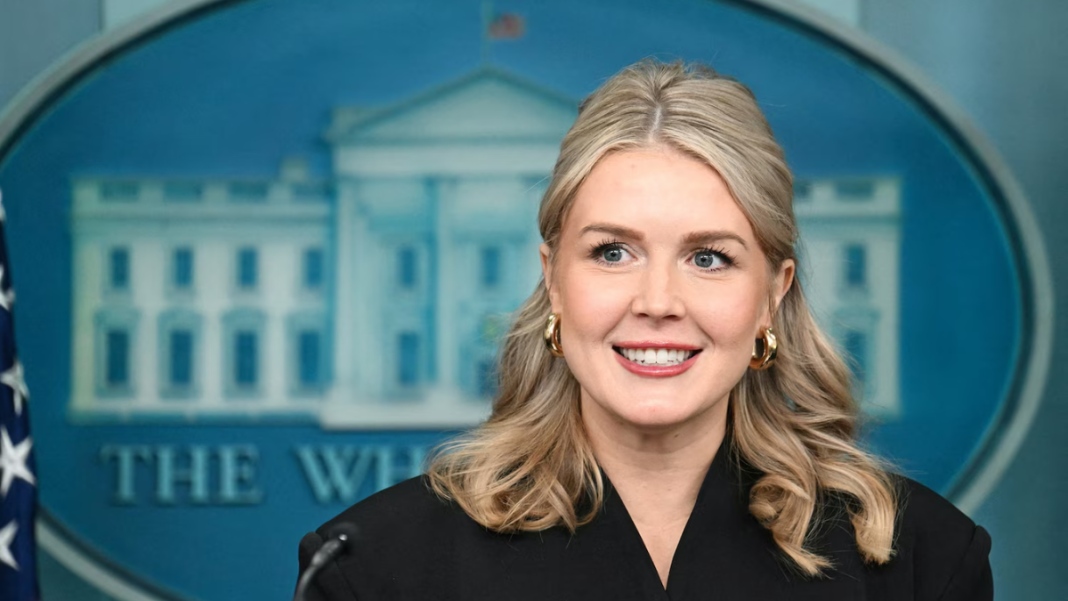
Karoline Leavitt’s light remark during Air Force One delay reignites debate over aging aircraft

A routine overseas trip turned into a widely discussed moment after Air Force One was forced to turn back to the United States due to a technical issue. The incident happened shortly after the aircraft took off on its way to Switzerland, drawing attention from reporters, officials, and the public.

What added fuel to the discussion was a light remark by Karoline Leavitt, which quickly spread across media platforms. Karoline Leavitt comment about a Qatari jet sounding better than the current Air Force One linked the incident to earlier debates about aircraft age, safety, and the controversial offer of a gifted plane from Qatar.

Air Force One Turned Back After Electrical Issue

On Tuesday night, Air Force One departed the United States carrying Donald Trump, Karoline Leavitt, and members of the press. Less than an hour into the flight, the crew detected a minor electrical problem. Soon after takeoff, reporters onboard noticed that lights in the press cabin briefly went out, which raised concern among those traveling.

Newsom’s tan suit throwback pulls Karoline Leavitt into a decade-old political fashion flashpoint

The White House later issued a statement explaining that the issue was identified quickly and handled with caution. Karoline Leavitt addressed reporters after the landing and said the aircraft returned to Joint Base Andrews as a safety measure. The statement stressed that there was no emergency and that the president and his team would continue the journey on a different aircraft.

After landing safely, plans were made for the president to board another plane and resume travel to Switzerland. The trip was meant for the World Economic Forum in Davos. This marked the first time since 2020 that Trump would attend the event in person.

Media coverage noted that Air Force One has been in service for decades. While it is carefully maintained, its age often becomes part of public discussion whenever technical issues arise.

Qatari Jet Comment Draws Attention

During the unexpected delay, Karoline Leavitt made a casual comment to reporters suggesting that a Qatari jet sounded “much better” than the current Air Force One. Though meant as a joke, the remark quickly gained attention because it connected to a previous announcement involving Qatar.

Seconds that mattered: Karoline Leavitt’s early exit turns routine briefing into viral betting scandal

Last year, Trump revealed that he planned to accept a jumbo jet donated by Qatar. The aircraft, reportedly worth around $400 million, was described as an unconditional gift. Trump said he did not want to turn down a “free plane” and explained that the cost of retrofitting it would be handled by the military.

The offer sparked public debate at the time. Critics questioned the optics of accepting such a valuable gift, while the White House insisted that the move was legal. Officials also stated that once Trump’s term ends, the aircraft will be transferred to his presidential library.

Karoline Leavitt’s remark brought that debate back into the spotlight. Social media users and news outlets quickly linked the comment to the ongoing conversation about the aging Air Force One fleet and delays in replacing it.

Aging Aircraft, Expert Views, and Broader Context

Aviation experts weighed in after Air Force One was forced to turn back shortly after takeoff due to a minor electrical issue. Peter Goelz, speaking on CNN, said the current Air Force One aircraft is around 30 to 40 years old and that even well-maintained planes can face wiring problems over time. He explained that heavy use can cause electrical systems to wear down, making brief faults more likely.

Goelz added that aging wiring can become brittle, which increases the chances of electrical disruptions. He said the incident could add pressure on Boeing to deliver the long-delayed replacement aircraft for Air Force One. Following the return to Joint Base Andrews, Karoline Leavitt reiterated that the aircraft was turned back out of caution and that all safety procedures were properly followed.

Insurrection Act back in focus as Trump signals military option amid Minnesota
protests

The flight disruption came on a busy day for President Donald Trump. Earlier on Tuesday, he held a lengthy news conference marking the first anniversary of his second term in office. The event lasted more than 100 minutes and covered topics such as immigration enforcement, public safety, and administration achievements.

During that appearance, Trump referred to recent ICE arrests and made remarks on several national issues, including a symbolic comment about renaming the Gulf of Mexico. Karoline Leavitt later addressed reporters, confirming that the president’s travel plans continued as scheduled despite the delay and that another aircraft was arranged to complete the trip.
Samruddhi Kulkarni
Samruddhi Kulkarni
Samruddhi Kulkarni is a cybersecurity and artificial intelligence specialist who reports on emerging cyber threats, advanced AI systems, and data-driven risk trends shaping the digital world.

TOP 10 TRENDING ON NEWSINTERPRETATION

Cyber Attacks on Space Infrastructure: Satellites, GPS and the Ground Systems Behind Them

From the Viasat KA-SAT hack to GPS jamming over the Baltic, a research guide to how attackers target satellites, navigation signals and ground stations, and why it matters on Earth.

How AI Agents Are Used in Cyber Attacks: From Assisted Hacking to AI-Orchestrated Espionage

Attackers now use AI agents to scan networks, write exploits and run extortion campaigns. A research guide to documented cases, including the first reported AI-orchestrated espionage campaign, and what defenders should do.

Cyber Attacks on AI and LLMs: How Attackers Target Large Language Models

Prompt injection, data poisoning, model theft and jailbreaks: a research guide to how attackers target AI systems and large language models, with real cases and defences.

French Supermarket Refrigeration Cyberattack: How Hacking the Cold Chain Can Endanger Lives

In October 2026 attackers heated refrigeration cabinets in hundreds of French supermarkets to as much as 50°C. No one was hurt, but the attack shows how hacking the cold chain can endanger lives through fire, food poisoning and spoiled medicines.

Cyberattacks on Nuclear Facilities: Stuxnet, Kudankulam and the Limits of Air Gaps

Stuxnet, the Davis-Besse worm and malware at India’s Kudankulam plant: what they show about cyber risk at nuclear facilities and the limits of air gaps.

Triton: When Hackers Target the Safety Systems That Prevent Industrial Disasters

The 2017 Triton attack targeted the safety systems that prevent industrial disasters. What happened, who was charged, and how plants protect their last line of defence.

Cybersecurity Risks in Smart Cities: When Connected Infrastructure Fails

How connecting traffic control, emergency alerts and utilities concentrates cyber risk in cities, what the Dallas and Atlanta incidents showed, and what governments recommend.

Weaponized Drones: Hijacking, GPS Spoofing and Emerging Cyber Warfare Risks

How drones can be hijacked, jammed or misled by GPS spoofing, what researchers have demonstrated, and why governments treat drone fleets as a security risk.

Ransomware Attacks on Hospitals: How Healthcare Cyberattacks Put Patients at Risk

How ransomware against hospitals and their suppliers delays care and endangers patients, what the Düsseldorf and WannaCry cases show, and what research says about deaths.

Operational blunder exposes massive Russian cyber espionage attack on Ukrainian prosecutors

A major cyberattack has compromised the email accounts of...

Cyber Attacks on Space Infrastructure: Satellites, GPS and the Ground Systems Behind Them

From the Viasat KA-SAT hack to GPS jamming over the Baltic, a research guide to how attackers target satellites, navigation signals and ground stations, and why it matters on Earth.

French Supermarket Refrigeration Cyberattack: How Hacking the Cold Chain Can Endanger Lives

In October 2026 attackers heated refrigeration cabinets in hundreds of French supermarkets to as much as 50°C. No one was hurt, but the attack shows how hacking the cold chain can endanger lives through fire, food poisoning and spoiled medicines.

Cyberattacks on Nuclear Facilities: Stuxnet, Kudankulam and the Limits of Air Gaps

Stuxnet, the Davis-Besse worm and malware at India’s Kudankulam plant: what they show about cyber risk at nuclear facilities and the limits of air gaps.

Triton: When Hackers Target the Safety Systems That Prevent Industrial Disasters

The 2017 Triton attack targeted the safety systems that prevent industrial disasters. What happened, who was charged, and how plants protect their last line of defence.

Cybersecurity Risks in Smart Cities: When Connected Infrastructure Fails

How connecting traffic control, emergency alerts and utilities concentrates cyber risk in cities, what the Dallas and Atlanta incidents showed, and what governments recommend.

Ransomware Attacks on Hospitals: How Healthcare Cyberattacks Put Patients at Risk

How ransomware against hospitals and their suppliers delays care and endangers patients, what the Düsseldorf and WannaCry cases show, and what research says about deaths.

FBI warns of AVrecon malware targeting outdated routers linked to proxy based cybercrime

A serious cybersecurity warning has been issued regarding commonly...

Related Articles

Popular Categories
