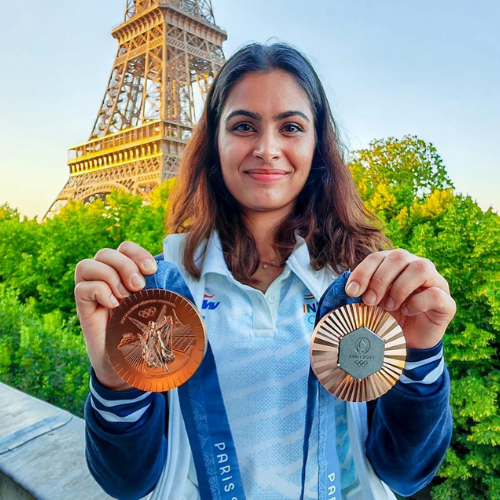

Manu Bhaker, ace shooter celebrated for her achievements in the Paris Olympics, has been doing the rounds of India, giving encouragement to students for sport. Her recent visit to a southern metropolis underlined how serious she was regarding pushing the youth toward taking up sports as a career option and garnering satisfaction. With such sterling accomplishments and personal experiences, Bhaker brings up quite a convincing motivational message, merging her triumphs with some very valuable life lessons.
Bhaker returned from Paris Olympics with her historic success, as she took two medals: a bronze in the women’s 10m air pistol event and another in the 10m air pistol mixed team event, where she paired with Sarabjot Singh. These achievements are a huge milestone in her career and stand in complete contrast to her performance previously at the Tokyo Olympics. The challenges Bhaker faced in Tokyo were remarkable, and she underperformed there, so this victory of Paris is all the more important. The victory at Paris escalated her to a higher status and came as a boost for Indian shooting at the international platform.
Motivational Message of Manu Bhaker
The most important element of Manu Bhaker’s message is the promotion of sports as a career field. She adds, quite enthusiastically, that a career in sports opens an ocean of benefits and paves the way for “a beautiful life.” Bhaker touts financial support and personal growth associated with making a career in sports. She wants the students to dream big and relentlessly work over their goals. For Manu Bhaker, sports success is achieved through hard work and effort, not just by setting big targets. Her call to take up sports as a professional career was only to inspire the students to take alternate choices and follow their passions.
FIFA Sanctions Canada Soccer Team for Drone Espionage Scandal at Paris Olympics
Personal Reflections and Inspirations
Bhaker often reflects on how huge a role was played by her family, especially her mother, in the dawn of her career. She credits most of her success to them because the support and encouragement instilled by the family was immeasurable. Bhaker emphasizes that family and support in the early stage are paramount, which shapes an athlete’s career. Her story brings forth the fact that there was adequate support at home and school. Bhaker’s journey shows that family and education are crucial in nurturing young athletes to reach their full potential. The aspect that comes out of this junction is that there was sufficient support at home and in the school.
Throughout her career, Bhaker has been continuously seeking improvement and self-upgrading. Her travel and exposure to different cultures added to her experience and knowledge, further expanding her vision. She highlights that learning new skills and adapting to new environments fosters growth both professionally and personally. Bhaker’s experiences reveal that ongoing learning and new challenges are key to achieving success. She inspires students and upcoming athletes that from her experiences, one ought to learn from them and grow. This sub menu item stresses the message of lifelong learning and self-improvement.
Dramatic Turn: Antim Panghal Deported from Olympics
Overcoming Setbacks and Challenges
Manu Bhaker’s journey from setbacks to success is indeed an inspiration on rising above challenges and building self-confidence. Her experiences taught her that the key to all struggles is to keep pushing forward. She struggled in Tokyo, but Bhaker’s spirit did not let her down in Paris. She says the beauty of sports lies in: turning failures into the foundations of future triumphs. Thus, Bhaker’s story shows how setbacks can sometimes give impetus. The key to success is persistence and a positive attitude, regardless of how challenging the journey may be.
Bhaker’s message for the students focused on resilience. Bhaker said that everyone faces setbacks as a part of any journey; to overcome these challenges, it’s important not to lose one’s resilience. From her personal experience, she teaches students about focus and determination in bouncing back to life after failures. Bhaker therefore encourages young fraternity never to give up in face of challenges but to keep pushing forward with courage. She teaches students that overcoming adversity with a positive attitude is key to success in any career, including sports.
According to Manu Bhaker, failure is an important part of the journey towards success. She believes that the setbacks should not be a source of hindrance but an approach to growth. She says her strategy for failure is to learn from experience and use it as a stepping stone to success. The recovery strategies that Bhaker employs are confidence, learning through mistakes, and keeping on striving towards one’s goal. Her story advises students to see failure as part of the journey and move forward with determination.