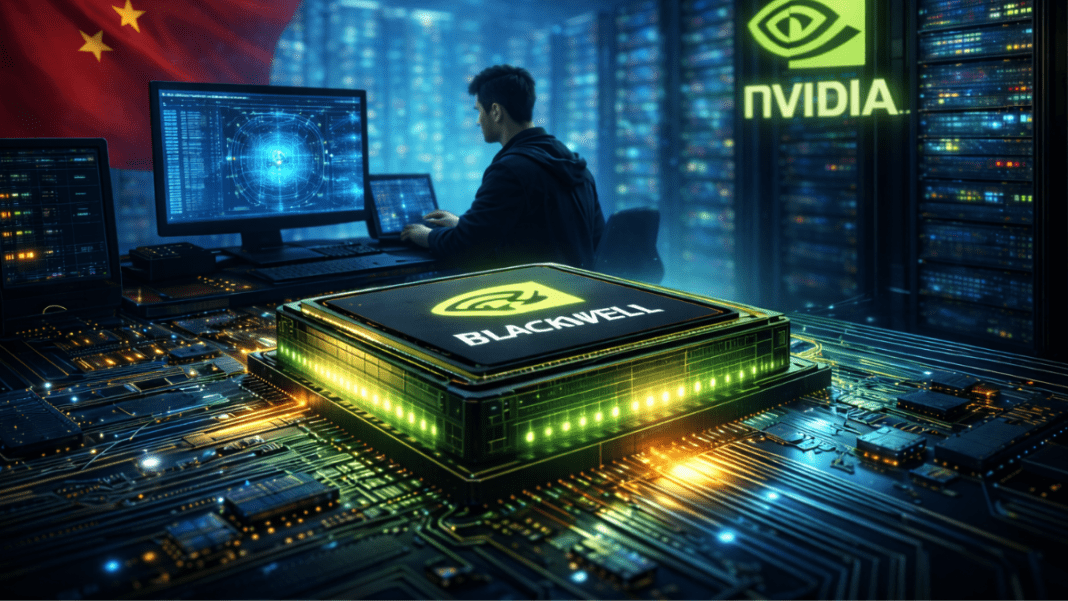

Reports about artificial intelligence development have brought attention to a technology dispute involving advanced computer chips. Information suggests that Chinese AI company DeepSeek trained its upcoming AI model using highly powerful chips made by Nvidia, despite strict export controls from the United States.
The issue has drawn interest because these chips are among the most advanced tools used to build modern AI systems. The claims were first reported by Reuters, which said officials believe the chips may be operating inside a data center located in Inner Mongolia, a region known for large computing facilities.
Concerns Over Use Of Nvidia Blackwell Chips
The chips at the center of the discussion belong to Nvidia’s newest generation, known as Blackwell. These processors are designed to train large AI models quickly and handle complex tasks like language understanding and data analysis. US policy currently restricts direct shipments of the most advanced versions of these chips to China. Anthropic says DeepSeek Moonshot and MiniMax ran coordinated distillation campaigns on Claude AI
Officials indicated that DeepSeek may have used Blackwell chips for training its next model, expected to be released soon. Details about how the chips reached the company have not been publicly shared. There are also claims that technical signals that could reveal chip usage might be removed, which could make tracking harder.
Nvidia has not commented on the report, and DeepSeek has not responded to questions. The situation has raised wider concerns about how export controls are enforced in a global technology supply chain where hardware can pass through several intermediaries.
The discussion comes after earlier policy shifts. Donald Trump previously opened the door for Nvidia to sell scaled-down versions of advanced chips in China but later reversed course, suggesting the most powerful chips should remain reserved for US companies. A decision to allow sales of Nvidia’s second-most advanced chip, the H200, also faced criticism, and shipments have remained delayed.
Policy Debate and National Security Questions
The reported use of advanced chips has intensified debate among policymakers. Some technology leaders, including David Sacks and Nvidia chief Jensen Huang, have argued that allowing limited chip sales could slow competitors such as Huawei from rapidly developing alternatives. They suggest controlled access might reduce pressure on domestic innovation elsewhere.
Bill Gates moves to step back from Delhi AI summit speech as new Epstein emails remain unverified
Others have raised national security concerns. Former national security official Chris McGuire, who served under Joe Biden, warned that exporting advanced AI hardware carries risks if companies do not follow restrictions. The fear is that powerful computing resources could be redirected from commercial research to military applications.
Another expert, Saif Khan, also linked to earlier national security work, said reports of smuggled Blackwell chips highlight gaps in domestic chip production and explain why some companies seek access to advanced hardware. These views show how technology policy now sits at the intersection of trade, security, and innovation.
Meanwhile, China’s response has focused on opposing what it describes as the politicization of technology. Foreign Ministry spokesperson Mao Ning said China was not aware of the specific circumstances but repeated earlier statements criticizing broad export restrictions.
Distillation Methods And Industry Impact
The report also mentions a training method called “distillation.” This technique allows a new AI model to learn from the outputs of more established systems instead of starting entirely from zero. Officials believe DeepSeek’s model may have benefited from knowledge patterns linked to systems built by companies such as Anthropic, Google, OpenAI, and xAI, while running on powerful hardware supplied by Nvidia.
Distillation is widely used because it lowers computing costs while improving performance. By combining powerful hardware — including advanced processors developed by Nvidia — with learning from existing models, developers can accelerate progress. This approach has become a key strategy across the AI industry.
DeepSeek, based in Hangzhou, previously drew global attention after releasing AI models that competed with leading systems from the United States. Those releases influenced markets and intensified discussion about how quickly the AI gap between countries might narrow.
A1 hallucinations hit U.S. courts as Judges impose sanctions over fake citations
The latest claims about Blackwell chip usage have again focused attention on data centers filled with specialized processors. These facilities represent the core infrastructure behind modern AI development. Access to advanced chips and large computing clusters often determines how fast companies can train new systems.
The situation highlights how artificial intelligence, semiconductor supply chains, and export policies are closely connected. As governments, companies, and researchers navigate these challenges, the use of advanced chips remains one of the most closely watched issues in the global AI race.