
Local Governments as the First Tier of Governance
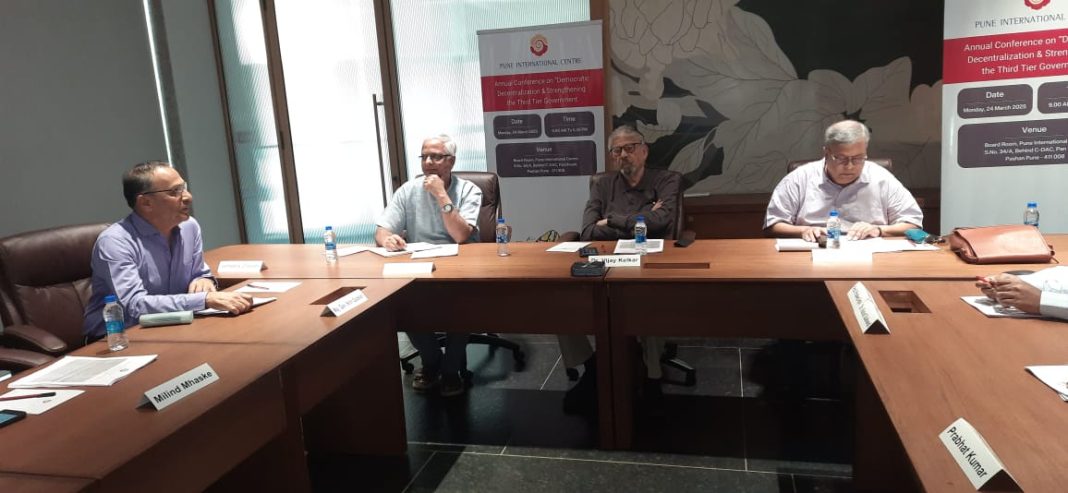
Urban and rural local governments (ULGs/RLGs) form the backbone of India’s governance structure, directly engaging with citizens and addressing region-specific concerns. Despite this, they are often regarded as the third tier of governance, secondary to the state and central governments. Dr. Vijay Kelkar, former bureaucrat and Vice President of the Pune International Centre (PIC), strongly advocated for a shift in this perception during the Annual Conference on ‘Democratic Decentralisation and Strengthening the 3rd Tier Government,’ held on March 24, 2025, at the PIC Campus in Pashan.
Dr. Kelkar argued that local governments should be considered the first tier of governance due to their proximity to citizens and their ability to implement policies that cater to local needs. He emphasized the necessity of inclusive policies and called for closer collaboration between think tanks and policymakers to strengthen local governance frameworks. His views aligned with discussions from a similar conference held in May 2024, where experts also stressed the importance of empowering local bodies to improve governance efficiency and service delivery.
The conference brought together a diverse group of experts, policymakers, urban planners, and governance specialists to deliberate on the pressing challenges facing municipal and rural governments. The discussions underscored the urgent need for financial sustainability, greater citizen participation, and systemic reforms to unlock India’s urban growth potential.
Challenges and Key Recommendations for Stronger Local Governance
A major challenge for local governments in India is financial dependence on state and central grants, limiting their autonomy. Experts at the conference emphasized the need for stronger fiscal devolution, independent evaluation frameworks, and legal reforms to enhance financial control.
Key recommendations included revising property tax structures, introducing user fees for municipal services, and leveraging public-private partnerships (PPPs) for infrastructure development. The integration of digital financial management tools was also highlighted to improve transparency, tax collection, and resource allocation.
Speakers, including Prof. Abhay Pethe, Mr. Sunil Kumar, and Dr. Chandrashekhar Pran, discussed governance challenges and financial constraints. Mr. Kumar stressed addressing legislative gaps, streamlining policies, and exploring alternative revenue sources such as municipal bonds and asset monetization to strengthen local governance.
Strengthening Financial Autonomy and Public Participation
One of the most critical discussions at the conference revolved around the need for financial independence for local bodies. Many municipalities struggle to raise their own revenues, leading to budget constraints and delayed service delivery. Dr. Ajit Ranade, former Vice Chancellor of Gokhale Institute of Politics and Economics, highlighted the rural-urban funding imbalance, stating that local governments need greater autonomy to make independent financial and administrative decisions.
Dr. Chandrashekhar Pran, Founder of Teesri Sarkar Abhiyan, provided insights from a social worker’s perspective. He discussed the distinction between governance and autonomy, stressing that while governance involves administrative control, true autonomy allows local governments to make decisions without excessive bureaucratic interference. He advocated for village-level discussions to foster democratic engagement and empower citizens to participate in decision-making processes.
A major challenge identified was the inconsistency in spending permissions across different states. Dr. Pran pointed out that some states provide their local governments with greater fiscal flexibility, while others impose restrictive financial regulations. This uneven approach affects the efficiency of fund utilization, creating disparities in local governance performance across the country.
Experts also emphasized the importance of capacity building for local government officials. Many municipalities face bureaucratic inefficiencies due to a lack of trained personnel and inadequate administrative structures. To address this, panelists suggested the implementation of training programs, knowledge-sharing initiatives, and independent evaluation mechanisms to assess governance performance.
The discussions at the conference reinforced the need for a systematic approach to improving local governance in India. Experts agreed that financial independence, technology integration, and active citizen participation are essential to making local governments more efficient, transparent, and responsive to public needs.
By focusing on these reforms, India can strengthen its local governance framework, ensuring that urban and rural bodies have the necessary resources and autonomy to drive regional development effectively.