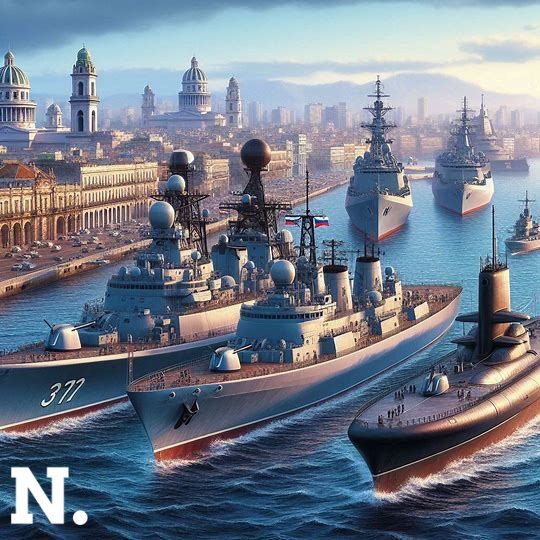

Tensions from the Cold War are recalled by the current gathering of US, Canadian, and Russian naval vessels in Cuba. Early on Friday, a patrol ship of the Canadian navy entered Havan. This occurred hours after the United States announced a fast-attack submarine docking at Guantanamo Bay. These movements follow Russian warships arriving in Cuba earlier in the week. Cuba, just 145 km south of Florida, is once again a focal point of international military activity.
The situation underscores ongoing friction between Russia and Western nations over the Ukraine conflict. Despite this, both the U.S. and Cuba claims that Russia’s warships pose no threat to the region. Russia also insists its naval presence in Cuba is routine.
Russian Warships in Havana
Russian warships arrived in Havana harbor on Wednesday. The group is led by Admiral Gorshkov frigate and the nuclear-powered submarine Kazan. These ships had just conducted missile weapons training in the Atlantic Ocean. Russia’s defense ministry confirmed the warships’ arrival and training activities. The Kazan, a nuclear-powered submarine, entered the harbor half-submerged with its crew on deck. Russia views this naval visit as a routine part of its military operations. However, the presence of these vessels in Cuba has drawn significant international attention. Moscow’s ties with Havana date back to the Soviet era. This relationship has persisted despite the end of the Cold War.
Canadian and U.S. Naval Visits
Canada’s Margaret Brooke patrol vessel arrived in Havana harbor early Friday. The Canadian Joint Operations Command described this as a port visit. They emphasized the long-standing bilateral relationship between Canada and Cuba. The Canadian diplomat in Havana also labeled the visit as routine. They stressed it was unrelated to the Russian ships’ presence. Hours earlier, the U.S. Southern Command announced the fast-attack submarine Helena’s arrival. The Helena docked at Guantanamo Bay, around 850 km southeast of Havana. The U.S. described the submarine’s visit as routine. However, Cuba’s foreign ministry expressed dissatisfaction with the U.S. submarine’s presence. Vice Foreign Minister Carlos Fernández de Cossío criticized the lack of invitation for the submarine’s visit. He highlighted the ongoing hostility between the U.S. and Cuba. Cuba has long-standing grievances with U.S. policies.
Historical Context and Future Implications
The recent naval activities in Cuba echo historical Cold War dynamics. Russia and Cuba were close allies during the Soviet Union era. The Cuban Missile Crisis of 1962 emphasises the peak of these tensions. Although the Cold War has ended, Moscow maintains strong ties with Havana. The arrival of Russian warships has sparked questions about Moscow’s intentions. Russian Foreign Ministry spokeswoman Maria Zakharova addressed these concerns. She criticized the West for ignoring diplomatic signals from Russia.
Zakharova emphasised that military activities often attract Western scrutiny. She argued that Russia’s diplomatic efforts often go unnoticed. The Russian warships are scheduled to remain in Havana harbor until Monday. This situation raises questions about future interactions between these nations.
Geopolitical Tensions
The recent naval movements in Cuba by Russian, Canadian, and U.S. vessels highlight significant geopolitical implications. Thus reflecting the complex interplay of international relations and power dynamics. The convergence of military assets from these nations in close proximity to U.S. rekindles memories of Cold War-era tensions. Hence, underlining the persistent strategic importance of the Caribbean region. Russia’s naval presence signals its ongoing support for Cuba. A longstanding ally, and serves as a demonstration of military capability and influence. Meanwhile, the Canadian and U.S. naval visits, framed as routine, reveal the delicate balance of power and the nuanced diplomatic interactions among Western nations and their adversaries. This maritime activity emphasises the enduring significance of Cuba in global geopolitics. Also illustrates the broader implications of military manoeuvres in projecting power, reassuring allies, and deterring potential adversaries in a volatile international landscape.
Conclusion
Currently, the naval movements in Cuba by Russian, Canadian, and U.S. vessels highlight ongoing international tensions. Despite claims of routine activities, the presence of these warships has significant geopolitical implications. The historical context of Cold War dynamics adds to the complexity of the situation. As these vessels continue their operations, the world watches closely. The actions of these nations in Cuba could have lasting impacts on international relations. The delicate balance of power and diplomacy remains a critical aspect of this unfolding narrative.