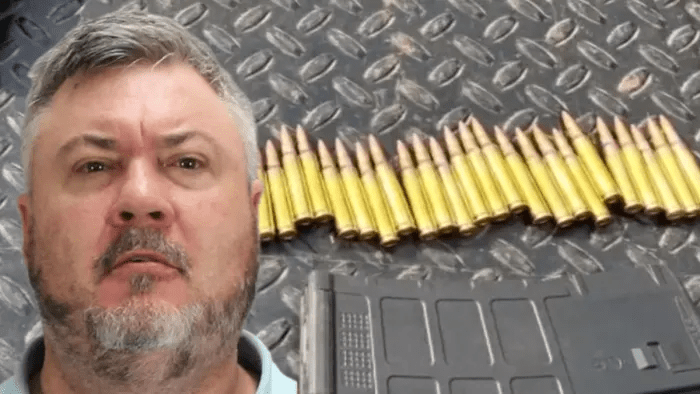

Authorities in Georgia have arrested Billy Joe Cagle, a 47-year-old man accused of planning a shooting at Hartsfield-Jackson Atlanta International Airport, one of the busiest airports in the world.
The arrest, which took place earlier this week, came just in time — police believe they stopped what could have been a major tragedy.
Cagle, who has a history of posting political messages and defending gun rights on social media, is now facing several serious charges, including terroristic threats, attempted aggravated assault, and possession of a firearm by a convicted felon.
The Arrest and What Police Found
According to officials, Billy Joe Cagle was detained after he was seen acting suspiciously near the TSA security checkpoint.
Police say he appeared “highly interested” in the area’s security layout and was later found carrying 27 rounds of ammunition in his vehicle.
After his arrest, officers searched his truck and discovered a Springfield AR-15 rifle loaded and ready to use.
Atlanta Police Chief Darin Schierbaum said in a press briefing that the suspect’s behavior raised immediate concern. “He appeared to be conducting surveillance,” Schierbaum explained. “Our officers made the decision to act swiftly, which may have prevented a potential attack.”
Investigators later confirmed that Cagle had live-streamed threats before arriving at the airport. His family, worried about his mental state and possible intentions, alerted law enforcement, a move that police say helped prevent what could have been “a devastating act of violence.”
The police department credited both the public and Cagle’s relatives for speaking up in time. “This case reminds us that when people see something concerning and report it, lives can be saved,” a spokesperson said.
A Trail of Social Media Posts
After his arrest, reporters reviewed Cagle’s Facebook history, revealing years of political and cultural posts.
He had frequently shared pro-Trump messages, including comments supporting the former president’s policies and criticizing mainstream media coverage.
In one 2021 post, written shortly after the January 6 Capitol riot, Cagle defended Trump, saying, “We don’t trust the news — Trump told everyone to be peaceful and patriotic.”
Between 2015 and 2016, Cagle also made several posts praising the Confederate flag, describing it as part of “Christian heritage.”
He once shared an image comparing the Confederate and American flags with the caption:
“Politically correct? Both these flags are American history, both established by the white race, both had slavery. One is being removed, the other walked on, burned, and disrespected.”
In another post, Cagle described himself as a responsible armed citizen who carried a concealed weapon to “protect others.”
He shared a viral message that read:
“I stand behind you in line at the store with a smile and a gun under my shirt — you are safer for having me next to you.”
At the time, those posts drew little public attention. However, investigators now say that his social-media activity, combined with his criminal record and access to weapons, paints a troubling picture.
As a convicted felon, Cagle was legally prohibited from owning firearms. Yet the AR-15 rifle recovered from his truck suggests he had continued to acquire and possess weapons.
Police confirmed that Cagle’s online statements will be part of the ongoing investigation, particularly the ones that appeared to glorify gun ownership and political violence.
Zach Bryan faces right-wing backlash over viral anti-ICE song — accused of betraying country roots
Preventing a Potential Tragedy
Authorities believe that Cagle’s family intervention played a key role in preventing harm. His relatives reportedly reached out to police after seeing his online videos, in which he made disturbing references to carrying out a shooting.
Within hours, law enforcement located and detained him at the Atlanta airport before he could return to his vehicle.
Investigators say the suspect had recorded a livestream expressing anger toward government officials, but they have not released the footage publicly.
So far, police have not found evidence that any other individuals were involved in the alleged plot.
The Atlanta Police Department, in coordination with federal agencies, is now conducting a deeper probe into Cagle’s motives, digital communications, and weapon sources. Officials also praised the quick action of officers stationed at the airport, noting that their rapid response “prevented loss of life.”
The Georgia Bureau of Investigation has also joined the case, confirming that the rifle and ammunition will undergo ballistic testing.
Authorities are reviewing whether Cagle had previously been under surveillance for firearm violations or extremist affiliations.
Residents of Atlanta have expressed relief that no one was injured. Many say the case underscores the importance of early reporting and digital monitoring.
Law enforcement officials used the opportunity to encourage citizens to report suspicious social media activity, especially when posts include threats or weapon references.
Meanwhile, Cagle remains in custody without bail. Court records show that he faces multiple felony charges, and prosecutors plan to pursue the case as a domestic terrorism investigation due to the nature of the alleged threats.
Police have not disclosed whether mental health evaluations will be part of the proceedings, but officials say the case demonstrates how ideological extremism, online rhetoric, and easy access to weapons can combine into a public safety threat.
The arrest of Billy Joe Cagle serves as a reminder of how social media posts can sometimes reveal dangerous intent long before a violent act occurs.
Authorities say that vigilance — from both law enforcement and the public — remains the most effective defense against such threats.