

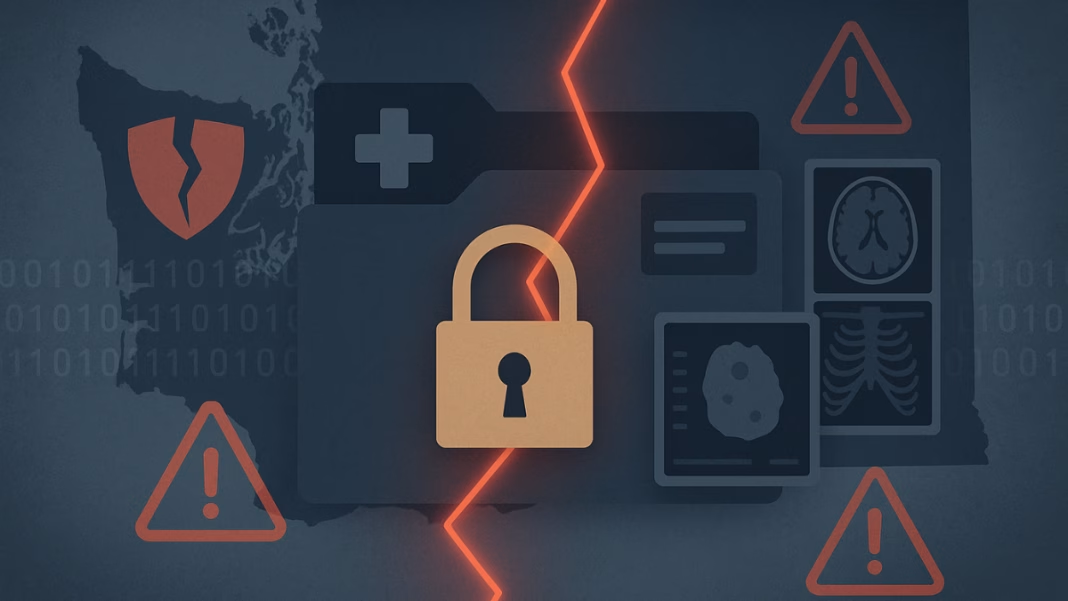
🔐 Massive Data Breach in Washington: 348,000 Medical Records Exposed in Cyber Attack on Mt. Baker Imaging

A large-scale cyber attack has compromised the private information of over 348,000 residents in Washington. The data breach took place between January 20 and January 25, targeting the computer systems of Mt. Baker Imaging and Northwest Radiologists. These companies provide diagnostic imaging services across six locations in Whatcom County.

Cyber Attack Hits Mt. Baker Imaging and Northwest Radiologists

Mt. Baker Imaging offers services such as MRIs, CT scans, X-rays, ultrasounds, and 3D mammograms. The imaging is interpreted by doctors at Northwest Radiologists.

During the cyber attack, hackers accessed personal details including names, home addresses, Social Security numbers, driver’s license numbers, military ID numbers, banking information, health insurance data, and confidential medical records.

Despite the breach occurring in January, the public remained unaware for nearly two months. The company briefly posted a notice on its website calling it a “computer network disruption” and said it was working with the FBI and private cybersecurity experts. That message has since been removed. Currently, there is no mention of the data breach on Mt. Baker Imaging’s website.

Company Delayed Reporting Despite State Rules

According to Washington State law, companies must notify the Attorney General within 30 days of discovering a data breach that affects more than 500 people. However, in this case, the Attorney General’s Office was notified only in July—nearly six months after the incident.

🔓 Australia’s political inboxes hacked — years of classified documents now in hacker hands

The law allows for an extension if the disclosure might interfere with an ongoing investigation, though no specific reason has been given for the delay.

Mt. Baker Imaging and Northwest Radiologists have said there is no proof that any of the stolen information has been misused. Still, this explanation hasn’t stopped legal consequences from unfolding.

A class action lawsuit has been filed in Whatcom County Superior Court. The lawsuit claims that the companies were negligent and failed to provide adequate security protections. It also says that their data systems were so poorly protected that hackers were able to steal highly sensitive patient information without much resistance.

The complaint accuses the medical providers of breaking both state and federal laws. It adds that patients may face ongoing harm from the breach, including financial loss, time spent managing the situation, stress, and emotional distress.

Cybersecurity Fears Grow as More Healthcare Providers Targeted

This data breach is not an isolated incident. Earlier this year, another cyber attack affected DaVita, a national dialysis care provider with centers in Bellingham, Ferndale, and Burlington. That breach impacted about 13,400 Washington residents. The attack was also reported to the Attorney General’s Office.

🧰 CISA Confirms: Microsoft Vulnerability Enables Remote Hijacking of Internal Networks

With the rise of cyber attacks on healthcare providers, more patient data is being put at risk. When medical and financial information is stolen, the consequences can be devastating and long-lasting. Victims of such attacks may have to deal with issues like identity theft, bank fraud, and emotional damage for years.

The growing number of healthcare-related cyber breaches has raised concerns among patients, lawmakers, and cybersecurity experts. Yet, companies continue to struggle with securing private data against evolving threats.
Renuka Bangale
Renuka Bangale
Renuka is a distinguished Chartered Accountant and a Certified Digital Threats Analyst from Riskpro, renowned for her expertise in cybersecurity. With a deep understanding of cybercrimes, malware, cyber warfare, and espionage, she has established herself as an authority in the field. Renuka combines her financial acumen with advanced knowledge of digital threats to provide unparalleled insights into the evolving landscape of information security. Her analytical prowess enables her to dissect complex cyber incidents, offering clarity on risks and mitigation strategies. As a key contributor to Newsinterpretation’s information security category, Renuka delivers authoritative articles that educate and inform readers about emerging threats and best practices.

TOP 10 TRENDING ON NEWSINTERPRETATION

Cyber Attacks on Space Infrastructure: Satellites, GPS and the Ground Systems Behind Them

From the Viasat KA-SAT hack to GPS jamming over the Baltic, a research guide to how attackers target satellites, navigation signals and ground stations, and why it matters on Earth.

How AI Agents Are Used in Cyber Attacks: From Assisted Hacking to AI-Orchestrated Espionage

Attackers now use AI agents to scan networks, write exploits and run extortion campaigns. A research guide to documented cases, including the first reported AI-orchestrated espionage campaign, and what defenders should do.

Cyber Attacks on AI and LLMs: How Attackers Target Large Language Models

Prompt injection, data poisoning, model theft and jailbreaks: a research guide to how attackers target AI systems and large language models, with real cases and defences.

French Supermarket Refrigeration Cyberattack: How Hacking the Cold Chain Can Endanger Lives

In October 2026 attackers heated refrigeration cabinets in hundreds of French supermarkets to as much as 50°C. No one was hurt, but the attack shows how hacking the cold chain can endanger lives through fire, food poisoning and spoiled medicines.

Cyberattacks on Nuclear Facilities: Stuxnet, Kudankulam and the Limits of Air Gaps

Stuxnet, the Davis-Besse worm and malware at India’s Kudankulam plant: what they show about cyber risk at nuclear facilities and the limits of air gaps.

Triton: When Hackers Target the Safety Systems That Prevent Industrial Disasters

The 2017 Triton attack targeted the safety systems that prevent industrial disasters. What happened, who was charged, and how plants protect their last line of defence.

Cybersecurity Risks in Smart Cities: When Connected Infrastructure Fails

How connecting traffic control, emergency alerts and utilities concentrates cyber risk in cities, what the Dallas and Atlanta incidents showed, and what governments recommend.

Weaponized Drones: Hijacking, GPS Spoofing and Emerging Cyber Warfare Risks

How drones can be hijacked, jammed or misled by GPS spoofing, what researchers have demonstrated, and why governments treat drone fleets as a security risk.

Ransomware Attacks on Hospitals: How Healthcare Cyberattacks Put Patients at Risk

How ransomware against hospitals and their suppliers delays care and endangers patients, what the Düsseldorf and WannaCry cases show, and what research says about deaths.

Operational blunder exposes massive Russian cyber espionage attack on Ukrainian prosecutors

A major cyberattack has compromised the email accounts of...

Cyber Attacks on Space Infrastructure: Satellites, GPS and the Ground Systems Behind Them

From the Viasat KA-SAT hack to GPS jamming over the Baltic, a research guide to how attackers target satellites, navigation signals and ground stations, and why it matters on Earth.

French Supermarket Refrigeration Cyberattack: How Hacking the Cold Chain Can Endanger Lives

In October 2026 attackers heated refrigeration cabinets in hundreds of French supermarkets to as much as 50°C. No one was hurt, but the attack shows how hacking the cold chain can endanger lives through fire, food poisoning and spoiled medicines.

Cyberattacks on Nuclear Facilities: Stuxnet, Kudankulam and the Limits of Air Gaps

Stuxnet, the Davis-Besse worm and malware at India’s Kudankulam plant: what they show about cyber risk at nuclear facilities and the limits of air gaps.

Triton: When Hackers Target the Safety Systems That Prevent Industrial Disasters

The 2017 Triton attack targeted the safety systems that prevent industrial disasters. What happened, who was charged, and how plants protect their last line of defence.

Cybersecurity Risks in Smart Cities: When Connected Infrastructure Fails

How connecting traffic control, emergency alerts and utilities concentrates cyber risk in cities, what the Dallas and Atlanta incidents showed, and what governments recommend.

Ransomware Attacks on Hospitals: How Healthcare Cyberattacks Put Patients at Risk

How ransomware against hospitals and their suppliers delays care and endangers patients, what the Düsseldorf and WannaCry cases show, and what research says about deaths.

FBI warns of AVrecon malware targeting outdated routers linked to proxy based cybercrime

A serious cybersecurity warning has been issued regarding commonly...

Related Articles

Popular Categories
