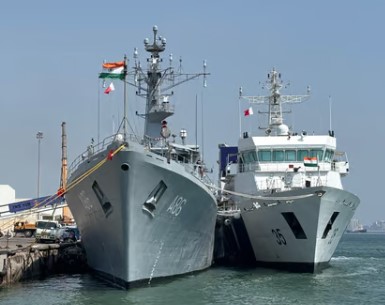

Strengthening Maritime Security: Indian Navy’s Deployment in Bahrain
The Indian Coast Guard Ship (ICGS) Veera and the Indian Naval Ship (INS) Tir have arrived at the Port of Manama, Bahrain, in a major step to increase maritime security in the Persian Gulf. This visit is part of a long-range training deployment that includes several countries and aims to enhance naval cooperation among nations. The First Training Squadron (1TS), which consists of these ships, emphasizes the importance of teamwork and best practices in maritime operations, reflecting the Indian Navy’s commitment to strengthening partnerships in the region. The Indian Navy’s presence in Bahrain underscores its dedication to collaborative efforts in ensuring maritime safety and security.
The Indian Navy has stated that this visit is focused on improving collaboration and interoperability with the Royal Bahrain Naval Forces (RBNF). Various activities are planned during the ships’ stay, which will foster professional interactions and exchanges. These include cross-ship visits, joint training sessions, yoga activities, band concerts, and friendly sports fixtures. Such events provide an opportunity for personnel from both navies to engage socially and professionally, building strong bonds through community welfare activities.
Additionally, the Indian Navy trainees will have the chance to visit various training facilities of the RBNF. This engagement is vital as it allows the trainees to learn and experience new skills that will be beneficial in their naval careers. A coordination meeting between operational teams from both navies is also on the agenda. This meeting will help plan a Maritime Partnership Exercise, which is crucial for strengthening ties between the two countries’ naval forces.
Engaging with the UAE and Indian Navy’s Role in Regional Security
Alongside the visit to Bahrain, the INS Shardul of the First Training Squadron has docked at Port Rashid in Dubai, UAE. Numerous training exercises and harbor contacts with the UAE Navy are planned during this visit. The presence of the 1TS in Bahrain and the UAE serves a dual purpose: it provides valuable training opportunities for sea trainees while also strengthening socio-political and military connections between the countries.
The naval deployment is a reflection of the growing defense relationships between India, Bahrain, and the UAE. It underscores the commitment to enhancing maritime security and cooperation among navies. Prior to visiting Bahrain and the UAE, the ships also stopped in Muscat, Oman, on October 5, 2024. This visit is significant as it marks the third time in ten years that the First Training Squadron has visited Oman, reinforcing existing defense relationships and promoting joint exercises focused on maritime security.
The ships of 1TS had earlier called at Bandar Abbas, Iran, where they engaged in activities aimed at strengthening maritime cooperation with the Iranian Navy. The Indian Navy highlighted that this visit plays a vital role in promoting mutual understanding and fostering collaborative efforts in the region. During the stay, the ships participated in professional exchanges, cross-training visits, and various friendly sports activities.
The Importance of Maritime Security and the Indian Navy’s Commitment
The region around the Persian Gulf and the Strait of Hormuz is strategically crucial for global trade and maritime security. With many merchant vessels passing through these waters, ensuring safety and security has become paramount. The Indian Navy has been proactive in addressing potential threats, especially in light of increasing maritime security incidents in shipping lanes such as the Red Sea, Gulf of Aden, and the Arabian Sea.
In December 2023, the Indian Navy significantly increased its maritime surveillance efforts in the Central and North Arabian Sea, deploying around 12 warships to enhance the naval presence in the region. This deployment aligns with the Indian Navy’s Mission Based Deployments, initiated in 2008, aimed at establishing a continuous naval presence across key maritime routes. Such measures enable India to respond quickly to emergencies and provide assistance to both Indian and international vessels navigating these critical waters.
The ongoing long-range training deployment of the First Training Squadron is a vital step in reinforcing India’s role as a responsible maritime power. It showcases the Indian Navy’s commitment to regional cooperation, ensuring the safety of international shipping lanes while fostering strong partnerships with other nations’ navies. As the deployment continues, the Indian Navy remains focused on enhancing operational capabilities, promoting peace, and strengthening maritime security in the Persian Gulf and beyond.