

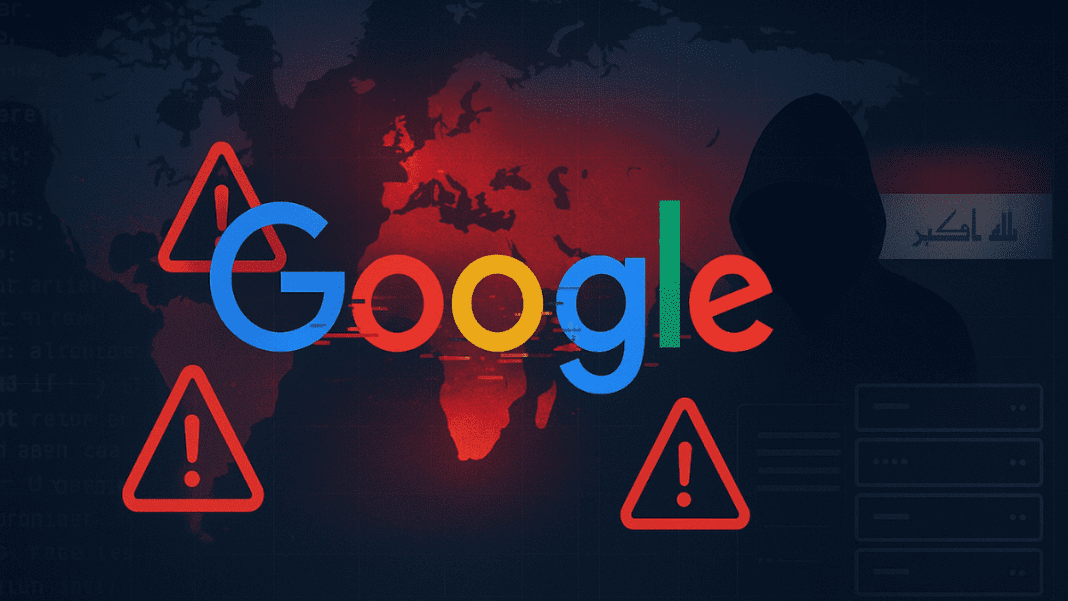
Google services falter in dozens of countries; Iran-linked Iraqi hackers claim responsibility

On the morning of September 4, 2025, millions of people around the world faced a sudden problem. Google services, including Gmail, YouTube, and the main search engine, went offline in many countries.

Google Services Hit Across Dozens of Countries

The outage stretched from Turkey and Southeast Europe to parts of Ukraine, Russia, Western Europe, and even U.S. cities like New York and Chicago.

Google confirmed that it had received a surge of outage reports. The company listed problems across Turkey, Bulgaria, Greece, Georgia, Croatia, Romania, Armenia, Serbia, Germany, the Netherlands, and more than 50 other countries. The issue was described as ongoing at the time. However, Google has not officially explained the cause of the disruption.

For many users, this outage created real difficulties. Students could not access study materials, businesses were unable to use Google’s tools, and millions could not reach their Gmail accounts. Videos on YouTube stopped loading, and Google Search returned errors.

Hacking Group Posts Video Claiming Attack

Just a short time after the outage began, an Iran-backed Iraqi hacking group came forward with a bold claim. At 7:58 AM UTC, the group announced on social media that it had attacked Google’s servers. According to their statement, this caused “paralysis of the search engine.”

The hackers posted a 44-second video as supposed proof. The video showed someone typing the group’s name into Google Search, which led to an ERR_CONNECTION_CLOSED error message. In contrast, Yahoo’s search engine worked normally in the clip.

How Cyber Attacks on Industrial Control Systems Can Endanger Lives ?

Alongside this video, the group declared responsibility for the disruption. They said they accepted “full liability for all damages caused to Google” during what they described as the “very first minutes of our operation.”

The group also shared outage maps, including screenshots from Downdetector and Google’s own outage map. These images highlighted service interruptions in Eastern European countries, parts of the Middle East, and areas in the United States.

Claims Under Question but Impact Remains Clear

Despite the bold declaration, the group’s video does not prove that its attack caused the outage. The clip only shows that Google services were unavailable in some regions, something already widely reported by users at the time. Security experts often note that internet outages can be caused by many issues, including technical failures, misconfigurations, or broader cyberattacks.

Google has not confirmed any link between the outage and the hacking group’s claims. The company has only acknowledged the widespread problem and the reports flooding in from dozens of countries.

Bridgestone Hit by Suspicious Cyberattack as Operations Disrupted in US and Canada

Still, the impact of the outage was impossible to ignore. The disruption was visible on Downdetector, which showed massive spikes in user complaints. From Europe to the Middle East and across parts of the U.S., users were left frustrated as key Google services failed to load.

While the hacking group took a public victory lap, many observers noted that their statement lacked clear technical evidence. Without Google’s own confirmation, their role in the outage remains uncertain.

For ordinary users, however, the cause mattered less than the effect. Millions were locked out of essential online tools, showing just how deeply Google services are woven into daily life across the globe.

Renuka Bangale
Renuka Bangale
Renuka is a distinguished Chartered Accountant and a Certified Digital Threats Analyst from Riskpro, renowned for her expertise in cybersecurity. With a deep understanding of cybercrimes, malware, cyber warfare, and espionage, she has established herself as an authority in the field. Renuka combines her financial acumen with advanced knowledge of digital threats to provide unparalleled insights into the evolving landscape of information security. Her analytical prowess enables her to dissect complex cyber incidents, offering clarity on risks and mitigation strategies. As a key contributor to Newsinterpretation’s information security category, Renuka delivers authoritative articles that educate and inform readers about emerging threats and best practices.

TOP 10 TRENDING ON NEWSINTERPRETATION

Cyber Attacks on Space Infrastructure: Satellites, GPS and the Ground Systems Behind Them

From the Viasat KA-SAT hack to GPS jamming over the Baltic, a research guide to how attackers target satellites, navigation signals and ground stations, and why it matters on Earth.

How AI Agents Are Used in Cyber Attacks: From Assisted Hacking to AI-Orchestrated Espionage

Attackers now use AI agents to scan networks, write exploits and run extortion campaigns. A research guide to documented cases, including the first reported AI-orchestrated espionage campaign, and what defenders should do.

Cyber Attacks on AI and LLMs: How Attackers Target Large Language Models

Prompt injection, data poisoning, model theft and jailbreaks: a research guide to how attackers target AI systems and large language models, with real cases and defences.

French Supermarket Refrigeration Cyberattack: How Hacking the Cold Chain Can Endanger Lives

In October 2026 attackers heated refrigeration cabinets in hundreds of French supermarkets to as much as 50°C. No one was hurt, but the attack shows how hacking the cold chain can endanger lives through fire, food poisoning and spoiled medicines.

Cyberattacks on Nuclear Facilities: Stuxnet, Kudankulam and the Limits of Air Gaps

Stuxnet, the Davis-Besse worm and malware at India’s Kudankulam plant: what they show about cyber risk at nuclear facilities and the limits of air gaps.

Triton: When Hackers Target the Safety Systems That Prevent Industrial Disasters

The 2017 Triton attack targeted the safety systems that prevent industrial disasters. What happened, who was charged, and how plants protect their last line of defence.

Cybersecurity Risks in Smart Cities: When Connected Infrastructure Fails

How connecting traffic control, emergency alerts and utilities concentrates cyber risk in cities, what the Dallas and Atlanta incidents showed, and what governments recommend.

Weaponized Drones: Hijacking, GPS Spoofing and Emerging Cyber Warfare Risks

How drones can be hijacked, jammed or misled by GPS spoofing, what researchers have demonstrated, and why governments treat drone fleets as a security risk.

Ransomware Attacks on Hospitals: How Healthcare Cyberattacks Put Patients at Risk

How ransomware against hospitals and their suppliers delays care and endangers patients, what the Düsseldorf and WannaCry cases show, and what research says about deaths.

Operational blunder exposes massive Russian cyber espionage attack on Ukrainian prosecutors

A major cyberattack has compromised the email accounts of...

Cyber Attacks on Space Infrastructure: Satellites, GPS and the Ground Systems Behind Them

From the Viasat KA-SAT hack to GPS jamming over the Baltic, a research guide to how attackers target satellites, navigation signals and ground stations, and why it matters on Earth.

French Supermarket Refrigeration Cyberattack: How Hacking the Cold Chain Can Endanger Lives

In October 2026 attackers heated refrigeration cabinets in hundreds of French supermarkets to as much as 50°C. No one was hurt, but the attack shows how hacking the cold chain can endanger lives through fire, food poisoning and spoiled medicines.

Cyberattacks on Nuclear Facilities: Stuxnet, Kudankulam and the Limits of Air Gaps

Stuxnet, the Davis-Besse worm and malware at India’s Kudankulam plant: what they show about cyber risk at nuclear facilities and the limits of air gaps.

Triton: When Hackers Target the Safety Systems That Prevent Industrial Disasters

The 2017 Triton attack targeted the safety systems that prevent industrial disasters. What happened, who was charged, and how plants protect their last line of defence.

Cybersecurity Risks in Smart Cities: When Connected Infrastructure Fails

How connecting traffic control, emergency alerts and utilities concentrates cyber risk in cities, what the Dallas and Atlanta incidents showed, and what governments recommend.

Ransomware Attacks on Hospitals: How Healthcare Cyberattacks Put Patients at Risk

How ransomware against hospitals and their suppliers delays care and endangers patients, what the Düsseldorf and WannaCry cases show, and what research says about deaths.

FBI warns of AVrecon malware targeting outdated routers linked to proxy based cybercrime

A serious cybersecurity warning has been issued regarding commonly...

Related Articles

Popular Categories
