

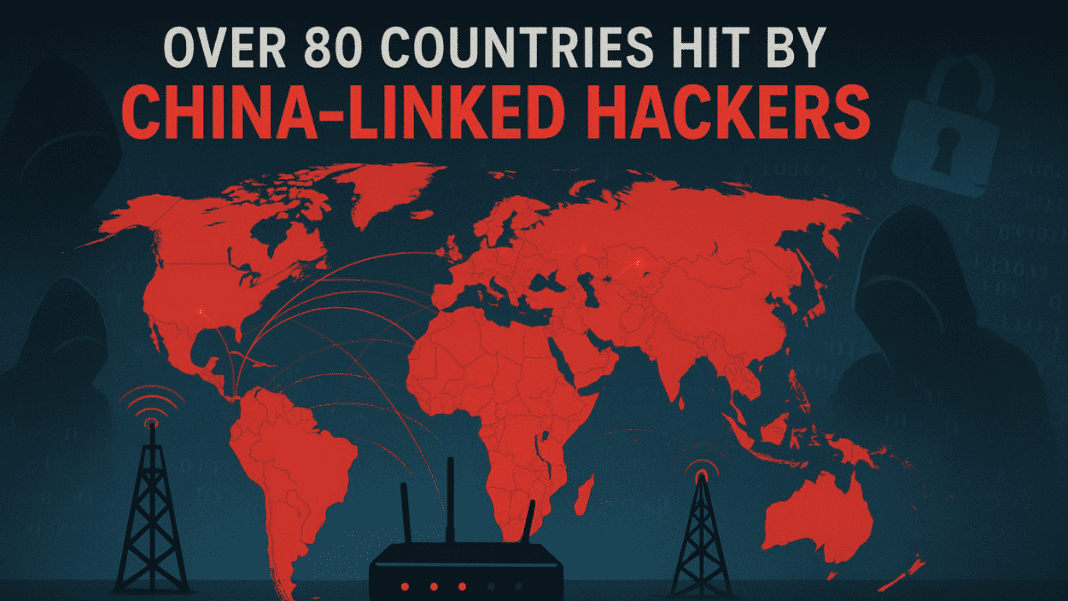
CISA warns China-linked hacking group continues long-running campaign against 80 countries

A secret cyber operation has been running for years without most people knowing. Since at least 2019, hackers linked to China have been breaking into networks around the world. Their main targets were telecom companies.

A Silent Hack That Lasted for Years

By breaking into routers and core systems, they gained the power to see and hear private communications.

This allowed the hackers to steal personal data, track calls and texts, and even follow the movements of people across countries. They also reached into sensitive areas like court-approved wiretaps. Experts say this was not a quick smash-and-grab. Instead, it was a patient and careful campaign that went deep into infrastructure.

What makes this more alarming is how widespread the impact is. More than 80 countries were hit, covering not just phone networks but also government agencies, transport systems, hotels, and even parts of military infrastructure. Millions of ordinary people may have been caught up in the attack without ever realizing it.

High-Profile Targets and U.S. Telecom Breaches

The hackers did not stop at everyday citizens. They also went after top leaders in the United States. Phones used during the 2024 election campaign were hacked through a major telecom provider’s system. Investigators later confirmed that this attack exposed calls, texts, and location data of not just the direct victims but also everyone who communicated with them.

Bridgestone Hit by Suspicious Cyberattack as Operations Disrupted in US and Canada

This means the ripple effect could reach millions of people. If one person was hacked, all their contacts became vulnerable too.

Telecom giants in the U.S., including Verizon, AT&T, and T-Mobile, were among those breached. These networks carry massive amounts of daily communication, which means the hackers may have had access to conversations and movements across the country. Investigators described the breach as one of the most serious cyber espionage cases in U.S. history.

Global Scale and Official Reactions

The cyber group behind the attack is known as Salt Typhoon. It has been linked to Chinese intelligence services and works through companies that provide hacking tools. However, Chinese officials denied any involvement and claimed they oppose all forms of cybercrime.

Authorities in the United States and other nations began piecing together the scale of the breach in 2024. The FBI first spotted the attacks after noticing suspicious activity around hacked phones. Soon after, government agencies across more than 20 countries released a joint warning confirming that the campaign had spread worldwide.

How Cyber Attacks on Industrial Control Systems Can Endanger Lives ?

In May 2025, lawmakers in the U.S. urged the Homeland Security Department to restore a cyber safety board that had been disbanded earlier in the year. They argued that such oversight is needed to investigate and prevent more breaches. By late August 2025, the U.S. Cybersecurity and Infrastructure Security Agency (CISA) issued a public warning that the campaign was still ongoing.

Experts have called the attack the worst telecom hack in American history. They say it marks a shift from earlier cyber thefts of trade secrets to deeper and more dangerous attempts to control the systems that keep global communications running.
Renuka Bangale
Renuka Bangale
Renuka is a distinguished Chartered Accountant and a Certified Digital Threats Analyst from Riskpro, renowned for her expertise in cybersecurity. With a deep understanding of cybercrimes, malware, cyber warfare, and espionage, she has established herself as an authority in the field. Renuka combines her financial acumen with advanced knowledge of digital threats to provide unparalleled insights into the evolving landscape of information security. Her analytical prowess enables her to dissect complex cyber incidents, offering clarity on risks and mitigation strategies. As a key contributor to Newsinterpretation’s information security category, Renuka delivers authoritative articles that educate and inform readers about emerging threats and best practices.

TOP 10 TRENDING ON NEWSINTERPRETATION

Cyber Attacks on Space Infrastructure: Satellites, GPS and the Ground Systems Behind Them

From the Viasat KA-SAT hack to GPS jamming over the Baltic, a research guide to how attackers target satellites, navigation signals and ground stations, and why it matters on Earth.

How AI Agents Are Used in Cyber Attacks: From Assisted Hacking to AI-Orchestrated Espionage

Attackers now use AI agents to scan networks, write exploits and run extortion campaigns. A research guide to documented cases, including the first reported AI-orchestrated espionage campaign, and what defenders should do.

Cyber Attacks on AI and LLMs: How Attackers Target Large Language Models

Prompt injection, data poisoning, model theft and jailbreaks: a research guide to how attackers target AI systems and large language models, with real cases and defences.

French Supermarket Refrigeration Cyberattack: How Hacking the Cold Chain Can Endanger Lives

In October 2026 attackers heated refrigeration cabinets in hundreds of French supermarkets to as much as 50°C. No one was hurt, but the attack shows how hacking the cold chain can endanger lives through fire, food poisoning and spoiled medicines.

Cyberattacks on Nuclear Facilities: Stuxnet, Kudankulam and the Limits of Air Gaps

Stuxnet, the Davis-Besse worm and malware at India’s Kudankulam plant: what they show about cyber risk at nuclear facilities and the limits of air gaps.

Triton: When Hackers Target the Safety Systems That Prevent Industrial Disasters

The 2017 Triton attack targeted the safety systems that prevent industrial disasters. What happened, who was charged, and how plants protect their last line of defence.

Cybersecurity Risks in Smart Cities: When Connected Infrastructure Fails

How connecting traffic control, emergency alerts and utilities concentrates cyber risk in cities, what the Dallas and Atlanta incidents showed, and what governments recommend.

Weaponized Drones: Hijacking, GPS Spoofing and Emerging Cyber Warfare Risks

How drones can be hijacked, jammed or misled by GPS spoofing, what researchers have demonstrated, and why governments treat drone fleets as a security risk.

Ransomware Attacks on Hospitals: How Healthcare Cyberattacks Put Patients at Risk

How ransomware against hospitals and their suppliers delays care and endangers patients, what the Düsseldorf and WannaCry cases show, and what research says about deaths.

Operational blunder exposes massive Russian cyber espionage attack on Ukrainian prosecutors

A major cyberattack has compromised the email accounts of...

Cyber Attacks on Space Infrastructure: Satellites, GPS and the Ground Systems Behind Them

From the Viasat KA-SAT hack to GPS jamming over the Baltic, a research guide to how attackers target satellites, navigation signals and ground stations, and why it matters on Earth.

French Supermarket Refrigeration Cyberattack: How Hacking the Cold Chain Can Endanger Lives

In October 2026 attackers heated refrigeration cabinets in hundreds of French supermarkets to as much as 50°C. No one was hurt, but the attack shows how hacking the cold chain can endanger lives through fire, food poisoning and spoiled medicines.

Cyberattacks on Nuclear Facilities: Stuxnet, Kudankulam and the Limits of Air Gaps

Stuxnet, the Davis-Besse worm and malware at India’s Kudankulam plant: what they show about cyber risk at nuclear facilities and the limits of air gaps.

Triton: When Hackers Target the Safety Systems That Prevent Industrial Disasters

The 2017 Triton attack targeted the safety systems that prevent industrial disasters. What happened, who was charged, and how plants protect their last line of defence.

Cybersecurity Risks in Smart Cities: When Connected Infrastructure Fails

How connecting traffic control, emergency alerts and utilities concentrates cyber risk in cities, what the Dallas and Atlanta incidents showed, and what governments recommend.

Ransomware Attacks on Hospitals: How Healthcare Cyberattacks Put Patients at Risk

How ransomware against hospitals and their suppliers delays care and endangers patients, what the Düsseldorf and WannaCry cases show, and what research says about deaths.

FBI warns of AVrecon malware targeting outdated routers linked to proxy based cybercrime

A serious cybersecurity warning has been issued regarding commonly...

Related Articles

Popular Categories