

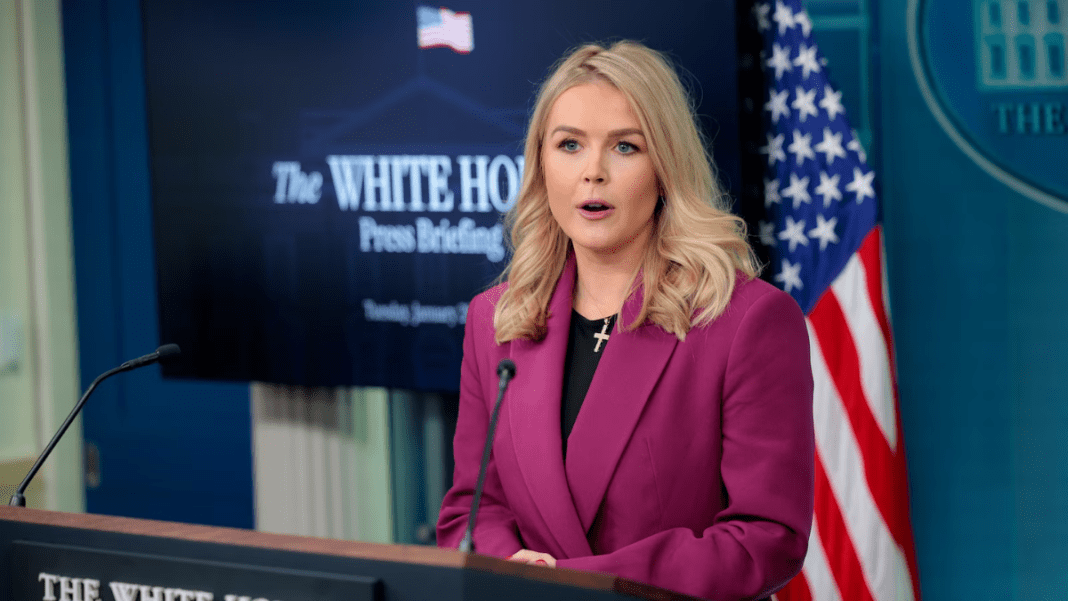
Karoline Leavitt shares post linking Utah earthquake to Charlie Kirk death timing

Earthquake in Utah Sparks Unusual Claim

Karoline Leavitt, press secretary for Donald Trump, drew attention this week after she reposted a message linking an earthquake in Utah to the death of Charlie Kirk.

The earthquake, confirmed by the University of Utah Seismograph Stations, measured 4.1 on the Richter scale. It struck at 5:57 p.m. local time on September 10, the same night Kirk was shot and killed at Utah Valley University. The epicenter was about 150 miles away from the campus.

The original post, which appeared on X and was later shared by Leavitt on her Instagram Story, pointed to the timing of the quake. It noted that 5:57 p.m. in Utah matched 7:57 p.m. eastern time.

The message then drew a parallel with Acts 7:57 in the Bible, which describes Saint Stephen, the first Christian martyr, being stoned to death as a crowd tried to silence him. The post added that scripture often says the earth trembles when God is angry.

Leavitt did not offer any further explanation but simply added the word “Wow” when she reshared the message.

Previous Posts Linking Events to Faith

The earthquake post was not the first time Karoline Leavitt highlighted messages tying tragic events to divine or spiritual meaning.

Just weeks before, following the deaths of two children in a Minneapolis church shooting, Leavitt shared another post on Instagram. That message, originally from a conservative lifestyle magazine, claimed a “demonic force” was behind the violence. It argued that political leaders and lawmakers were wrong to focus on issues like the Second Amendment or discrimination, and instead suggested the act was driven by evil.

Leavitt has consistently framed her role in politics as guided by faith. She studied at a Catholic university but often attends non-denominational churches now. She frequently wears a cross necklace, visible during many of her press briefings.

Stadiums fall silent as NFL, MLB, college football, and UFC remember Charlie Kirk

In interviews, she has described the Trump administration as engaged in a “spiritual battle” against evil forces. Speaking to the Christian Broadcasting Network earlier this year, she credited God with protecting Donald Trump during the assassination attempt in Butler, Pennsylvania, in July 2024. She said she believed he survived “for a reason” and that God placed him in this moment of history.

Leavitt also revealed that her team prays before each press briefing. She said the group uses that time to ask for confidence, clarity, and protection before addressing the press. She described it as a way to reset and focus on their mission.

Symbolism of Numbers and Scripture

The Utah earthquake post that Leavitt shared relied on biblical symbolism to make its point. The original author argued that in scripture, the number 40 represents trials, while 41 signifies a shift or new phase. Because the earthquake measured 4.1, the post implied this was no coincidence.

It also pointed to Acts 7:57 as a direct link to the time of the quake. In that verse, an angry crowd drags out Saint Stephen and stones him after he testifies to his faith. The post drew a parallel, saying that just as the crowd silenced Stephen’s voice, so too was Charlie Kirk’s silenced on the night of his death.   The message added that the earth “groaned” as a sign of divine anger.

Leavitt has not commented further on her repost beyond her brief reaction. Still, her decision to share it added to her pattern of highlighting religious or spiritual explanations for real-world tragedies.

Mary Kirk, once unknown as Charlie Kirk’s sister, now stands with Bernie Sanders’ progressive movement

This approach has attracted attention both from supporters who admire her devotion and from critics who see the connections as unusual. Yet for Leavitt, her faith remains a public and visible part of her identity.

Her religious perspective has also surfaced in political settings. Senator John Kennedy of Louisiana questioned FBI director Kash Patel about Jeffrey Epstein case files during a Senate Judiciary Committee hearing earlier this week.

For Leavitt, the combination of public service, politics, and faith appears inseparable. Whether commenting on natural events like earthquakes, violent incidents at churches, or the survival of Donald Trump, she continues to frame them within the context of a larger spiritual struggle.


Renuka Bangale
Renuka Bangale
Renuka is a distinguished Chartered Accountant and a Certified Digital Threats Analyst from Riskpro, renowned for her expertise in cybersecurity. With a deep understanding of cybercrimes, malware, cyber warfare, and espionage, she has established herself as an authority in the field. Renuka combines her financial acumen with advanced knowledge of digital threats to provide unparalleled insights into the evolving landscape of information security. Her analytical prowess enables her to dissect complex cyber incidents, offering clarity on risks and mitigation strategies. As a key contributor to Newsinterpretation’s information security category, Renuka delivers authoritative articles that educate and inform readers about emerging threats and best practices.

TOP 10 TRENDING ON NEWSINTERPRETATION

Cyber Attacks on Space Infrastructure: Satellites, GPS and the Ground Systems Behind Them

From the Viasat KA-SAT hack to GPS jamming over the Baltic, a research guide to how attackers target satellites, navigation signals and ground stations, and why it matters on Earth.

How AI Agents Are Used in Cyber Attacks: From Assisted Hacking to AI-Orchestrated Espionage

Attackers now use AI agents to scan networks, write exploits and run extortion campaigns. A research guide to documented cases, including the first reported AI-orchestrated espionage campaign, and what defenders should do.

Cyber Attacks on AI and LLMs: How Attackers Target Large Language Models

Prompt injection, data poisoning, model theft and jailbreaks: a research guide to how attackers target AI systems and large language models, with real cases and defences.

French Supermarket Refrigeration Cyberattack: How Hacking the Cold Chain Can Endanger Lives

In October 2026 attackers heated refrigeration cabinets in hundreds of French supermarkets to as much as 50°C. No one was hurt, but the attack shows how hacking the cold chain can endanger lives through fire, food poisoning and spoiled medicines.

Cyberattacks on Nuclear Facilities: Stuxnet, Kudankulam and the Limits of Air Gaps

Stuxnet, the Davis-Besse worm and malware at India’s Kudankulam plant: what they show about cyber risk at nuclear facilities and the limits of air gaps.

Triton: When Hackers Target the Safety Systems That Prevent Industrial Disasters

The 2017 Triton attack targeted the safety systems that prevent industrial disasters. What happened, who was charged, and how plants protect their last line of defence.

Cybersecurity Risks in Smart Cities: When Connected Infrastructure Fails

How connecting traffic control, emergency alerts and utilities concentrates cyber risk in cities, what the Dallas and Atlanta incidents showed, and what governments recommend.

Weaponized Drones: Hijacking, GPS Spoofing and Emerging Cyber Warfare Risks

How drones can be hijacked, jammed or misled by GPS spoofing, what researchers have demonstrated, and why governments treat drone fleets as a security risk.

Ransomware Attacks on Hospitals: How Healthcare Cyberattacks Put Patients at Risk

How ransomware against hospitals and their suppliers delays care and endangers patients, what the Düsseldorf and WannaCry cases show, and what research says about deaths.

Operational blunder exposes massive Russian cyber espionage attack on Ukrainian prosecutors

A major cyberattack has compromised the email accounts of...

Cyber Attacks on Space Infrastructure: Satellites, GPS and the Ground Systems Behind Them

From the Viasat KA-SAT hack to GPS jamming over the Baltic, a research guide to how attackers target satellites, navigation signals and ground stations, and why it matters on Earth.

French Supermarket Refrigeration Cyberattack: How Hacking the Cold Chain Can Endanger Lives

In October 2026 attackers heated refrigeration cabinets in hundreds of French supermarkets to as much as 50°C. No one was hurt, but the attack shows how hacking the cold chain can endanger lives through fire, food poisoning and spoiled medicines.

Cyberattacks on Nuclear Facilities: Stuxnet, Kudankulam and the Limits of Air Gaps

Stuxnet, the Davis-Besse worm and malware at India’s Kudankulam plant: what they show about cyber risk at nuclear facilities and the limits of air gaps.

Triton: When Hackers Target the Safety Systems That Prevent Industrial Disasters

The 2017 Triton attack targeted the safety systems that prevent industrial disasters. What happened, who was charged, and how plants protect their last line of defence.

Cybersecurity Risks in Smart Cities: When Connected Infrastructure Fails

How connecting traffic control, emergency alerts and utilities concentrates cyber risk in cities, what the Dallas and Atlanta incidents showed, and what governments recommend.

Ransomware Attacks on Hospitals: How Healthcare Cyberattacks Put Patients at Risk

How ransomware against hospitals and their suppliers delays care and endangers patients, what the Düsseldorf and WannaCry cases show, and what research says about deaths.

FBI warns of AVrecon malware targeting outdated routers linked to proxy based cybercrime

A serious cybersecurity warning has been issued regarding commonly...

Related Articles

Popular Categories
