

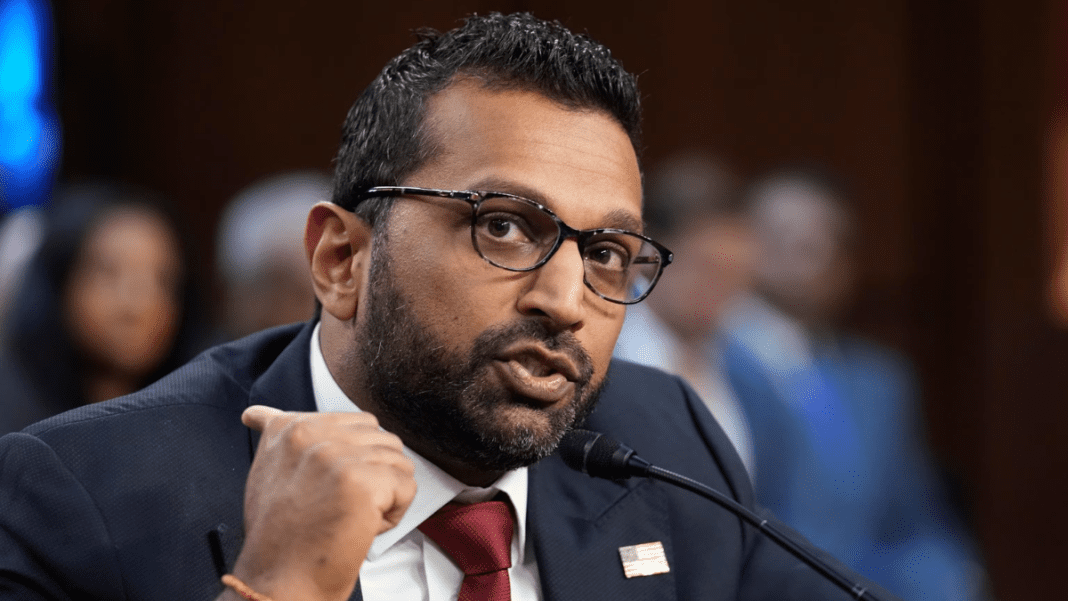
Jet-setting scandal: FBI chief Kash Patel accused of using government plane to watch girlfriend’s concert at wrestling event

A recent report has caused a stir after it claimed that FBI Director Kash Patel used a government jet to watch his girlfriend, country singer Alexis Wilkins, perform at a wrestling event. The trip reportedly took place at Pennsylvania State University during the weekend.

Flight records show that a jet registered to the Department of Justice flew from Manassas Regional Airport in Virginia to State College, Pennsylvania, on October 25. The flight lasted about 40 minutes. Two and a half hours later, the same aircraft departed for Nashville, Tennessee, where Wilkins lives.

Photos posted online showed Patel and Wilkins attending the Real American Freestyle wrestling show, an unscripted wrestling event co-founded by the late wrestling legend Hulk Hogan. The images quickly spread online, prompting questions about how Patel traveled to the event and whether his trip was official or personal.

Why the Jet’s Use Raised Eyebrows

Government planes like the one Patel used are not regular aircraft. They are fitted with secure communication systems that allow top officials to stay connected during emergencies. Because of this, the FBI director is required to use a government plane for all travel — official or personal — to ensure secure communication at all times.

Kash Patel’s hearing exposes decades-old investigative failures that shielded Epstein from scrutiny

However, the rule also requires that when the trip is personal, the director must reimburse the government for the cost of a normal commercial ticket. The policy is designed to prevent taxpayer money from being used for personal trips.

In recent months, Patel has faced criticism from lawmakers who accuse him of overusing government jets for private reasons. Reports have linked several flights to visits with Wilkins in Nashville or to sporting events. Some of these trips included short work stops, such as visiting local FBI offices, which may have allowed them to be listed as official travel.

Critics argue that this pattern blurs the line between official duty and personal convenience. They question whether taxpayers are indirectly paying for personal outings under the cover of business travel.

Questions of Judgment and Accountability

In response to earlier questions about his travel habits, Kash Patel has said that he is following the rules Congress established. He explained that the FBI director cannot use commercial flights because of the need for secure communications at all times. Patel also stated that he reimburses the government when a trip has a personal purpose.

Despite that, the issue has remained controversial. Patel himself previously criticized former FBI Director Christopher Wray for what he described as excessive personal use of a government jet. He said at the time that such trips were an abuse of taxpayer funds. Those comments have now resurfaced online, with many observers pointing out the irony in the current situation.

Trump’s 18-year-old granddaughter Kai Trump gets LPGA invite — no top-20 finishes, just a famous last name?

Growing Public Scrutiny

The Penn State trip has intensified the debate. According to reports, there was no official FBI business scheduled at the university during Patel’s visit. It appears the main reason for his travel was to attend the wrestling event and watch Alexis Wilkins perform. No passenger list for the government jet has been released, and the FBI has not yet commented on the report.

Even if Patel reimbursed the government for the flight, critics say the optics remain troubling. A senior law enforcement leader using a taxpayer-funded aircraft for a personal engagement can raise concerns about accountability and judgment.

The story has spread widely online, with many discussing whether the trip shows poor decision-making or simply an example of how rigid travel rules for top officials can create awkward situations. The report has once again brought attention to how senior government figures use public resources and how closely their actions are watched by the public.

At the moment, it remains unclear whether Patel conducted any official duties during the trip. What is clear is that the short flight to Pennsylvania — and the attention it drew — has turned into another public debate over ethics, responsibility, and how government officials balance personal life with public duty.


T U Deshmukh
T U Deshmukh
T U Deshmukh is the leading voice on the subject of Jobs, AI, Data and layoffs and she regularly contributes a column on Jobs for Newsinterpretation.

TOP 10 TRENDING ON NEWSINTERPRETATION

Cyber Attacks on Space Infrastructure: Satellites, GPS and the Ground Systems Behind Them

From the Viasat KA-SAT hack to GPS jamming over the Baltic, a research guide to how attackers target satellites, navigation signals and ground stations, and why it matters on Earth.

How AI Agents Are Used in Cyber Attacks: From Assisted Hacking to AI-Orchestrated Espionage

Attackers now use AI agents to scan networks, write exploits and run extortion campaigns. A research guide to documented cases, including the first reported AI-orchestrated espionage campaign, and what defenders should do.

Cyber Attacks on AI and LLMs: How Attackers Target Large Language Models

Prompt injection, data poisoning, model theft and jailbreaks: a research guide to how attackers target AI systems and large language models, with real cases and defences.

French Supermarket Refrigeration Cyberattack: How Hacking the Cold Chain Can Endanger Lives

In October 2026 attackers heated refrigeration cabinets in hundreds of French supermarkets to as much as 50°C. No one was hurt, but the attack shows how hacking the cold chain can endanger lives through fire, food poisoning and spoiled medicines.

Cyberattacks on Nuclear Facilities: Stuxnet, Kudankulam and the Limits of Air Gaps

Stuxnet, the Davis-Besse worm and malware at India’s Kudankulam plant: what they show about cyber risk at nuclear facilities and the limits of air gaps.

Triton: When Hackers Target the Safety Systems That Prevent Industrial Disasters

The 2017 Triton attack targeted the safety systems that prevent industrial disasters. What happened, who was charged, and how plants protect their last line of defence.

Cybersecurity Risks in Smart Cities: When Connected Infrastructure Fails

How connecting traffic control, emergency alerts and utilities concentrates cyber risk in cities, what the Dallas and Atlanta incidents showed, and what governments recommend.

Weaponized Drones: Hijacking, GPS Spoofing and Emerging Cyber Warfare Risks

How drones can be hijacked, jammed or misled by GPS spoofing, what researchers have demonstrated, and why governments treat drone fleets as a security risk.

Ransomware Attacks on Hospitals: How Healthcare Cyberattacks Put Patients at Risk

How ransomware against hospitals and their suppliers delays care and endangers patients, what the Düsseldorf and WannaCry cases show, and what research says about deaths.

Operational blunder exposes massive Russian cyber espionage attack on Ukrainian prosecutors

A major cyberattack has compromised the email accounts of...

Cyber Attacks on Space Infrastructure: Satellites, GPS and the Ground Systems Behind Them

From the Viasat KA-SAT hack to GPS jamming over the Baltic, a research guide to how attackers target satellites, navigation signals and ground stations, and why it matters on Earth.

French Supermarket Refrigeration Cyberattack: How Hacking the Cold Chain Can Endanger Lives

In October 2026 attackers heated refrigeration cabinets in hundreds of French supermarkets to as much as 50°C. No one was hurt, but the attack shows how hacking the cold chain can endanger lives through fire, food poisoning and spoiled medicines.

Cyberattacks on Nuclear Facilities: Stuxnet, Kudankulam and the Limits of Air Gaps

Stuxnet, the Davis-Besse worm and malware at India’s Kudankulam plant: what they show about cyber risk at nuclear facilities and the limits of air gaps.

Triton: When Hackers Target the Safety Systems That Prevent Industrial Disasters

The 2017 Triton attack targeted the safety systems that prevent industrial disasters. What happened, who was charged, and how plants protect their last line of defence.

Cybersecurity Risks in Smart Cities: When Connected Infrastructure Fails

How connecting traffic control, emergency alerts and utilities concentrates cyber risk in cities, what the Dallas and Atlanta incidents showed, and what governments recommend.

Ransomware Attacks on Hospitals: How Healthcare Cyberattacks Put Patients at Risk

How ransomware against hospitals and their suppliers delays care and endangers patients, what the Düsseldorf and WannaCry cases show, and what research says about deaths.

FBI warns of AVrecon malware targeting outdated routers linked to proxy based cybercrime

A serious cybersecurity warning has been issued regarding commonly...

Related Articles

Popular Categories
