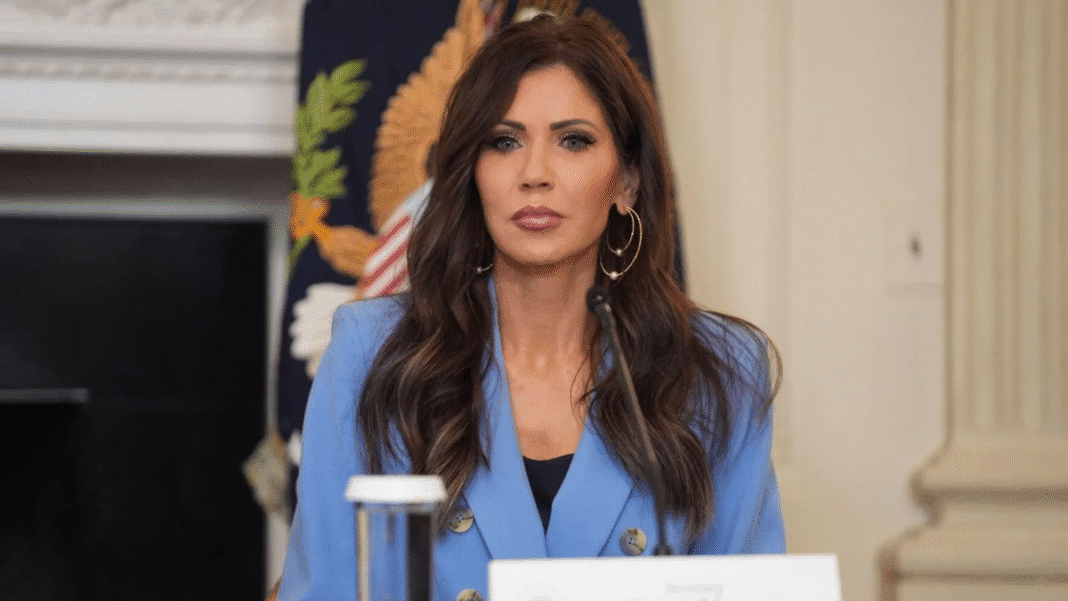

A heated debate broke out on Wednesday after Homeland Security Secretary Kristi Noem made strong remarks during a White House roundtable. She compared antifa, a loose network of anti-fascist activists, to well-known terrorist groups such as MS-13, Hamas, Hezbollah, and the Islamic State (ISIS).
Speaking in front of reporters and social media commentators, Noem said that antifa was “just as dangerous” and “just as sophisticated” as those violent organizations. She claimed that the group had “an agenda to destroy” the country, much like other terrorist groups that have caused harm for years.
The event, described as a roundtable on national security, included several conservative journalists and influencers, such as Andy Ngo, Nick Sortor, and Katie Daviscourt, who often report on left-wing protests. The discussion focused on political unrest, street violence, and what officials described as the growing threat of “domestic extremism.”
Noem’s comments quickly spread online and were met with intense reactions. Supporters praised her for taking a strong stance, while critics said the comparison was extreme and misleading.
Kristi Noem mocked after “facing down” an army of 8 protesters — including a guy in a chicken suit
What Happened During the Roundtable
The White House meeting was attended by President Donald Trump, Pam Bondi, and several conservative media figures. Participants spoke about acts of violence at protests and blamed antifa for fueling chaos in cities.
Noem compared antifa to terrorist organizations such as Hamas, Hezbollah, and ISIS, as well as criminal gangs like MS-13 and Tren de Aragua (TDA). She argued that antifa shared the same threat level, saying, “These groups are dangerous, organized, and aim to destroy societies.”
Pam Bondi, seated beside President Trump, added that “this is not activism, it’s anarchy,” stressing that the government would not allow violence to threaten law enforcement or communities.
President Trump repeated his earlier claims that antifa was a domestic terrorist organization. He pointed to attacks on federal agents that he linked to antifa and described what he called “left-wing violence” as an ongoing problem. Trump also referenced the shooting of Charlie Kirk, claiming that the suspect, Tyler Robinson, was a “far-left extremist,” though officials have not confirmed any connection to antifa.
Kristi Noem Accused of Rushing Millions to Florida Pier Near Rumored Lover’s Home
In 2020, Trump signed an executive order attempting to label antifa a domestic terrorist organization, though legal experts noted that U.S. law only allows such designations for foreign groups.
Federal agencies, including the FBI and the Department of Homeland Security, have stated there is no evidence that antifa operates as a coordinated terrorist network. Officials have described it instead as a loosely organized movement composed of local activists with shared beliefs rather than a structured group with leadership or a central command.
Expert and Law Enforcement Perspectives
Experts on extremism and domestic security emphasize that antifa is not a formal organization. It has no headquarters, official members, or hierarchy. The term “antifa” refers to a broad movement of individuals who oppose fascism and far-right ideologies.
Some antifa-aligned activists have engaged in vandalism or street clashes, particularly during protests, but researchers note that these actions differ greatly from the organized, large-scale operations carried out by terrorist groups like Hamas, Hezbollah, or ISIS. Antifa does not control territory, plan coordinated attacks, or maintain armed divisions.
Chicago erupts after Kristi Noem and YouTuber Benny Johnson join live immigration raid near Walmart
Law enforcement has occasionally investigated individuals involved in violent acts linked to antifa-related protests. However, agencies have repeatedly clarified that such incidents are isolated and not directed by any national structure.
Despite this, antifa continues to be a lightning rod in American politics. Critics, including President Trump and Kristi Noem, argue that the movement encourages chaos and violence, while supporters claim it stands against hate and authoritarianism.
By comparing antifa to international terrorist organizations, Kristi Noem reignited a fierce national debate over how extremism is defined in the United States. Her remarks brought renewed attention to political polarization surrounding protest movements and the line between activism and criminal behavior.
The controversy surrounding Noem’s statements shows how discussions about domestic extremism remain deeply divided. Her comparison of antifa to groups like ISIS, Hamas, Hezbollah, and MS-13 has fueled intense debate and highlighted the ongoing struggle over how the government and public view protest movements and their role in American society.