

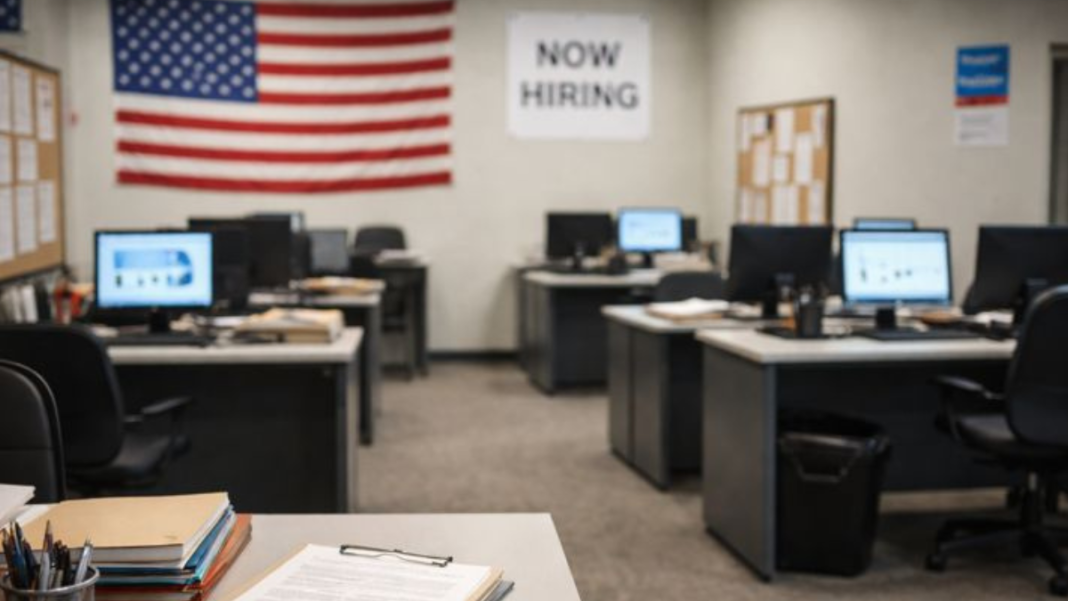

The unemployment rate for people born in the United States rose over the past year, even as the number of immigrant workers in the country fell sharply. New government data show that policies aimed at reducing both legal and illegal immigration in 2025 did not improve job prospects for U.S.-born workers. Instead, fewer workers overall were active in the labor market, and joblessness increased among those born in the country.
These findings challenge the idea that cutting immigration automatically creates more jobs for citizens. Official labor data reveal that the decline in foreign-born workers did not lead to stronger employment outcomes for U.S.-born individuals or bring more people back into the workforce.
Immigration Policies Cut Foreign-Born Labor Supply in 2025
Throughout 2025, immigration policies led to a noticeable decline in the number of foreign-born workers in the U.S. labor market. Monthly job reports consistently showed fewer immigrants working or actively seeking employment. According to labor data, the foreign-born workforce fell by hundreds of thousands compared to the start of the year and by more than a million from its peak earlier in 2025.
This decline was larger than expected. Federal projections had assumed the U.S. economy would gain well over a million additional immigrant workers in 2025. Instead, the labor market faced a gap of more than two million workers compared to those expectations. This shortfall represented a significant shock to the economy, particularly at a time when many industries were already struggling to fill open positions.
Labor force growth is a key part of economic strength. When more people work, businesses can expand, productivity increases, and living standards improve. Immigrants have historically been central to this growth. Over the previous decade, they accounted for more than half of total labor force expansion in the United States. Their reduced presence in 2025 slowed overall workforce growth and limited economic activity.
U.S.-Born Workers Did Not See Job Gains
Supporters of tighter immigration rules argued that fewer immigrant workers would create more opportunities for U.S.-born workers. However, employment data did not reflect this outcome. Instead of falling, the unemployment rate for U.S.-born individuals rose over the year. By December 2025, joblessness among U.S.-born workers was notably higher than it had been twelve months earlier.
As unemployment reaches 4.6%, Trump challenges official labor statistics
This increase occurred alongside a broader rise in unemployment across the entire workforce. The overall jobless rate moved up during 2025, showing that the labor market weakened rather than improved. Year-over-year comparisons are especially important because unemployment data by place of birth are not adjusted for seasonal changes, making annual trends the most reliable indicator.
Another concerning trend was the decline in labor force participation. Fewer U.S.-born adults were either working or actively seeking work by the end of 2025 compared to the year before. This meant that not only were more people unemployed, but some had stopped looking for jobs altogether. The expected return of U.S.-born workers to fill positions vacated by immigrants did not materialize.
Why Fewer Immigrants Help Unemployment ?
Several economic factors explain why the reduction in immigrant labor did not benefit U.S.-born workers. When businesses cannot find enough employees, they often scale back operations or delay expansion plans. This can lead to fewer job openings overall, even for citizens. In some cases, companies choose not to invest at all due to uncertainty about labor availability.
Immigrants also play a major role as consumers. They spend money on housing, food, transportation, and other essentials, supporting local businesses and jobs. When the immigrant population shrinks, consumer spending declines, which can reduce demand and lead to job losses in sectors that depend on steady consumption.
In addition, immigrants contribute significantly to business creation. Many start small companies that grow over time and employ U.S.-born workers. A decline in immigrant entrepreneurship reduces the number of new businesses, limiting job creation and economic dynamism.
Isiah Kangar Gets 12 Months in Prison for Deceiving U.S. Immigration
Data from 2025 showed that the economy does not operate with a fixed number of jobs. Removing workers from the labor force did not cause jobs to automatically shift to others. Instead, the overall level of economic activity adjusted downward. With fewer workers producing goods and services and fewer consumers spending money, the number of available jobs declined.
Government statistics from the year made it clear that cutting immigration alone did not strengthen employment for U.S.-born workers. Higher unemployment, lower labor force participation, and slower workforce growth defined the labor market in 2025, underscoring the close link between immigration, economic activity, and job availability in the United States.