

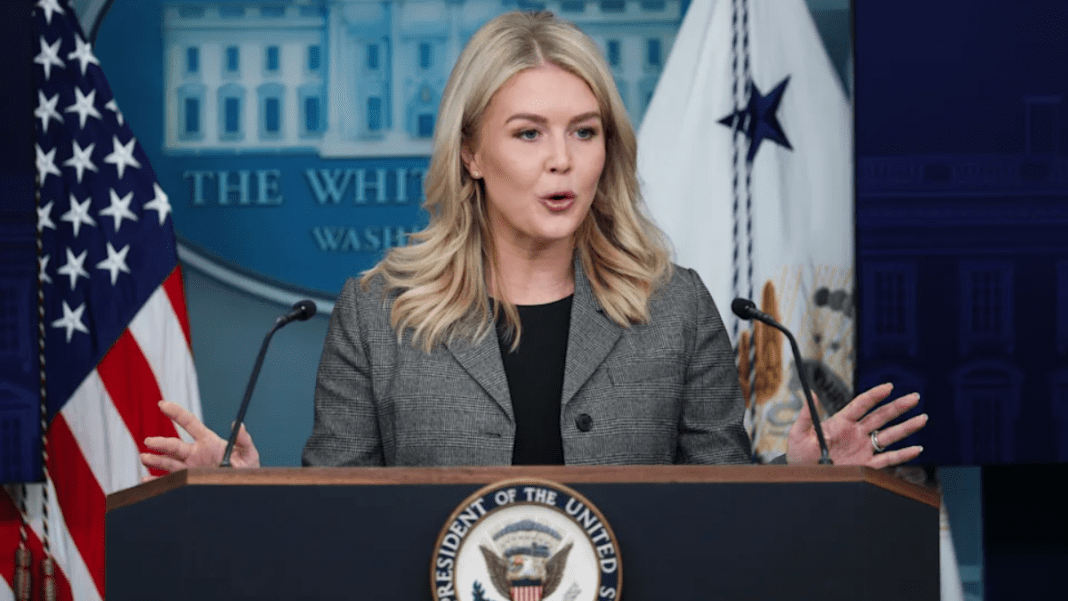
Heated clash erupts as reporters corner press secretary Karoline Leavitt over ‘free health care’ shutdown spin

A tense scene unfolded in the White House press briefing room when Press Secretary Karoline Leavitt faced tough questions about the ongoing government shutdown. What began as a routine exchange quickly turned into a heated back-and-forth that caught the attention of everyone present.

Leavitt repeated a claim that the shutdown was linked to demands for free health care for undocumented immigrants. This statement was met with immediate pushback. Reporters pointed out that current federal law already requires hospitals to provide emergency care to anyone in need, regardless of status. This means hospitals cannot legally turn away patients in life-threatening situations.

When pressed on whether the administration was actually changing this law or its interpretation, Leavitt struggled to give a clear answer. Instead of clarifying, the claim was repeated again, which only brought more pointed questions from the press. The repeated challenge seemed to corner Leavitt, creating visible frustration.

The exchange grew increasingly uncomfortable as questions piled on, asking for specific details. At this point, Leavitt chose to abruptly end the briefing and leave the room, avoiding further questions. The quick exit drew widespread attention, sparking strong reactions and debate about what had just unfolded.

Families, seniors, and workers pay the price — Ocasio-Cortez says Trump’s shutdown is “cruel political theater”

The Shutdown and the Controversy

The backdrop to this dramatic scene is the ongoing government shutdown. The administration has insisted that one of the central reasons for the standoff is health care policy related to undocumented immigrants. Officials have claimed that Democrats want to expand taxpayer-funded benefits, while critics argue that this is a misrepresentation of the facts.

The law in question, known to health professionals and legal experts alike, is clear about emergency medical treatment. It requires hospitals to stabilize and treat patients who arrive with urgent medical conditions. This standard has been in place for decades, and it applies regardless of citizenship or ability to pay.

By linking the shutdown directly to a fight over “free health care,” Leavitt’s words suggested a major policy conflict that does not fully align with existing law. Reporters, aware of this, pressed harder to understand whether there was a new directive or legal change. None was given.

The tension rose as the room filled with rapid-fire questions. Each time, Leavitt fell back on the same talking point, insisting that Democrats were pushing an agenda that would make care free for all undocumented individuals. However, no evidence of a new policy shift was provided.

This gap between the legal reality and the political talking point became the flashpoint of the briefing. It highlighted the gap between official statements and the legal protections already on the books.

Bernie Sanders blasts Trump as ‘megalomaniac’ as brutal government shutdown throws millions into chaos

The Abrupt Exit and Public Reaction

Leavitt’s decision to walk out rather than continue answering questions made the briefing one of the most talked-about moments of the week. The exit drew strong reactions from reporters and the public. Some described it as an avoidance tactic, while others saw it as a sign of how intense the shutdown debate has become.

The abrupt end left many of the press corps frustrated, as critical questions went unanswered. The lack of clarity also meant that the claim linking the shutdown to health care for undocumented immigrants remained unsubstantiated during the briefing.

Observers noted that the briefing was meant to provide information to the public, but instead it became a scene of confrontation. The unanswered questions about the shutdown’s true causes and the role of health care in the debate only fueled further discussion outside the briefing room.

The walkout underscored the growing tension around the government shutdown, which continues to affect public services, workers, and families across the country. The clash between reporters and Leavitt was more than a heated exchange—it revealed just how high the stakes have become in the battle over funding and policy.

While the shutdown drags on, the moment serves as a reminder of how contentious and emotional the discussions have grown. The sight of Press Secretary Karoline Leavitt leaving under pressure has become one of the most striking images connected to the standoff.

T U Deshmukh
T U Deshmukh
T U Deshmukh is the leading voice on the subject of Jobs, AI, Data and layoffs and she regularly contributes a column on Jobs for Newsinterpretation.

TOP 10 TRENDING ON NEWSINTERPRETATION

Cyber Attacks on Space Infrastructure: Satellites, GPS and the Ground Systems Behind Them

From the Viasat KA-SAT hack to GPS jamming over the Baltic, a research guide to how attackers target satellites, navigation signals and ground stations, and why it matters on Earth.

How AI Agents Are Used in Cyber Attacks: From Assisted Hacking to AI-Orchestrated Espionage

Attackers now use AI agents to scan networks, write exploits and run extortion campaigns. A research guide to documented cases, including the first reported AI-orchestrated espionage campaign, and what defenders should do.

Cyber Attacks on AI and LLMs: How Attackers Target Large Language Models

Prompt injection, data poisoning, model theft and jailbreaks: a research guide to how attackers target AI systems and large language models, with real cases and defences.

French Supermarket Refrigeration Cyberattack: How Hacking the Cold Chain Can Endanger Lives

In October 2026 attackers heated refrigeration cabinets in hundreds of French supermarkets to as much as 50°C. No one was hurt, but the attack shows how hacking the cold chain can endanger lives through fire, food poisoning and spoiled medicines.

Cyberattacks on Nuclear Facilities: Stuxnet, Kudankulam and the Limits of Air Gaps

Stuxnet, the Davis-Besse worm and malware at India’s Kudankulam plant: what they show about cyber risk at nuclear facilities and the limits of air gaps.

Triton: When Hackers Target the Safety Systems That Prevent Industrial Disasters

The 2017 Triton attack targeted the safety systems that prevent industrial disasters. What happened, who was charged, and how plants protect their last line of defence.

Cybersecurity Risks in Smart Cities: When Connected Infrastructure Fails

How connecting traffic control, emergency alerts and utilities concentrates cyber risk in cities, what the Dallas and Atlanta incidents showed, and what governments recommend.

Weaponized Drones: Hijacking, GPS Spoofing and Emerging Cyber Warfare Risks

How drones can be hijacked, jammed or misled by GPS spoofing, what researchers have demonstrated, and why governments treat drone fleets as a security risk.

Ransomware Attacks on Hospitals: How Healthcare Cyberattacks Put Patients at Risk

How ransomware against hospitals and their suppliers delays care and endangers patients, what the Düsseldorf and WannaCry cases show, and what research says about deaths.

Operational blunder exposes massive Russian cyber espionage attack on Ukrainian prosecutors

A major cyberattack has compromised the email accounts of...

Cyber Attacks on Space Infrastructure: Satellites, GPS and the Ground Systems Behind Them

From the Viasat KA-SAT hack to GPS jamming over the Baltic, a research guide to how attackers target satellites, navigation signals and ground stations, and why it matters on Earth.

French Supermarket Refrigeration Cyberattack: How Hacking the Cold Chain Can Endanger Lives

In October 2026 attackers heated refrigeration cabinets in hundreds of French supermarkets to as much as 50°C. No one was hurt, but the attack shows how hacking the cold chain can endanger lives through fire, food poisoning and spoiled medicines.

Cyberattacks on Nuclear Facilities: Stuxnet, Kudankulam and the Limits of Air Gaps

Stuxnet, the Davis-Besse worm and malware at India’s Kudankulam plant: what they show about cyber risk at nuclear facilities and the limits of air gaps.

Triton: When Hackers Target the Safety Systems That Prevent Industrial Disasters

The 2017 Triton attack targeted the safety systems that prevent industrial disasters. What happened, who was charged, and how plants protect their last line of defence.

Cybersecurity Risks in Smart Cities: When Connected Infrastructure Fails

How connecting traffic control, emergency alerts and utilities concentrates cyber risk in cities, what the Dallas and Atlanta incidents showed, and what governments recommend.

Ransomware Attacks on Hospitals: How Healthcare Cyberattacks Put Patients at Risk

How ransomware against hospitals and their suppliers delays care and endangers patients, what the Düsseldorf and WannaCry cases show, and what research says about deaths.

FBI warns of AVrecon malware targeting outdated routers linked to proxy based cybercrime

A serious cybersecurity warning has been issued regarding commonly...

Related Articles

Popular Categories
