

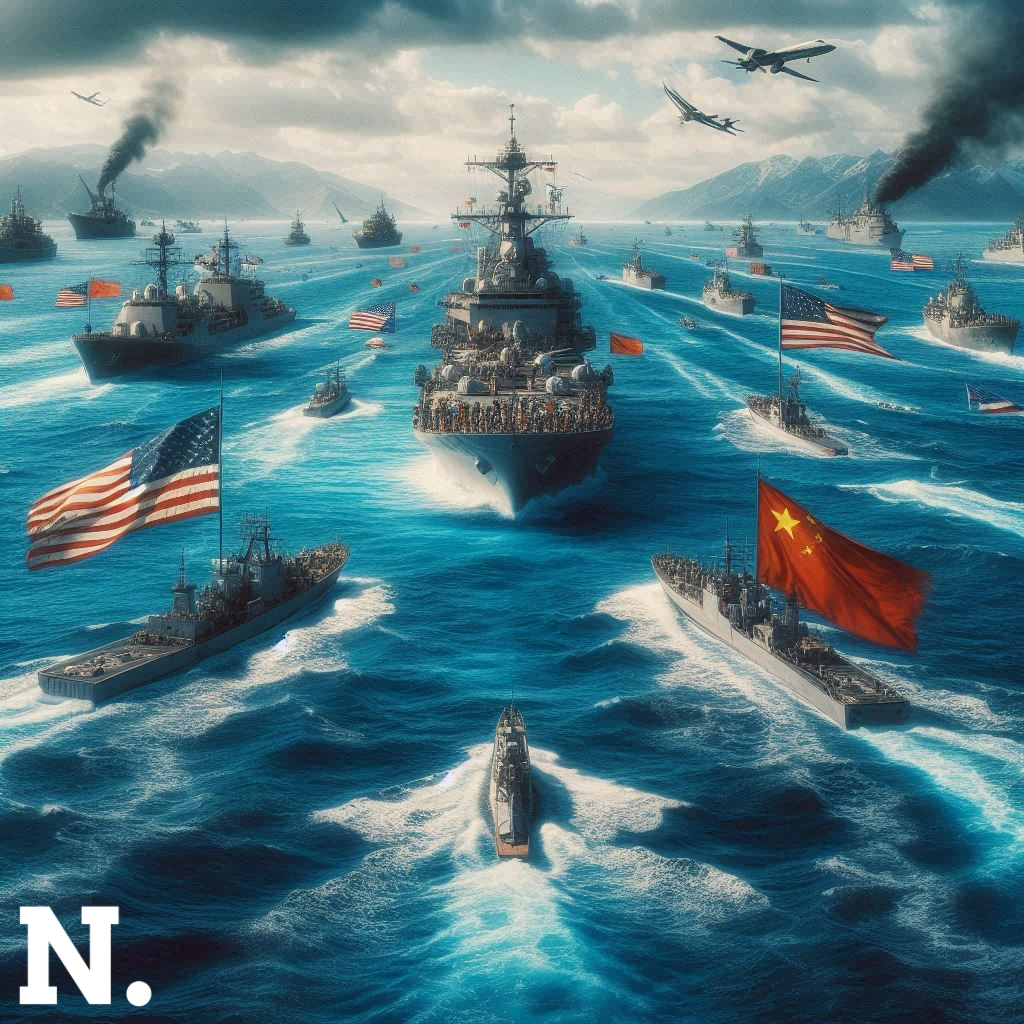
South China Sea: China Intercepts US Submarine Probe, Escalating Regional Tensions

On June 26, China reported that they had caught a submarine probe which was dropped by a U.S. military aircraft in the South China Sea. Yuyuan Tantian, a social media account associated with Chinese state broadcaster CCTV made coverage of the incident. The US Military Aircraft were noticed overflying the South China Sea dropping “unidentified items” into the waters.

China’s coastguard was able to quickly recover and inspect one of the objects that were dropped. In a Yuyuan Tantian account’s video their interception process is shown. Based on the video, the probe can sense Chinese submarine signals as well as counter signals from submarines underwater. Expert quoted in the video highlighted the capability and potential threat of Chinese submarines emphasised by the probe.

The strategic importance of the South China Sea

South China Sea is one of the most important passageways at the global level. It possesses both strategic as well as economic importance. This is the busiest maritime highway and trade of trillions of dollars takes place through it every year. Further, the area has an abundance of natural resources including oil and gas reserves. The ownership of these waters gives an edge in terms of economy as well as military. This recent interception by China is further proof of the deep-seated tensions in the South China Sea. The region is strategic, and a hotly contested area with multiple countries laying claims to parts of it. United States and its allies’ presence in the area is a bone of contention with China. Many times these activities result into confrontations where the risk of conflicts escalates.

Re-Evaluation of the US-China Relationship

It is this expansion and assertiveness that has made China one of the prominent actors in the South China Sea. It has achieved this through building artificial islands and military installations to fortify its position. Such move has been met with opposition from the neighbouring countries as well as the international community. The US and its allies’ objective is to challenge these claims and assert international maritime rights thus they conduct freedom of navigation operations.

 US and Allied Response in the South China Sea

US and Allied took steps to counter the nuclear threat from North Korea. This is definitely a very dangerous step in history because it doesn’t solve anything.The United States and its allies consider these actions in the South China Sea as lawful and necessary. They assert that free of navigation is the key to larger trade and security concerns worldwide. Periodic naval exercises and patrols certainly guarantee that the principles are respected. Nonetheless, Beijing views these operations as provocative and menacing.

Diplomatic Efforts and Tensions in South China Sea

Diplomatic efforts and negotiations are proving to be difficult in order to permanently resolve the ongoing dispute. To address the above outlined problems, different inter and intra governmental formations have adopted forums; Bilateral discussions. Nonetheless, the stakes of the conflicting party are quite high and render coming to a solution easy. However in the observations of the recent interceptions indicated that such incidents heighten tensions.

Conclusion

China’s live interception of the American submarine proves the region is volatile for affairs especially in the sea. Some of the importance of global issues is that it emphasizes on the endless tension for dominance between superpowers. The US and its partners do not accept China’s controversial territorial assertions regarding the South China Sea’s claims and thus, international confrontation is rampant.

As long as these disputes in South China Sea remain unsolved the possibility of conflict will always be there. That is why diplomatic actions and compliance with international law are sometimes crucial. In order to regulate for and, consequently, mitigate such tensions.


Rajlaxmi Deshmukh
Rajlaxmi Deshmukh
Rajlaxmi Deshmukh is a Political Science Expert with Keen Interest in Geopolitics. She was working with a Think Tank Based in Pune before she joined News Interpretation in the capacity of Geo Political Editor.

TOP 10 TRENDING ON NEWSINTERPRETATION

Cyber Attacks on Space Infrastructure: Satellites, GPS and the Ground Systems Behind Them

From the Viasat KA-SAT hack to GPS jamming over the Baltic, a research guide to how attackers target satellites, navigation signals and ground stations, and why it matters on Earth.

How AI Agents Are Used in Cyber Attacks: From Assisted Hacking to AI-Orchestrated Espionage

Attackers now use AI agents to scan networks, write exploits and run extortion campaigns. A research guide to documented cases, including the first reported AI-orchestrated espionage campaign, and what defenders should do.

Cyber Attacks on AI and LLMs: How Attackers Target Large Language Models

Prompt injection, data poisoning, model theft and jailbreaks: a research guide to how attackers target AI systems and large language models, with real cases and defences.

French Supermarket Refrigeration Cyberattack: How Hacking the Cold Chain Can Endanger Lives

In October 2026 attackers heated refrigeration cabinets in hundreds of French supermarkets to as much as 50°C. No one was hurt, but the attack shows how hacking the cold chain can endanger lives through fire, food poisoning and spoiled medicines.

Cyberattacks on Nuclear Facilities: Stuxnet, Kudankulam and the Limits of Air Gaps

Stuxnet, the Davis-Besse worm and malware at India’s Kudankulam plant: what they show about cyber risk at nuclear facilities and the limits of air gaps.

Triton: When Hackers Target the Safety Systems That Prevent Industrial Disasters

The 2017 Triton attack targeted the safety systems that prevent industrial disasters. What happened, who was charged, and how plants protect their last line of defence.

Cybersecurity Risks in Smart Cities: When Connected Infrastructure Fails

How connecting traffic control, emergency alerts and utilities concentrates cyber risk in cities, what the Dallas and Atlanta incidents showed, and what governments recommend.

Weaponized Drones: Hijacking, GPS Spoofing and Emerging Cyber Warfare Risks

How drones can be hijacked, jammed or misled by GPS spoofing, what researchers have demonstrated, and why governments treat drone fleets as a security risk.

Ransomware Attacks on Hospitals: How Healthcare Cyberattacks Put Patients at Risk

How ransomware against hospitals and their suppliers delays care and endangers patients, what the Düsseldorf and WannaCry cases show, and what research says about deaths.

Operational blunder exposes massive Russian cyber espionage attack on Ukrainian prosecutors

A major cyberattack has compromised the email accounts of...

Cyber Attacks on Space Infrastructure: Satellites, GPS and the Ground Systems Behind Them

From the Viasat KA-SAT hack to GPS jamming over the Baltic, a research guide to how attackers target satellites, navigation signals and ground stations, and why it matters on Earth.

French Supermarket Refrigeration Cyberattack: How Hacking the Cold Chain Can Endanger Lives

In October 2026 attackers heated refrigeration cabinets in hundreds of French supermarkets to as much as 50°C. No one was hurt, but the attack shows how hacking the cold chain can endanger lives through fire, food poisoning and spoiled medicines.

Cyberattacks on Nuclear Facilities: Stuxnet, Kudankulam and the Limits of Air Gaps

Stuxnet, the Davis-Besse worm and malware at India’s Kudankulam plant: what they show about cyber risk at nuclear facilities and the limits of air gaps.

Triton: When Hackers Target the Safety Systems That Prevent Industrial Disasters

The 2017 Triton attack targeted the safety systems that prevent industrial disasters. What happened, who was charged, and how plants protect their last line of defence.

Cybersecurity Risks in Smart Cities: When Connected Infrastructure Fails

How connecting traffic control, emergency alerts and utilities concentrates cyber risk in cities, what the Dallas and Atlanta incidents showed, and what governments recommend.

Ransomware Attacks on Hospitals: How Healthcare Cyberattacks Put Patients at Risk

How ransomware against hospitals and their suppliers delays care and endangers patients, what the Düsseldorf and WannaCry cases show, and what research says about deaths.

FBI warns of AVrecon malware targeting outdated routers linked to proxy based cybercrime

A serious cybersecurity warning has been issued regarding commonly...

Related Articles

Popular Categories
