

👁️South Korea Indicts 2 Chinese Nationals for Filming U.S. Aircraft Carrier and Military Sites

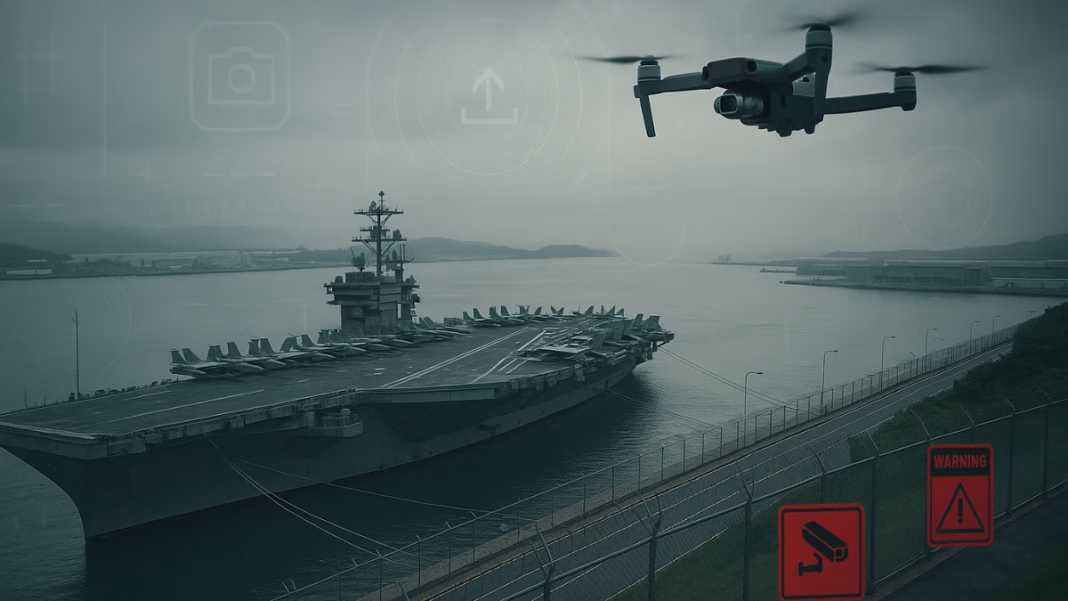
Two Chinese nationals have been indicted in South Korea for filming sensitive military locations, including a U.S. aircraft carrier, using drones.

Chinese Nationals Caught Filming Military Sites

This marks the first time foreign nationals have been charged under the country’s strict “general espionage” law. The suspects, both Chinese graduate students, are currently in custody.

The Busan District Prosecutors’ Office made the announcement on Friday. The two men — one in his 40s and the other in his 30s — are accused of violating both the Criminal Act and the Military Installation and Military Facilities Protection Act. These laws are meant to protect South Korea’s national security and military interests.

Authorities say the two entered South Korea in March 2023. Over the next year, until June 2024, they used drones to secretly capture images and videos of military bases. These included close-up footage of the U.S. Navy aircraft carrier USS Theodore Roosevelt while it was docked at the Busan Naval Base. The content was later uploaded to online platforms that can be accessed in China.

The act of “general espionage” under South Korean law applies to actions that may harm national defense or give military advantage to enemy states like North Korea. The crime carries a sentence of at least three years in prison and can go up to life imprisonment.

👀 Kremlin espionage reaches Latin America: 21-year-old Russian hacker arrested in Colombia over drone sabotage plot

Drone Used to Capture U.S. Carrier and Fighter Jets

The military investigation revealed that the two men flew a Chinese-made drone near military bases on at least nine different occasions. These drone flights were not permitted, and the areas captured were restricted zones under South Korean law.

One of the key targets of the surveillance was the USS Theodore Roosevelt. The aircraft carrier is one of the U.S. Navy’s largest warships. It carries advanced systems and fighter jets such as the F/A-18. On June 25, 2023, the same day a major public event involving the ship took place, the suspects were caught by military personnel while taking photos near the ship.

In total, the two men recorded 172 photos and 22 videos. The footage took up around 11.9 gigabytes of data. This included clear views of weapons systems, launch pads, and military structures. According to police, the drone used in the act automatically uploaded footage to servers managed by the Chinese manufacturer. In addition, one of the suspects also used his mobile phone to take more pictures. These were later posted on Chinese social media sites.

Third Suspect Under Investigation, Spy Links Found

A third person, a Chinese woman in her 30s, is also being investigated. Authorities say she helped scout filming locations and drove the two men to the areas. She is not in custody at the moment but is under investigation for breaking military facility laws.

Police found signs that the case may be linked to Chinese authorities. They found contact details on one suspect’s phone. These contacts are believed to be linked to the Chinese police. The suspects said they did not mean any harm. They claimed they were only “interested in military facilities.” They also said they did not know they were breaking any laws.

💻 Digital Espionage Crisis—China-Linked Hackers Slip Past Microsoft Defenses, Steal Encryption Keys

Initially, only the older man was charged with espionage. The younger man was first charged only for filming military facilities. But prosecutors later added the espionage charge against him too. This change came after a full review by South Korea’s military counterintelligence team. The agency concluded that both men’s actions seriously harmed the country’s military security.

South Korean officials are treating this as a serious threat to national defense. The fact that so much sensitive material was gathered and shared on foreign platforms has raised alarm within the military and intelligence community.

This case has drawn widespread attention, especially since it involves foreign nationals and high-level military surveillance. Investigations are still ongoing, and the legal process continues.
Renuka Bangale
Renuka Bangale
Renuka is a distinguished Chartered Accountant and a Certified Digital Threats Analyst from Riskpro, renowned for her expertise in cybersecurity. With a deep understanding of cybercrimes, malware, cyber warfare, and espionage, she has established herself as an authority in the field. Renuka combines her financial acumen with advanced knowledge of digital threats to provide unparalleled insights into the evolving landscape of information security. Her analytical prowess enables her to dissect complex cyber incidents, offering clarity on risks and mitigation strategies. As a key contributor to Newsinterpretation’s information security category, Renuka delivers authoritative articles that educate and inform readers about emerging threats and best practices.

TOP 10 TRENDING ON NEWSINTERPRETATION

Cyber Attacks on Space Infrastructure: Satellites, GPS and the Ground Systems Behind Them

From the Viasat KA-SAT hack to GPS jamming over the Baltic, a research guide to how attackers target satellites, navigation signals and ground stations, and why it matters on Earth.

How AI Agents Are Used in Cyber Attacks: From Assisted Hacking to AI-Orchestrated Espionage

Attackers now use AI agents to scan networks, write exploits and run extortion campaigns. A research guide to documented cases, including the first reported AI-orchestrated espionage campaign, and what defenders should do.

Cyber Attacks on AI and LLMs: How Attackers Target Large Language Models

Prompt injection, data poisoning, model theft and jailbreaks: a research guide to how attackers target AI systems and large language models, with real cases and defences.

French Supermarket Refrigeration Cyberattack: How Hacking the Cold Chain Can Endanger Lives

In October 2026 attackers heated refrigeration cabinets in hundreds of French supermarkets to as much as 50°C. No one was hurt, but the attack shows how hacking the cold chain can endanger lives through fire, food poisoning and spoiled medicines.

Cyberattacks on Nuclear Facilities: Stuxnet, Kudankulam and the Limits of Air Gaps

Stuxnet, the Davis-Besse worm and malware at India’s Kudankulam plant: what they show about cyber risk at nuclear facilities and the limits of air gaps.

Triton: When Hackers Target the Safety Systems That Prevent Industrial Disasters

The 2017 Triton attack targeted the safety systems that prevent industrial disasters. What happened, who was charged, and how plants protect their last line of defence.

Cybersecurity Risks in Smart Cities: When Connected Infrastructure Fails

How connecting traffic control, emergency alerts and utilities concentrates cyber risk in cities, what the Dallas and Atlanta incidents showed, and what governments recommend.

Weaponized Drones: Hijacking, GPS Spoofing and Emerging Cyber Warfare Risks

How drones can be hijacked, jammed or misled by GPS spoofing, what researchers have demonstrated, and why governments treat drone fleets as a security risk.

Ransomware Attacks on Hospitals: How Healthcare Cyberattacks Put Patients at Risk

How ransomware against hospitals and their suppliers delays care and endangers patients, what the Düsseldorf and WannaCry cases show, and what research says about deaths.

Operational blunder exposes massive Russian cyber espionage attack on Ukrainian prosecutors

A major cyberattack has compromised the email accounts of...

Cyber Attacks on Space Infrastructure: Satellites, GPS and the Ground Systems Behind Them

From the Viasat KA-SAT hack to GPS jamming over the Baltic, a research guide to how attackers target satellites, navigation signals and ground stations, and why it matters on Earth.

French Supermarket Refrigeration Cyberattack: How Hacking the Cold Chain Can Endanger Lives

In October 2026 attackers heated refrigeration cabinets in hundreds of French supermarkets to as much as 50°C. No one was hurt, but the attack shows how hacking the cold chain can endanger lives through fire, food poisoning and spoiled medicines.

Cyberattacks on Nuclear Facilities: Stuxnet, Kudankulam and the Limits of Air Gaps

Stuxnet, the Davis-Besse worm and malware at India’s Kudankulam plant: what they show about cyber risk at nuclear facilities and the limits of air gaps.

Triton: When Hackers Target the Safety Systems That Prevent Industrial Disasters

The 2017 Triton attack targeted the safety systems that prevent industrial disasters. What happened, who was charged, and how plants protect their last line of defence.

Cybersecurity Risks in Smart Cities: When Connected Infrastructure Fails

How connecting traffic control, emergency alerts and utilities concentrates cyber risk in cities, what the Dallas and Atlanta incidents showed, and what governments recommend.

Ransomware Attacks on Hospitals: How Healthcare Cyberattacks Put Patients at Risk

How ransomware against hospitals and their suppliers delays care and endangers patients, what the Düsseldorf and WannaCry cases show, and what research says about deaths.

FBI warns of AVrecon malware targeting outdated routers linked to proxy based cybercrime

A serious cybersecurity warning has been issued regarding commonly...

Related Articles

Popular Categories
