

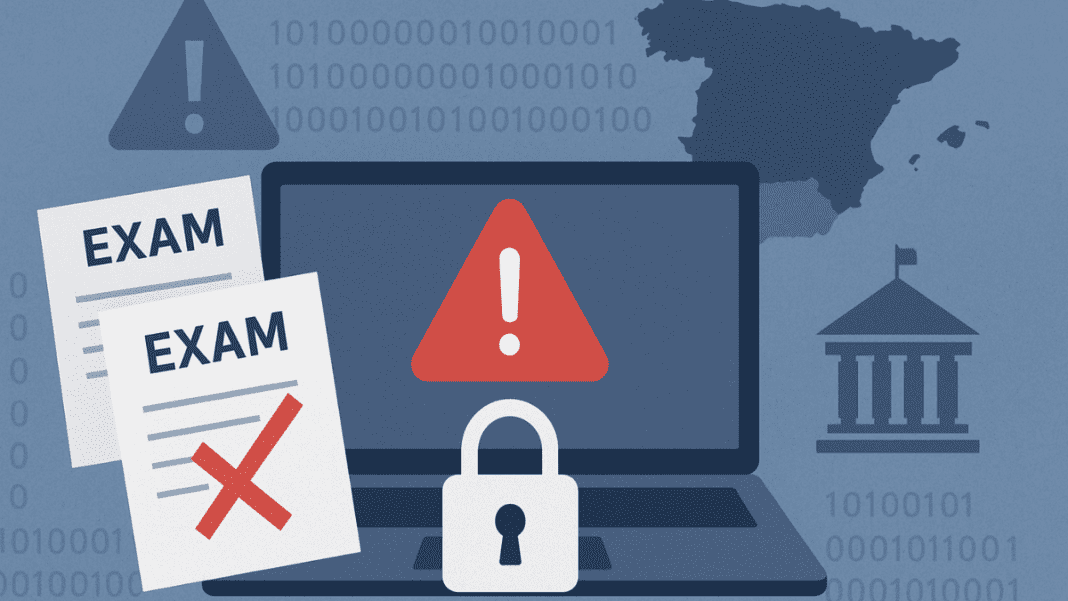
Spanish police arrest suspect accused of hacking exam system to change grades

Spanish police have arrested a 21-year-old man suspected of hacking into official education systems to change exam results. Authorities say the suspect illegally accessed the Ministry of Education’s Séneca platform. The system is widely used across the Andalusia region. It manages student grades, attendance, and school records.

Student Exam System Breached

The investigation began when a teacher at the San Juan Bosco secondary school in Jaén noticed unusual activity on his account. Hackers reportedly compromised his login. This raised concerns that they were manipulating sensitive information and exam grades without permission.

The Séneca platform is an online portal used by thousands of schools in Andalusia. It allows teachers to upload student grades, track attendance, and share information with families. Because it acts as an official record system, any unauthorized changes can have serious consequences for both students and institutions.

Israel used hacked phones of Iranian bodyguards to track senior leaders during June conflict

According to police, the suspect attempted to alter his own grades, as well as those of classmates close to him. Investigators say the suspect wanted to improve his scores. The changes affected both high school assessments and university entrance exams. In Spain, these exams are called the PAU, or Pruebas de Acceso a la Universidad.

Teachers’ Accounts Hacked

During the probe, officers discovered that the attack was broader than first believed. At least 13 teachers from universities across Andalusia had their professional email accounts hacked. The universities affected include those in Almería, Cádiz, Córdoba, Seville, and Jaén.

Hackers breached the accounts of some professors. These professors were directly involved in preparing the 2025 PAU university entrance exams. Police say this created an additional risk, since access to confidential exam materials could have compromised the integrity of the entire process.

Taiwan Cracks Down on Chinese Hacker Group in Shocking Data Trafficking Case

The suspect was arrested in Seville. He is accused of identity theft and unauthorized access to computer systems. He also faces charges of interfering with official academic records. Police searched his home and seized computer equipment. Investigators believe the devices were used in the hack. Investigators also found a notebook that allegedly contained a handwritten list of manipulated grades.

Identity theft in hacking cases often means using someone else’s credentials to log into secure systems. Investigators say the suspect accessed teacher accounts without permission. This gave him control over sensitive platforms like Séneca and university email networks. By posing as a legitimate user, a hacker can bypass normal security checks, making the attack harder to detect.

Previous Cases Highlight Risks

Authorities note that cases of students trying to improve their grades through hacking are not entirely new. In previous years, students in different countries hacked into school networks. They adjusted results or stole exam information.

Tesla hacker restores missing crash logs exposing Autopilot pedestrian collision

One such case happened in the United States. A student in Georgia was caught after breaking into a grading system. He also collected sensitive login details. In another case, a university student in Kansas used a keylogger device. The device recorded teachers’ passwords. With those passwords, the student changed his failing results into top grades.

Another incident took place in New Jersey, where a high school student hacked into his school’s system in hopes of raising his grades to reach an Ivy League college.

These examples underline how digital education platforms can become targets if not adequately protected. In response to the latest breach, Spain’s Séneca platform has reportedly undergone additional security measures to prevent similar attacks in the future.

Police emphasize that the investigation is still ongoing. They aim to determine the full scope of the breach. Officers are also checking if other individuals were involved or benefited from the manipulated records.

T U Deshmukh
T U Deshmukh
T U Deshmukh is the leading voice on the subject of Jobs, AI, Data and layoffs and she regularly contributes a column on Jobs for Newsinterpretation.

TOP 10 TRENDING ON NEWSINTERPRETATION

Cyber Attacks on Space Infrastructure: Satellites, GPS and the Ground Systems Behind Them

From the Viasat KA-SAT hack to GPS jamming over the Baltic, a research guide to how attackers target satellites, navigation signals and ground stations, and why it matters on Earth.

How AI Agents Are Used in Cyber Attacks: From Assisted Hacking to AI-Orchestrated Espionage

Attackers now use AI agents to scan networks, write exploits and run extortion campaigns. A research guide to documented cases, including the first reported AI-orchestrated espionage campaign, and what defenders should do.

Cyber Attacks on AI and LLMs: How Attackers Target Large Language Models

Prompt injection, data poisoning, model theft and jailbreaks: a research guide to how attackers target AI systems and large language models, with real cases and defences.

French Supermarket Refrigeration Cyberattack: How Hacking the Cold Chain Can Endanger Lives

In October 2026 attackers heated refrigeration cabinets in hundreds of French supermarkets to as much as 50°C. No one was hurt, but the attack shows how hacking the cold chain can endanger lives through fire, food poisoning and spoiled medicines.

Cyberattacks on Nuclear Facilities: Stuxnet, Kudankulam and the Limits of Air Gaps

Stuxnet, the Davis-Besse worm and malware at India’s Kudankulam plant: what they show about cyber risk at nuclear facilities and the limits of air gaps.

Triton: When Hackers Target the Safety Systems That Prevent Industrial Disasters

The 2017 Triton attack targeted the safety systems that prevent industrial disasters. What happened, who was charged, and how plants protect their last line of defence.

Cybersecurity Risks in Smart Cities: When Connected Infrastructure Fails

How connecting traffic control, emergency alerts and utilities concentrates cyber risk in cities, what the Dallas and Atlanta incidents showed, and what governments recommend.

Weaponized Drones: Hijacking, GPS Spoofing and Emerging Cyber Warfare Risks

How drones can be hijacked, jammed or misled by GPS spoofing, what researchers have demonstrated, and why governments treat drone fleets as a security risk.

Ransomware Attacks on Hospitals: How Healthcare Cyberattacks Put Patients at Risk

How ransomware against hospitals and their suppliers delays care and endangers patients, what the Düsseldorf and WannaCry cases show, and what research says about deaths.

Operational blunder exposes massive Russian cyber espionage attack on Ukrainian prosecutors

A major cyberattack has compromised the email accounts of...

Cyber Attacks on Space Infrastructure: Satellites, GPS and the Ground Systems Behind Them

From the Viasat KA-SAT hack to GPS jamming over the Baltic, a research guide to how attackers target satellites, navigation signals and ground stations, and why it matters on Earth.

French Supermarket Refrigeration Cyberattack: How Hacking the Cold Chain Can Endanger Lives

In October 2026 attackers heated refrigeration cabinets in hundreds of French supermarkets to as much as 50°C. No one was hurt, but the attack shows how hacking the cold chain can endanger lives through fire, food poisoning and spoiled medicines.

Cyberattacks on Nuclear Facilities: Stuxnet, Kudankulam and the Limits of Air Gaps

Stuxnet, the Davis-Besse worm and malware at India’s Kudankulam plant: what they show about cyber risk at nuclear facilities and the limits of air gaps.

Triton: When Hackers Target the Safety Systems That Prevent Industrial Disasters

The 2017 Triton attack targeted the safety systems that prevent industrial disasters. What happened, who was charged, and how plants protect their last line of defence.

Cybersecurity Risks in Smart Cities: When Connected Infrastructure Fails

How connecting traffic control, emergency alerts and utilities concentrates cyber risk in cities, what the Dallas and Atlanta incidents showed, and what governments recommend.

Ransomware Attacks on Hospitals: How Healthcare Cyberattacks Put Patients at Risk

How ransomware against hospitals and their suppliers delays care and endangers patients, what the Düsseldorf and WannaCry cases show, and what research says about deaths.

FBI warns of AVrecon malware targeting outdated routers linked to proxy based cybercrime

A serious cybersecurity warning has been issued regarding commonly...

Related Articles

Popular Categories
