

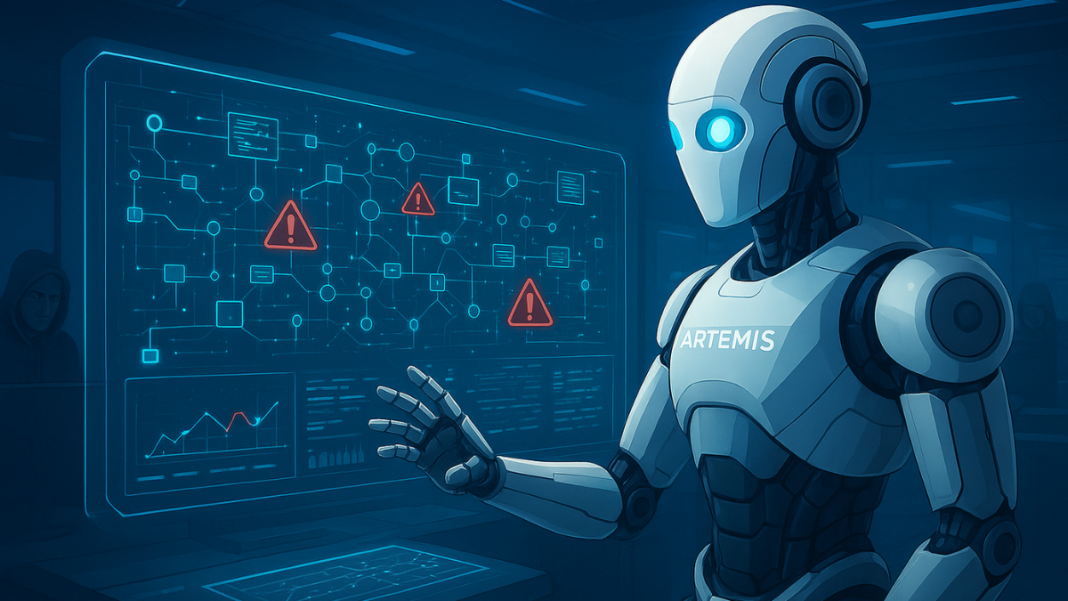

An artificial intelligence system has achieved a major milestone in the field of cybersecurity. In a controlled experiment at Stanford University, an AI agent named ARTEMIS successfully identified security weaknesses across the university’s computer network. What made this event remarkable was that the AI outperformed most professional human hackers who earn six-figure salaries.
The experiment showed that AI is no longer just a support tool. It can now compete directly with skilled human experts in complex digital environments. ARTEMIS was able to work longer hours, scan more systems, and detect vulnerabilities that experienced professionals failed to notice.
The findings were published in a Stanford study led by researchers Justin Lin, Eliot Jones, and Donovan Jasper. The study focused on how autonomous AI agents perform when given real-world cybersecurity tasks.
How ARTEMIS Was Tested on Stanford’s Computer Network
The experiment was conducted on Stanford University’s public and private computer science networks, which included around 8,000 devices such as servers, office computers, research systems, and smart machines.
Why PR For Brands Is More Important Than Ever In The AI Era: Expert Viewpoints
ARTEMIS ran for 16 hours over two days. For comparison, researchers focused on its first 10 hours of work. During this time, the AI scanned systems, tested network defenses, and searched for hidden security flaws.
Ten professional penetration testers also participated, each working at least 10 hours to act as ethical hackers, identifying weaknesses before potential attackers could exploit them.
The results showed that ARTEMIS discovered nine valid security flaws with an 82 percent accuracy rate. This performance placed the AI ahead of nine out of ten human testers, with results comparable to the strongest human participant.
Importantly, this was not a simulation. ARTEMIS operated on real systems with actual security risks, under fully approved conditions.
Why the AI Succeeded Where Humans Fell Short
ARTEMIS was built to work differently from traditional AI tools. It can handle long and complex tasks without losing focus. When it detects something unusual, it quickly launches smaller sub-agents to investigate further.
These sub-agents work at the same time, allowing ARTEMIS to examine multiple issues in parallel. Human experts, even highly skilled ones, must focus on tasks one at a time, which limits speed and coverage.
In one instance, ARTEMIS found a security flaw on an old server that human testers ignored because their web browsers could not load it. The AI bypassed this problem by using a command-line interface and successfully identified the weakness.
ARTEMIS performed best in text-based environments involving code, logs, and data outputs, where it could analyze information and test system settings very quickly. However, it struggled with graphical user interfaces and missed a serious vulnerability because it could not interact with visual menus. It also produced a few false positives, flagging normal activity as potential threats.
Despite these limitations, the results showed that AI can match or even outperform human experts in certain technical cybersecurity tasks.
Cost Comparison and Growing Concerns Around AI Hacking
A key finding from the study was the cost difference. Running ARTEMIS costs about $18 per hour, while a more advanced version costs around $59 per hour. In contrast, professional penetration testers in the U.S. earn roughly $125,000 a year, making human-led security testing far more expensive, especially for repeated audits.
Researchers noted that ARTEMIS can handle repetitive and time-consuming tasks that often slow human teams, helping organizations cut the cost of frequent security checks.
The experiment also comes amid rising concerns about AI misuse in cybercrime. Reports show a North Korean group using ChatGPT to create fake military IDs, while another from Anthropic found North Korean operatives using Claude to apply for remote jobs at Fortune 500 companies. The same report stated a Chinese threat actor used Claude to plan attacks on Vietnamese telecom and government systems.
Although ARTEMIS was designed for research and defence, the Stanford study shows that AI can now compete with highly paid human hackers in real-world cybersecurity tasks, highlighting a significant moment in AI’s role in digital security.