

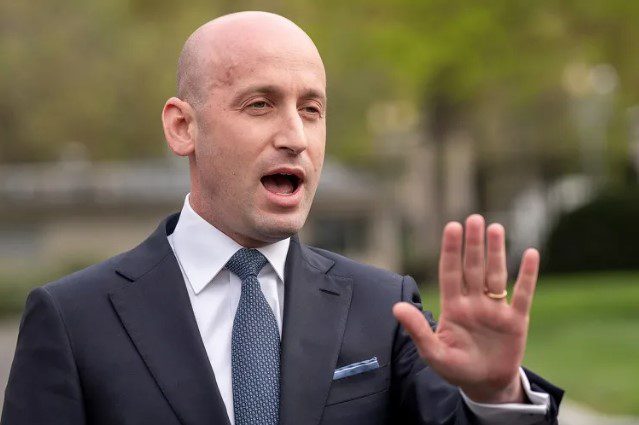

A tense moment unfolded during a live CNN interview when White House Deputy Chief of Staff Stephen Miller claimed that former President Donald Trump has “plenary authority.” The term “plenary authority” means having full or complete power to act on an issue without needing anyone’s approval. However, Stephen Miller’s statement immediately caused a stir because it implied that Trump could make certain decisions without checks from Congress, the courts, or state governments.
Miller’s Controversial Claim on Live Television
The controversy began when Stephen Miller was asked about Trump’s attempt to send the National Guard from California to Portland, Oregon. The issue had already been blocked by a federal judge, who said that the president cannot deploy a state’s National Guard without the state’s consent. But Stephen Miller defended the administration’s actions, saying the president has complete power to act under certain laws.
During the interview, Stephen Miller said, “The administration filed an appeal this morning with the Ninth Circuit. I would note the administration won an identical case in the Ninth Circuit just a few months ago with respect to the federalizing of the California National Guard under Title 10 of the US Code.”
Then, as he added, “The president has plenary authority…” Stephen Miller suddenly stopped mid-sentence. For several seconds, he appeared frozen on camera. Viewers were confused — was it a technical glitch or an awkward pause? Some observers claimed that he blinked during the freeze, suggesting he was still conscious but possibly hesitated after realizing the weight of his words.
The moment quickly spread across social media, with many users replaying the clip and debating whether Stephen Miller’s silence was intentional or accidental. The unusual pause, combined with his claim about “plenary authority,” became one of the most discussed political moments of the week.
Understanding What ‘Plenary Authority’ Means
To understand why Stephen Miller’s statement drew so much attention, it’s important to know what “plenary authority” means in the American legal system. The word “plenary” means “complete” or “absolute.” When used in law or government, it refers to full power that isn’t restricted by other bodies or rules — but this kind of power is very rare in U.S. governance.
In the United States, no single branch of government, including the presidency, has unlimited authority. The Constitution divides power among three branches — the executive, legislative, and judicial — to prevent any one branch from becoming too powerful. This system is known as “checks and balances.”
The president has certain powers under the Constitution, such as serving as commander-in-chief of the armed forces and enforcing federal laws. However, these powers are not unlimited. For example, the president cannot deploy state National Guard troops into another state without consent unless specific legal conditions are met, such as under Title 10 of the U.S. Code or during a national emergency declared by Congress.
Stephen Miller’s claim that Trump has “plenary authority” over such actions contradicted the legal understanding of the president’s powers. Legal experts immediately pointed out that even though the president can take emergency actions, these actions are still subject to oversight and judicial review.
This is why Stephen Miller’s statement raised alarm. It suggested a misunderstanding or misrepresentation of the Constitution’s balance of power. Political analysts and constitutional scholars emphasized that the president’s authority is limited by both Congress and the courts, and cannot be described as “plenary” in most cases.
Court Blocks Trump’s Move to Deploy National Guard
The debate over “plenary authority” came after a legal setback for Trump’s administration. A federal judge in Oregon, Karin Immergut, blocked Trump’s order to send National Guard troops from California to Portland, ruling it would violate Oregon’s state sovereignty. The court rejected the administration’s argument that federalizing the Guard was necessary to control unrest, echoing an earlier Supreme Court ruling limiting presidential power over state-controlled forces.
Newsom office doubles down on fascist label for Miller citing his political actions and views
Judge Immergut said deploying troops without the governor’s consent would “undermine the balance of power between the federal and state governments.” After the ruling, Stephen Miller reacted sharply, calling it “one of the most egregious and thunderous violations of constitutional order” and framing it as an effort to nullify the 2024 election.
The incident sparked debate over federal versus state authority. Experts noted that presidential powers during emergencies are still subject to judicial review. Stephen Miller’s on-air freeze during his earlier claim about “plenary authority” highlighted the tension, and the clip continues to circulate as Americans discuss what such claims mean for presidential power.


