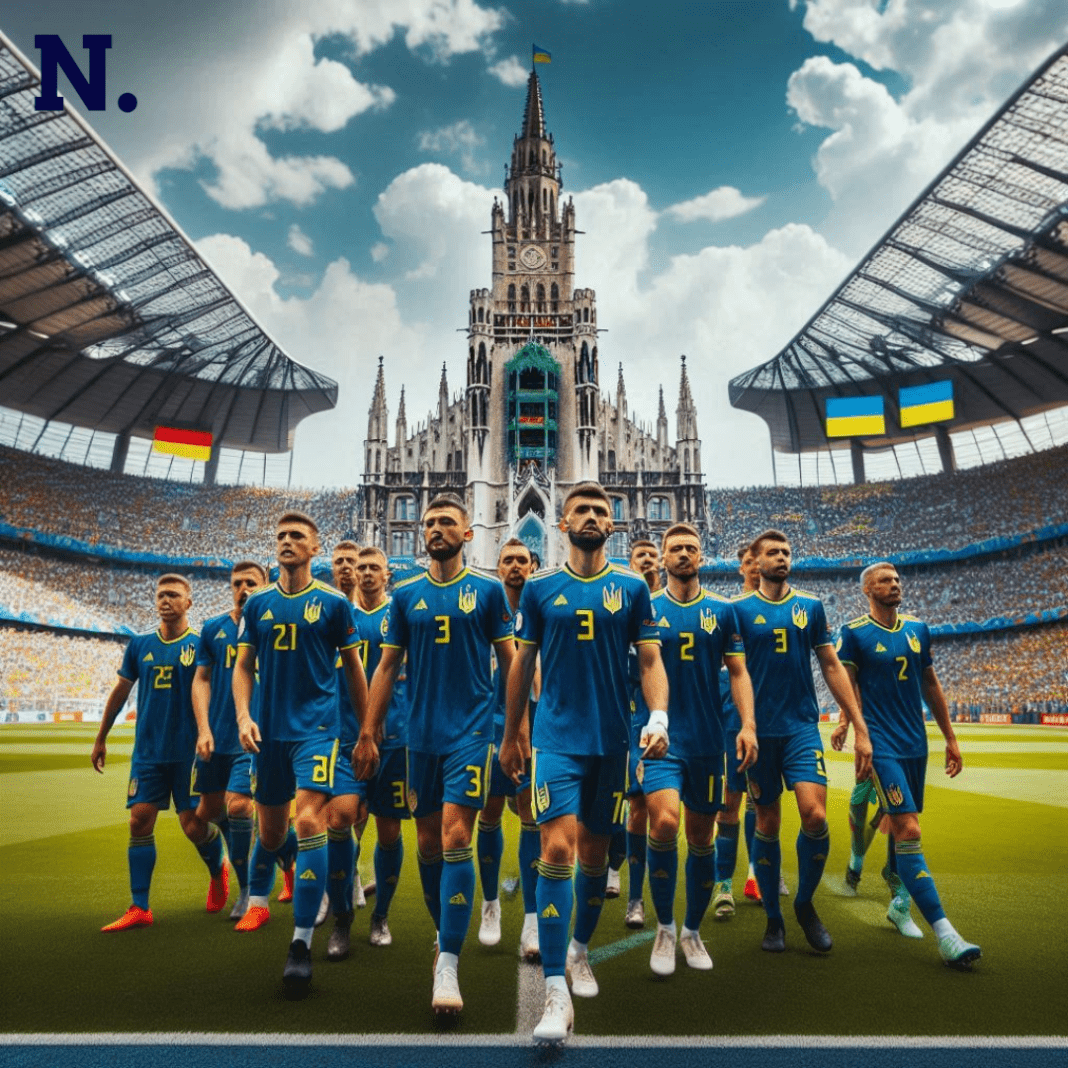

As the Ukrainian national football team prepares to face Romania in their European Championship on Monday, the stakes are higher than the usual bid for points. In each game, opportunities must be seized by Ukraine to underline its nation’s resilience in the fight with the Russian invasion.
European Dreams Shattered
Once the jewel in the crown of Shakhtar Donetsk and an architectural beacon signaling Ukraine’s rise, today the Donbas Arena lies desecrated and abandoned within Donetsk’s conflict zone. The stadium, which has 52,000 seats, opened in 2009 with a Beyoncé concert and hosted the semifinal of the 2012 European soccer championships. But since a 2014 Russia-engineered insurgency swept across eastern Ukraine, Shakhtar Donetsk has been displaced, with this stadium representing just one sad illustration of this country’s ongoing tragedy.
For the past decade, Shakhtar Donetsk, Ukraine’s most famous football club, has not used Donbas Arena for its football matches. This wartime tension urged the team’s constant movement: first, to Lviv in Western Ukraine; then to Poland; and afterward, by the time of full-scale invasion by Russia in 2022, to Germany. And yet, in these conditions, Shakhtar continued to succeed at the European scene, representing Ukrainian soccer.
European Spotlight on Ukraine
In February, aerial video released by Ukrainian forces showed the abandoned Donbass Arena—once a place of great hopes and shattered dreams. Ten years ago, President Volodymyr Zelensky said he was in this city, in this stadium, pushing the Ukrainian players. Today, when the national team steps onto the field of Munich, they will carry the hopes and dreams of a beleaguered nation.
During the war, on the pitch you used to only think about the outcome. But now, we consider both the outcome and displaying Europe the authentic essence of our country. This is one of the very few opportunities for Ukraine in the sun, a way to bring together and uplift compatriots both at home and in exile.
And, on top of that, Ukraine’s road to the European Championship was a struggle. They had to book a spot in the playoff after failing to easily qualify, which they secured in March, immediately after missing out on the 2022 World Cup in Qatar. During the last Euros, the team reached the quarterfinals, and that was before the war personally destroyed their homeland. Those same group- stage games, against Romania, Belgium, and Slovakia, will now be in front of crowds in Germany likely to be bolstered by throngs of Ukrainian exiles feeling their pain.
From Soccer field to Front Line
Speaking after Thursday’s game, Ukraine’s star players, the majority of whom play for the top clubs in Britain, Spain, and Italy, have spoken of the plight of their nation and the guilt at being away from the front lines. “Every day people die, cities destroyed,” said veteran Shakhtar midfielder Taras Stepanenko. I call my parents every morning to ask if they’re okay. We’ve been living in this condition for almost three years. It’s so difficult.”
This lot of payers has been at the forefront of fund-raising for humanitarian aid in the war and heads charity projects on the war-wounded. “We need to talk about it, shout about it every day,” said Arsenal’s Oleksandr Zinchenko. “This is the only way we can win.”
The fighting, outmanned and outgunned, was grimly holding the line against Russian forces. A peace conference in Switzerland spearheaded by Kyiv over the weekend saw little progress, with Russia and China being absent. A Russian proposal for a ceasefire and the surrender of four Ukrainian regions was swiftly batted aside by Kyiv and its allies.
Ukraine’s Fight on the European Stage
Against this gloomy backdrop, the Ukrainian team has been preparing to compete against Europe’s finest, knowing some of these gallant on-field performances can inspire an embattled nation. “In many ways, sports supposedly should be free from politics. But at the same time, Ukraine’s presence at the European Championship surely will contribute to bringing more international focus to the situation with the Russian invasion,” Mark Temnycky, with the Atlantic Council, said. The Ukrainian team will be aware that they represent a nation fighting for survival.
Players and staff of Ukraine, getting ready for that tournament under more difficult conditions, quickly got on board with such duties as observing safety requirements, air raids, curfew, and blackouts. “We have to work through a whole host of restrictions, including safety requirements, air raids, missile attacks from Russia, curfews and blackouts,” said Andriy Shevchenko, head of Ukraine’s main soccer body. ” We find it a little challenging to function, but we are managing.”
And as the national side ran out on the pitch in Munich, creative attacker Ruslan Malinovsky said what everybody felt. During every game in Ukraine, the people have more than 90 minutes of football that they can watch on TV with lights; it’s a reminder of the indomitable spirit they possess and a plea about solidarity, even in their darkest hours.