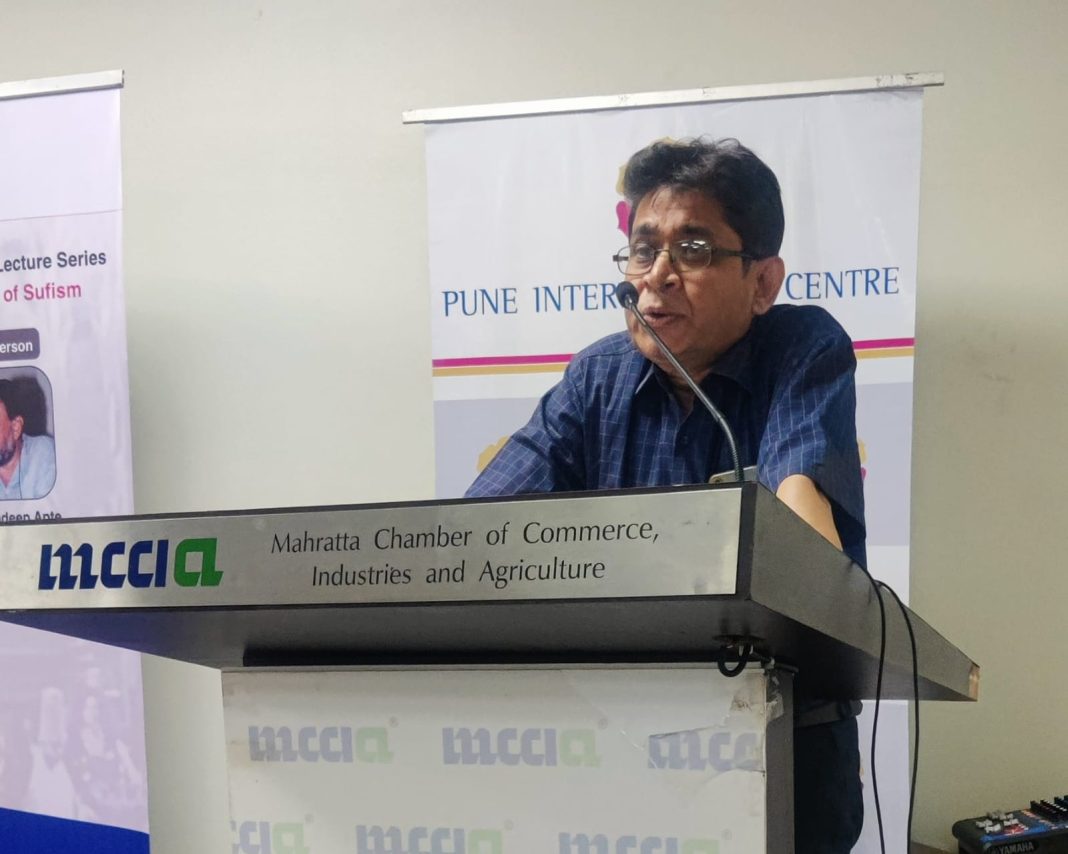

The Pune International Centre (PIC) marked the conclusion of its 11-part lecture series titled ‘India and the World’s Great Religions’ on December 19, 2024. The final lecture of this engaging series, which aimed to foster a deeper understanding of the world’s diverse religious traditions, focused on the philosophy of Sufism. Delivered by writer and columnist Mr. Sumit Paul, the lecture, titled ‘The All-encompassing Philosophy of Sufism’, explored the profound wisdom of Sufi teachings and their relevance in today’s fragmented world.
Mr. Paul, an independent researcher and expert in Semitic languages, culture, and civilisation, shared insights from his vast experiences, including his time in Iran, where he immersed himself in the study of Sufism. Currently based in Pune, Mr. Paul emphasized that the core spirit of Sufi philosophy—rooted in love, humanity, and spiritual universality—was urgently needed in contemporary society, which is often marred by conflict and division.
The lecture series, which ran for several months, featured discussions by prominent speakers from diverse backgrounds. Among them were Justice Rohinton Fali Nariman, who spoke on Zoroastrianism; Dr. Abhay Firodia, who provided insights into Jainism; Amb. Pavan Varma, who elaborated on Hinduism; and Mr. Wajahat Habibullah, who shared his thoughts on Islam, among others. The series also covered topics such as Buddhism, Christianity, Judaism, Sikhism, Bhagwat Dharma, Atheism, and more, making it a comprehensive exploration of global religious traditions.
A Platform for Pluralism: The Vision Behind the Lecture Series
Dr. Vijay Kelkar, Vice President of PIC, conceived the lecture series and envisioned a forum that would explore the diverse and pluralistic ethos of India. Dr. Latika Padgaonkar and Prof. Pradeep Apte curated the series, designing it to foster interfaith dialogue and mutual understanding. The lectures aimed not only to educate attendees about different religions but also to promote a broader vision of unity through pluralism.
Prof. Pradeep Apte, a Senior Fellow at PIC and Professor Emeritus at Savitribai Phule Pune University, presided over the last session, which focused on Sufism. During the event, Dr. Charu Gidwani presented her book, *An Anthology of Sindhi Sufi Poetry*, co-authored with French scholar Michel Boivin, to the distinguished speakers. Rohitesh Gidwani, Dr. Gidwani’s brother, handed over the book.
Sufism: A Universal Philosophy Beyond Boundaries
Mr. Paul began his lecture by explaining that Sufism is not confined to Islam alone. Rather, it is a philosophy that transcends religious boundaries, drawing inspiration from a variety of traditions, including Hinduism and Islam. He pointed out that Sufism is non-denominational and non-religious, rooted in the values of love, humanity, and the pursuit of spiritual truth. According to Mr. Paul, the central tenet of Sufi philosophy is love, not religious assertion.
A key theme of the lecture was the inclusive and non-assertive nature of Sufism, which promotes humaneness and a universal sense of belonging. Mr. Paul emphasized that Sufism’s teachings have historically been instrumental in diminishing the more militant and divisive aspects of religion. He explained that many of Sufism’s esoteric teachings originated from ancient Oriental mysticism, long before they became part of Islamic thought.
One of the most powerful points raised in the lecture was the shared philosophical underpinnings of Sufism and Hinduism, particularly through concepts such as ‘Ana al-Haq’ (I am Truth, I am God) in Sufism and ‘Aham Brahmasmi’ (I am Brahman) in Vedanta. Mr. Paul pointed out the striking parallels between these ideas, showing how both traditions, though from different religious backgrounds, share a deep spiritual resonance.
Influence of Sufism on Art, Culture, and Music
In his lecture, Mr. Paul also touched upon the profound impact of Sufism on the arts, culture, and music, both within India and across the world. He highlighted the growing popularity of Sufi poetry, especially that of Rumi, whose works have seen a surge in readership in the US and Europe. This, he argued, was a testament to the universal appeal of Sufi thought, which transcends cultural and geographical boundaries.
Mr. Paul noted that the Sindhi community, which has deep roots in Sufi tradition, refers to Sindh as the “Land of Sufis.” He spoke about the reverence for Sufism within this community and how its teachings have influenced both the cultural and spiritual fabric of the region.
In addition to this, he discussed the influence of Sufi philosophy on prominent figures from various cultural and spiritual traditions. He pointed out that figures like Kabir, Ramakrishna Paramahansa, St. Augustine, Rabindranath Tagore, and poets like John Donne and Walt Whitman exhibited sensibilities similar to those of Sufism. Their teachings, he said, reflected the universal values of love, peace, and spiritual enlightenment that Sufism advocates.
A Call for Harmony in a Divided World
In conclusion, Mr. Paul’s lecture was a call to embrace the teachings of Sufism in today’s world, which is increasingly divided along ideological and religious lines. Sufism’s emphasis on love, humanity, and spiritual universality offers a pathway to peace and mutual respect, he argued. The lecture served as a reminder that the world’s great spiritual traditions, including Sufism, offer timeless wisdom that can help heal the divisions and conflicts of the modern age.
As the lecture series came to an end, the attendees left with a renewed sense of appreciation for the diversity and richness of world religions, and a deeper understanding of the potential for unity and peace through the teachings of Sufism. This series was a significant step toward promoting interfaith dialogue and fostering a more inclusive and harmonious world.