

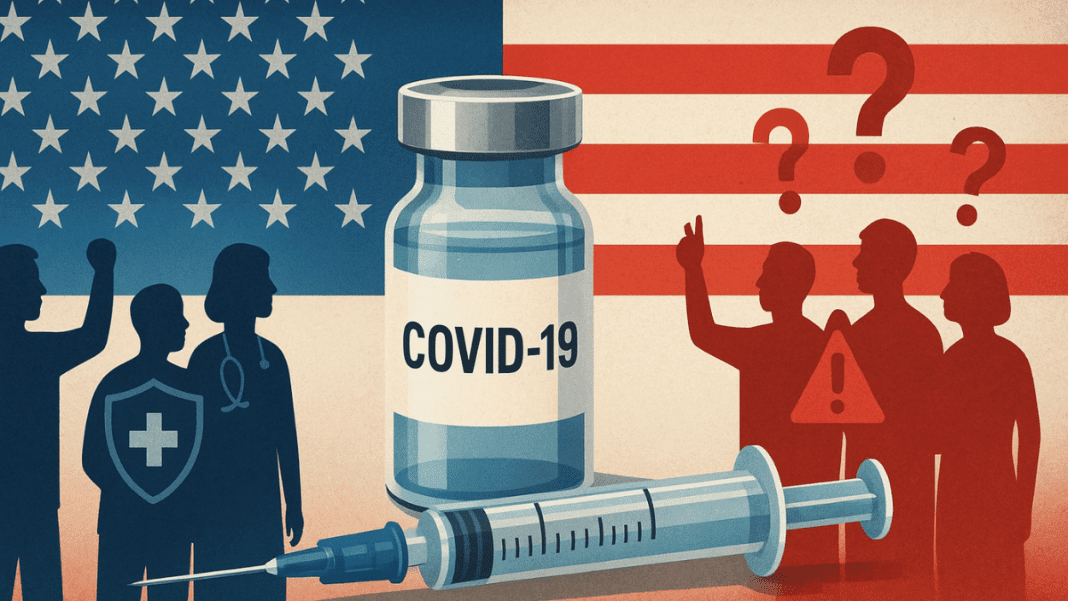
Donald Trump and RFK Jr. plan dramatic move to pull COVID vaccine within months

A surprising claim has emerged that the U.S. government may take steps to remove the COVID-19 vaccine from the market. Officials say the move will come “within months” as growing pressure inside the administration and ongoing debates over vaccine safety drive the decision. Reports suggest this decision is gaining traction among top officials, sparking concerns across the medical community and political circles alike.

Claims of vaccine removal and ongoing reviews

The news comes after strong criticism of mRNA vaccines. These shots were the most widely used during the pandemic. People around the world praised them for preventing serious illness and deaths. But some groups have continued to question their safety. Removing the vaccine would be one of the biggest public health decisions in U.S. history.

The claims center around reports that officials close to the administration want to suspend or ban COVID-19 vaccines in the United States. A senior adviser within the Health and Human Services department said officials could make the decision in stages. One option is a gradual review of vaccine safety data. Another is a sudden, single ruling to stop the use of the shots altogether.

Supporters of the move say the vaccine may have risks that are not fully known. They point to studies that show more side effects in some groups. One study from 2022 reported a small rise in serious health problems among people who took the mRNA vaccines. The study said people who got the vaccine had a 16 percent higher risk of serious side effects compared to those who got a placebo.

However, most of the scientific community has rejected this claim. Experts say the study had flaws, relied on selective data, and ignored the overwhelming evidence that the vaccines saved millions of lives. Health agencies around the world, including in the U.S., have repeatedly stated that the benefits of vaccination outweigh the risks.

Funding cuts and rising criticism

The government has already taken big steps against COVID-19 vaccines. It recently canceled $500 million in funding for new mRNA vaccines. Many people see this as a move away from these vaccines. mRNA vaccines work by using genetic instructions to help the body’s immune system fight disease.

Critics say the cancellation undermines scientific progress and could slow down medical innovation. At the same time, the Health and Human Services secretary has faced backlash for publicly calling the COVID-19 shot “the deadliest vaccine ever made.” He also linked it to conditions like myocarditis, fatigue, and other health problems.

Johnson and Johnson unit ends two year legal battle on Skin360 app storage of biometric information

These words have angered many in the medical community. More than 750 current and former workers from the CDC, NIH, and HHS signed a letter. They asked the administration to stop spreading what they called harmful misinformation and said that officials were putting public health at risk. They also said this was breaking trust in the institutions meant to protect Americans.

The letter also linked vaccine misinformation to a recent tragedy. Earlier this month, an anti-vaccine extremist opened fire on the CDC, killing a police officer. The attacker believed the COVID vaccine had harmed him or would harm him, and investigators said his hatred of vaccination fueled his actions.

White House responds as controversy grows

As the debate grows, the White House has responded. Officials dismissed talk of a coming ban as speculation. A spokesperson said the administration is relying on trusted science to guide its choices. He added that no policy changes have been announced. He also said people should not take media reports as fact unless they are officially confirmed.

Cyberattack Catastrophe: How Hackers Can Endanger Human Lives ?

Still, reports of a possible ban have raised alarms among doctors, scientists, and public health workers. They warn that even suggesting such a move creates mistrust, deepens political divides, and discourages people from seeking vaccines that prevent serious illness.

For now, the official policy has not changed, and COVID-19 vaccines remain available across the country. But influential voices inside the administration are questioning their safety, throwing the future of vaccination in the U.S. into uncertainty.

Renuka Bangale
Renuka Bangale
Renuka is a distinguished Chartered Accountant and a Certified Digital Threats Analyst from Riskpro, renowned for her expertise in cybersecurity. With a deep understanding of cybercrimes, malware, cyber warfare, and espionage, she has established herself as an authority in the field. Renuka combines her financial acumen with advanced knowledge of digital threats to provide unparalleled insights into the evolving landscape of information security. Her analytical prowess enables her to dissect complex cyber incidents, offering clarity on risks and mitigation strategies. As a key contributor to Newsinterpretation’s information security category, Renuka delivers authoritative articles that educate and inform readers about emerging threats and best practices.

TOP 10 TRENDING ON NEWSINTERPRETATION

Cyber Attacks on Space Infrastructure: Satellites, GPS and the Ground Systems Behind Them

From the Viasat KA-SAT hack to GPS jamming over the Baltic, a research guide to how attackers target satellites, navigation signals and ground stations, and why it matters on Earth.

How AI Agents Are Used in Cyber Attacks: From Assisted Hacking to AI-Orchestrated Espionage

Attackers now use AI agents to scan networks, write exploits and run extortion campaigns. A research guide to documented cases, including the first reported AI-orchestrated espionage campaign, and what defenders should do.

Cyber Attacks on AI and LLMs: How Attackers Target Large Language Models

Prompt injection, data poisoning, model theft and jailbreaks: a research guide to how attackers target AI systems and large language models, with real cases and defences.

French Supermarket Refrigeration Cyberattack: How Hacking the Cold Chain Can Endanger Lives

In October 2026 attackers heated refrigeration cabinets in hundreds of French supermarkets to as much as 50°C. No one was hurt, but the attack shows how hacking the cold chain can endanger lives through fire, food poisoning and spoiled medicines.

Cyberattacks on Nuclear Facilities: Stuxnet, Kudankulam and the Limits of Air Gaps

Stuxnet, the Davis-Besse worm and malware at India’s Kudankulam plant: what they show about cyber risk at nuclear facilities and the limits of air gaps.

Triton: When Hackers Target the Safety Systems That Prevent Industrial Disasters

The 2017 Triton attack targeted the safety systems that prevent industrial disasters. What happened, who was charged, and how plants protect their last line of defence.

Cybersecurity Risks in Smart Cities: When Connected Infrastructure Fails

How connecting traffic control, emergency alerts and utilities concentrates cyber risk in cities, what the Dallas and Atlanta incidents showed, and what governments recommend.

Weaponized Drones: Hijacking, GPS Spoofing and Emerging Cyber Warfare Risks

How drones can be hijacked, jammed or misled by GPS spoofing, what researchers have demonstrated, and why governments treat drone fleets as a security risk.

Ransomware Attacks on Hospitals: How Healthcare Cyberattacks Put Patients at Risk

How ransomware against hospitals and their suppliers delays care and endangers patients, what the Düsseldorf and WannaCry cases show, and what research says about deaths.

Operational blunder exposes massive Russian cyber espionage attack on Ukrainian prosecutors

A major cyberattack has compromised the email accounts of...

Cyber Attacks on Space Infrastructure: Satellites, GPS and the Ground Systems Behind Them

From the Viasat KA-SAT hack to GPS jamming over the Baltic, a research guide to how attackers target satellites, navigation signals and ground stations, and why it matters on Earth.

French Supermarket Refrigeration Cyberattack: How Hacking the Cold Chain Can Endanger Lives

In October 2026 attackers heated refrigeration cabinets in hundreds of French supermarkets to as much as 50°C. No one was hurt, but the attack shows how hacking the cold chain can endanger lives through fire, food poisoning and spoiled medicines.

Cyberattacks on Nuclear Facilities: Stuxnet, Kudankulam and the Limits of Air Gaps

Stuxnet, the Davis-Besse worm and malware at India’s Kudankulam plant: what they show about cyber risk at nuclear facilities and the limits of air gaps.

Triton: When Hackers Target the Safety Systems That Prevent Industrial Disasters

The 2017 Triton attack targeted the safety systems that prevent industrial disasters. What happened, who was charged, and how plants protect their last line of defence.

Cybersecurity Risks in Smart Cities: When Connected Infrastructure Fails

How connecting traffic control, emergency alerts and utilities concentrates cyber risk in cities, what the Dallas and Atlanta incidents showed, and what governments recommend.

Ransomware Attacks on Hospitals: How Healthcare Cyberattacks Put Patients at Risk

How ransomware against hospitals and their suppliers delays care and endangers patients, what the Düsseldorf and WannaCry cases show, and what research says about deaths.

FBI warns of AVrecon malware targeting outdated routers linked to proxy based cybercrime

A serious cybersecurity warning has been issued regarding commonly...

Related Articles

Popular Categories
