

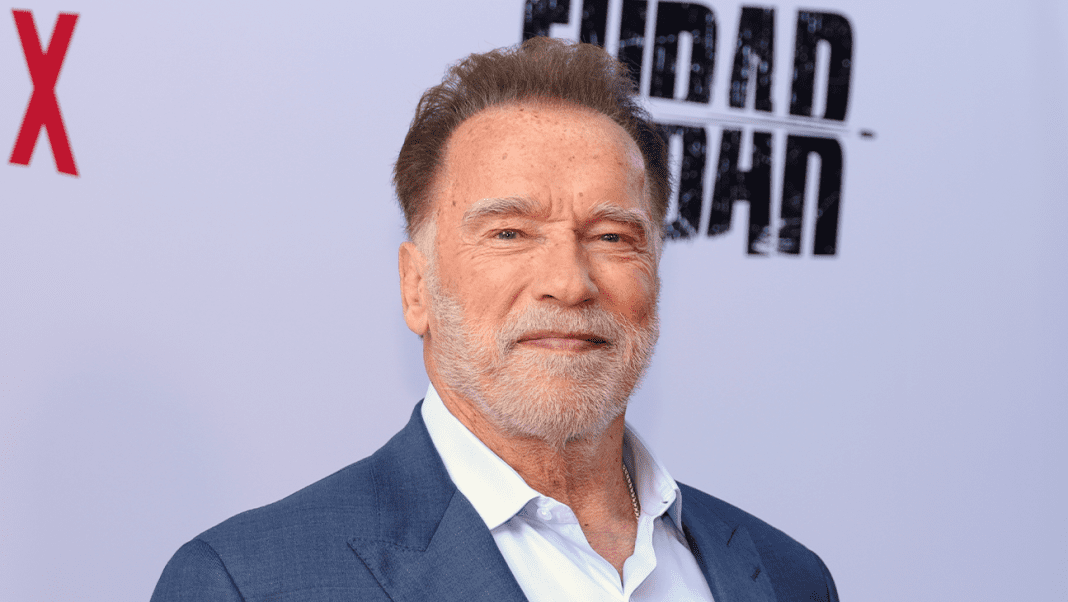

Former California governor Arnold Schwarzenegger issued a powerful condemnation of Nazi sympathizers and extremist ideology during an appearance on CNN’s State of the Union on Sunday, drawing upon his own family’s dark history under Adolf Hitler’s regime.
In a tense exchange with host Jake Tapper, the 78-year-old actor and political figure was asked to respond to the recent surge of Nazi symbols and rhetoric in American politics — from Senate candidate Graham Platner’s controversial tattoo to leaked messages by Trump aide Paul Ingrassia and a Young Republicans group chat celebrating Nazi imagery.
Tapper referenced Schwarzenegger’s long record of speaking candidly about his father, Gustav Schwarzenegger, a member of the Nazi Party during World War II. “You have spoken so movingly in the past about your father’s membership in the Nazi Party—denouncing it. What is your message to anybody in politics today embracing or praising Nazis or Hitler in any way?” Tapper asked.
Schwarzenegger paused briefly before answering with controlled firmness. “I can just tell you one thing,” he said. “Anyone that idolizes Nazis, it’s bad news. Because we have been there before, and we have seen the outcome. There are no winners, okay? It’s that simple. And I think that’s not the direction we want to go.”
His response was a sharp rebuke at a time when far-right symbolism has reemerged in segments of American political culture, sparking alarm among historians and civil rights advocates.
A family shadowed by history
Schwarzenegger has long spoken publicly about his father’s service under Hitler’s regime, describing it as a source of both personal pain and public responsibility. Gustav Schwarzenegger voluntarily joined the Nazi Party in Austria in 1938 and served as a police officer before being injured at the Battle of Leningrad in 1943.
The elder Schwarzenegger’s affiliation with Nazism became a prominent issue during Arnold’s rise to power in the United States. When he was elected governor of California in 2003, opponents frequently raised questions about his family’s past. Schwarzenegger, however, directly confronted the issue, denouncing his father’s actions and expressing deep regret for the suffering caused by the regime.
On Sunday, the former governor again made clear that acknowledging history was not about guilt, but accountability. “We’ve seen what hate does,” he said. “I’ve seen it in my own family. I’ve seen how it destroys people, how it ruins generations. There is nothing strong or patriotic about it.”
The conversation with Tapper comes amid a growing number of reports involving Nazi iconography and rhetoric among political candidates and officials. Schwarzenegger’s blunt remarks echoed the tone of several past public speeches in which he warned against “anti-democratic nostalgia” and called for civic courage over extremism.
While his comments were triggered by American controversies, his underlying message touched on the universal lessons of history — that fascism and racism begin not with wars, but with normalization and silence. “It starts with people saying, ‘It’s not a big deal,’” Schwarzenegger said. “And before long, it becomes normal. I think we have to remember that history already told us where that road ends.”
California declares war on loud commercials — Gavin Newsom signs law to silence streaming annoyances
Controversies fueling the discussion
The CNN exchange followed a series of politically charged incidents involving Nazi-related imagery and rhetoric that have dominated American headlines in recent weeks.
One case centers on Graham Platner, a Democratic Senate hopeful from Maine, who was photographed with a tattoo resembling a Nazi symbol. Platner claimed that he had been unaware of the tattoo’s meaning when he received it nearly two decades ago while stationed with the Marines in Croatia. He has since apologized publicly, stating that the incident “does not reflect my beliefs.”
Another controversy erupted around Paul Ingrassia, a Trump administration aide whose leaked text messages included references to having a “Nazi streak.” Following public backlash, Ingrassia withdrew his nomination for a senior federal position.
Meanwhile, a separate scandal emerged when a Young Republicans group chat was leaked, revealing members sharing racist memes and pro-Nazi remarks, prompting internal investigations and public outrage.
Asked by Tapper about these incidents, Schwarzenegger acknowledged that he was unfamiliar with the specific cases but refused to equivocate. “Anyone that idolizes Nazis is bad news,” he reiterated, stressing that such ideologies had no place in a civilized democracy.
Schwarzenegger also pivoted to a broader critique of political division and moral decline in the United States. “What we want to do is make sure that both of the parties — it doesn’t matter if you’re Democrat or Republican — get together and start figuring out what is best for the people of America,” he said. “Because that’s what patriotism looks like.”
The actor-turned-politician’s statement underscores a recurring theme in his public life: his commitment to unity and moderation in an era of polarization. As governor, Schwarzenegger frequently clashed with his own Republican Party over climate policy and immigration but remained vocal about rejecting extremism on all sides.
His recent CNN remarks continue that trajectory — a firm moral stance rooted in personal history and civic identity. The former governor has long used his platform to caution against authoritarian impulses, describing democracy as “fragile and worth protecting.”
Schwarzenegger’s warning to those embracing Nazi rhetoric comes amid rising political tension in the United States and Europe, where fringe ideologies have gained renewed attention through social media and populist movements.
For a man whose own family once served under Hitler’s regime, the message carried unmistakable weight. As he reminded viewers on Sunday, “There are no winners when you glorify hate.”


