

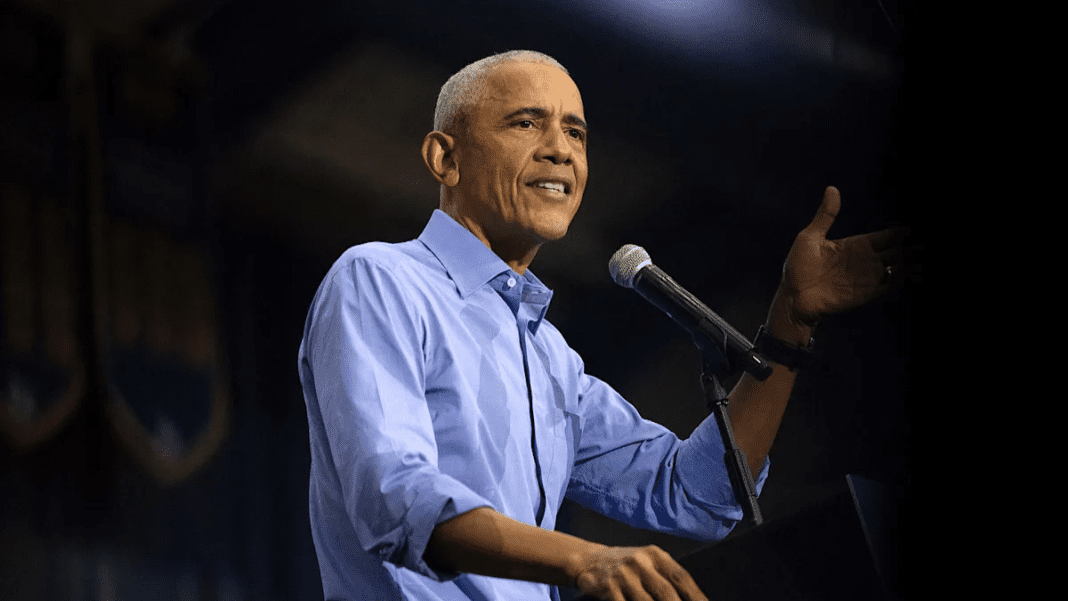

Obama attacks Trump family’s crypto riches — says “White House became a crypto exchange”

During a weekend rally in Virginia, former U.S. President Barack Obama delivered a fiery speech criticizing President Donald Trump and his family for their growing fortune tied to cryptocurrency. Speaking at the event held in support of Democratic gubernatorial candidate Abigail Spanberger, Obama accused the Trump administration of favoring “billionaire pals and finance insiders” while everyday Americans struggle with high living costs.

Obama said the economy may not be working for most citizens, but it certainly seems to be working for the Trump family. He claimed that President Trump’s relatives are expanding their crypto ventures while ignoring the nation’s broader economic issues. The former President’s remarks quickly gained national attention for their sharp tone and direct attack on the Trump family’s cryptocurrency involvement.

He told the crowd that the country’s current leadership has created an environment where “every day feels like Halloween — all tricks and no treats.” According to Obama, what he feared during the campaign has now become reality, as the Trump family continues to benefit from financial ventures while the public faces economic strain.

The Trump Family’s Crypto Empire Under Scrutiny

Obama’s criticism focused on a company called World Liberty Financial, a digital currency venture reportedly owned mostly by members of the Trump family. Reports suggest that the family controls more than half of the company, which has already generated hundreds of millions of dollars in profits.

Barack Obama chooses not to endorse Zohran Mamdani, citing post-presidency policy on local races

World Liberty Financial, launched during President Trump’s term, has gained attention for attracting investors from both the United States and abroad. The company offers digital tokens and other crypto products that have become popular among traders and wealthy investors. However, Obama questioned the motives behind these investments, hinting that some individuals might be putting money into the company to stay in the President’s good favor rather than for genuine financial reasons.

The former President warned that such arrangements raise serious concerns about fairness and transparency. He said that while ordinary Americans are struggling with bills and inflation, the Trump family seems to be doing better than ever.

Obama also mocked what he called the Trump family’s extravagant lifestyle, referring to a new $300 million ballroom and the renovation of the White House Rose Garden. He suggested that these projects symbolize how disconnected the family has become from the economic realities facing most Americans. His remarks drew laughter and applause from the audience, many of whom cheered at his pointed humor and emotional tone.

Obama emerges from behind the scenes to shape battle for U.S. democracy as Trump re-ascends

Accusations of Distraction and Manipulation

In addition to attacking the Trump family’s crypto dealings, Obama accused President Trump of using social media to distract voters from pressing economic issues. He pointed to several viral online posts, including AI-generated videos that depict the President as a larger-than-life figure. According to Obama, such content is designed to keep the public entertained while the wealthiest people in the country quietly gain more power and money.

He argued that these online distractions allow the administration to avoid accountability for its financial policies. “They want you to look at the show, not the scoreboard,” Obama said, claiming that the government’s actions primarily benefit the rich while ordinary families continue to pay the price.

Obama’s comments quickly spread across social media and news outlets, sparking debate over whether political families should have financial interests in private ventures that could be influenced by government decisions. His remarks also brought renewed attention to World Liberty Financial, which remains under scrutiny for its ownership structure and the size of profits it has generated for the Trump family.

The former President’s speech, though humorous at times, carried a strong message about ethics and public service. He reminded voters that leadership should focus on improving people’s lives, not enriching those already at the top. His direct criticism of President Trump’s family and their cryptocurrency fortune marked one of his most forceful public interventions since leaving office.


Pearl Croft
Pearl Crofthttps://newsinterpretation.com
I am Pearl Croft I give “News Interpretation” an insight into the most recent news hitting the “Consumer Goods” sector in Wall Street. I have been an independent financial adviser for over 11 years in the city and in recent years turned my experience in finance and passion for journalism into a full time role. I perform analysis of Companies and publicize valuable information for shareholder community. But writing about the political developments is my hobby.

TOP 10 TRENDING ON NEWSINTERPRETATION

Cyber Attacks on Space Infrastructure: Satellites, GPS and the Ground Systems Behind Them

From the Viasat KA-SAT hack to GPS jamming over the Baltic, a research guide to how attackers target satellites, navigation signals and ground stations, and why it matters on Earth.

How AI Agents Are Used in Cyber Attacks: From Assisted Hacking to AI-Orchestrated Espionage

Attackers now use AI agents to scan networks, write exploits and run extortion campaigns. A research guide to documented cases, including the first reported AI-orchestrated espionage campaign, and what defenders should do.

Cyber Attacks on AI and LLMs: How Attackers Target Large Language Models

Prompt injection, data poisoning, model theft and jailbreaks: a research guide to how attackers target AI systems and large language models, with real cases and defences.

French Supermarket Refrigeration Cyberattack: How Hacking the Cold Chain Can Endanger Lives

In October 2026 attackers heated refrigeration cabinets in hundreds of French supermarkets to as much as 50°C. No one was hurt, but the attack shows how hacking the cold chain can endanger lives through fire, food poisoning and spoiled medicines.

Cyberattacks on Nuclear Facilities: Stuxnet, Kudankulam and the Limits of Air Gaps

Stuxnet, the Davis-Besse worm and malware at India’s Kudankulam plant: what they show about cyber risk at nuclear facilities and the limits of air gaps.

Triton: When Hackers Target the Safety Systems That Prevent Industrial Disasters

The 2017 Triton attack targeted the safety systems that prevent industrial disasters. What happened, who was charged, and how plants protect their last line of defence.

Cybersecurity Risks in Smart Cities: When Connected Infrastructure Fails

How connecting traffic control, emergency alerts and utilities concentrates cyber risk in cities, what the Dallas and Atlanta incidents showed, and what governments recommend.

Weaponized Drones: Hijacking, GPS Spoofing and Emerging Cyber Warfare Risks

How drones can be hijacked, jammed or misled by GPS spoofing, what researchers have demonstrated, and why governments treat drone fleets as a security risk.

Ransomware Attacks on Hospitals: How Healthcare Cyberattacks Put Patients at Risk

How ransomware against hospitals and their suppliers delays care and endangers patients, what the Düsseldorf and WannaCry cases show, and what research says about deaths.

Operational blunder exposes massive Russian cyber espionage attack on Ukrainian prosecutors

A major cyberattack has compromised the email accounts of...

Cyber Attacks on Space Infrastructure: Satellites, GPS and the Ground Systems Behind Them

From the Viasat KA-SAT hack to GPS jamming over the Baltic, a research guide to how attackers target satellites, navigation signals and ground stations, and why it matters on Earth.

French Supermarket Refrigeration Cyberattack: How Hacking the Cold Chain Can Endanger Lives

In October 2026 attackers heated refrigeration cabinets in hundreds of French supermarkets to as much as 50°C. No one was hurt, but the attack shows how hacking the cold chain can endanger lives through fire, food poisoning and spoiled medicines.

Cyberattacks on Nuclear Facilities: Stuxnet, Kudankulam and the Limits of Air Gaps

Stuxnet, the Davis-Besse worm and malware at India’s Kudankulam plant: what they show about cyber risk at nuclear facilities and the limits of air gaps.

Triton: When Hackers Target the Safety Systems That Prevent Industrial Disasters

The 2017 Triton attack targeted the safety systems that prevent industrial disasters. What happened, who was charged, and how plants protect their last line of defence.

Cybersecurity Risks in Smart Cities: When Connected Infrastructure Fails

How connecting traffic control, emergency alerts and utilities concentrates cyber risk in cities, what the Dallas and Atlanta incidents showed, and what governments recommend.

Ransomware Attacks on Hospitals: How Healthcare Cyberattacks Put Patients at Risk

How ransomware against hospitals and their suppliers delays care and endangers patients, what the Düsseldorf and WannaCry cases show, and what research says about deaths.

FBI warns of AVrecon malware targeting outdated routers linked to proxy based cybercrime

A serious cybersecurity warning has been issued regarding commonly...

Related Articles

Popular Categories
