

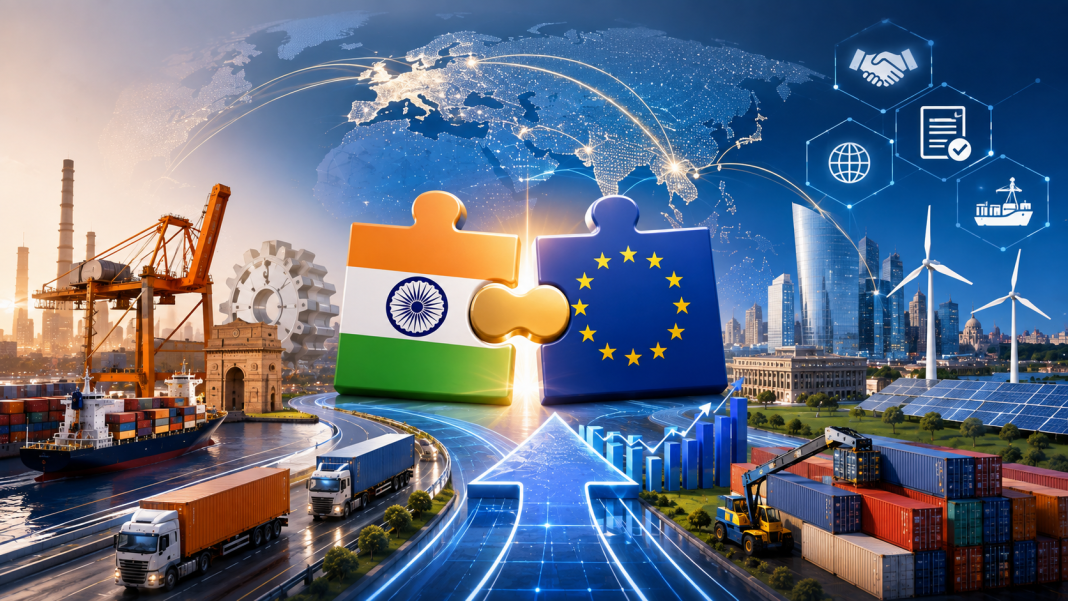

The proposed India–European Union (EU) Free Trade Agreement (FTA) is shaping up to be one of the most significant trade deals negotiated by either side. While trade agreements are often associated with lower import duties, this one goes much further. It seeks to improve market access, simplify customs procedures, strengthen investment, protect intellectual property and make it easier for businesses to operate across two of the world’s largest economies.
The timing is equally important. As businesses diversify supply chains following the pandemic, geopolitical tensions and shifting trade policies, both India and the EU are looking to deepen economic ties. India offers a rapidly expanding manufacturing base and one of the world’s fastest-growing major economies, while the EU remains one of the largest consumer markets and investment destinations globally. The agreement is expected to strengthen this relationship by reducing barriers that continue to increase the cost and complexity of cross-border trade.
According to the European Commission, trade in goods and services between India and the EU already exceeds €180 billion annually. EU exports to India reached €75 billion in 2024, including €48.8 billion in goods and €26 billion in services, while European investment stock in India stood at €140.1 billion in 2023. Rather than creating a new trade partnership, the FTA aims to unlock the untapped potential of an already significant commercial relationship.
What Is the India–EU Free Trade Agreement?
A Free Trade Agreement is a legally binding arrangement between two economies that reduces barriers affecting trade and investment. While tariff reductions remain one of its most visible features, modern FTAs also address customs procedures, services, investment, intellectual property, regulatory transparency and sustainable development.
The India–EU FTA follows this broader approach. Instead of focusing solely on lowering duties, it seeks to create a more predictable business environment where companies can move goods more efficiently, expand into overseas markets with greater certainty and invest with increased confidence.
The agreement broadly aims to:
- Reduce tariffs on a large share of traded goods.
- Simplify customs and border procedures.
- Improve market access for goods and services.
- Encourage bilateral investment.
- Strengthen protection for intellectual property.
- Improve regulatory transparency.
- Support small and medium-sized enterprises (SMEs) engaged in international trade.
How the Agreement Could Affect Businesses
| Business area | Current challenge | Expected impact of the FTA |
| Importing goods | Higher tariffs increase costs | Lower duties improve price competitiveness |
| Customs | Lengthy documentation and border delays | Faster clearance and simplified procedures |
| Services | Limited access in some sectors | Better market opportunities and regulatory transparency |
| Investment | Regulatory uncertainty | Improved investor confidence |
| Intellectual property | Different protection standards | Stronger safeguards for innovation |
| SMEs | Complex overseas regulations | Easier access to trade information and procedures |
Why the Agreement Matters Now
The renewed momentum behind the India–EU FTA reflects changes in the global economy rather than a sudden shift in bilateral relations.
Over the past few years, businesses have increasingly diversified manufacturing and sourcing strategies to reduce dependence on a limited number of markets. Supply chain disruptions, geopolitical tensions and changing trade policies have encouraged companies to look for reliable long-term trading partners.
India has emerged as an attractive destination because of its expanding industrial base, growing domestic market and improving infrastructure. At the same time, the European Union continues to strengthen partnerships with economies that can contribute to resilient and diversified supply chains.
The agreement therefore serves both commercial and strategic objectives. For India, it offers greater access to one of the world’s largest consumer markets while encouraging investment and technology collaboration. For European businesses, it provides improved opportunities in one of the world’s fastest-growing major economies.
Together, India and the EU represent nearly two billion consumers and account for approximately one-quarter of global GDP, making any improvement in market access significant for international trade.
How the FTA Could Change the Way Businesses Operate
Lower tariffs improve competitiveness
Import duties directly influence the final price of products entering overseas markets. Lower tariffs allow exporters to sell products at more competitive prices without reducing manufacturing costs or profit margins.
The European Commission estimates that the agreement will reduce or eliminate tariffs on 96.6% of EU goods exports, potentially saving European businesses up to €4 billion annually in customs duties. It also expects EU goods exports to India to double by 2032 following implementation of the agreement.
Indian exporters are also expected to benefit from improved access to one of the world’s largest high-income consumer markets, particularly in sectors where tariff barriers have traditionally reduced competitiveness.
Customs reforms can be equally important
For many businesses, administrative procedures create costs that receive far less attention than tariffs.
War on Iran: An Indian Civilisational Perspective
Every international shipment requires customs documentation, regulatory checks and compliance with border procedures. Delays increase warehousing expenses, disrupt production schedules and tie up working capital.
The agreement seeks to simplify customs processes through greater transparency, cooperation and more efficient border procedures. Faster clearance can reduce logistics costs while improving delivery reliability, particularly for manufacturers operating integrated supply chains.
For SMEs with limited compliance resources, simpler customs procedures can significantly reduce the administrative burden associated with international trade.
Expanding opportunities beyond goods
Trade between India and the EU increasingly extends beyond manufactured products. Services such as information technology, engineering, finance, consulting and logistics now play a much larger role in bilateral commerce.
The FTA includes commitments aimed at improving market access in selected service sectors while increasing transparency around licensing and regulatory procedures. Although domestic regulations will continue to apply, greater clarity can make overseas expansion easier for businesses evaluating new markets.
Investment is another major component of the agreement. Companies establishing manufacturing facilities, research centres or logistics operations require long-term regulatory certainty before committing capital. By improving transparency and strengthening commercial cooperation, the agreement seeks to create a more stable investment environment for businesses on both sides.
Supporting innovation and smaller businesses
The agreement also recognises that international trade increasingly depends on knowledge, technology and innovation.
It includes commitments relating to trademarks, copyrights, industrial designs, trade secrets and geographical indications, helping businesses protect valuable intellectual property when operating across international markets.
At the same time, a dedicated chapter on SMEs acknowledges that smaller businesses often face greater challenges in navigating international regulations. By improving access to information and increasing transparency, the agreement aims to make overseas markets more accessible for companies that lack the specialised compliance resources available to large multinational corporations.
Which Industries Could Benefit the Most?
The impact of the India–EU FTA will not be uniform across the economy. Sectors that rely heavily on exports, imported inputs or cross-border investment are expected to see the most immediate benefits. The extent of those gains will depend on the final agreement, implementation timelines and how quickly businesses adapt to the new framework.
Rather than creating opportunities overnight, the FTA is expected to improve long-term competitiveness by lowering costs, expanding market access and making international trade more predictable.
| Industry | What could change | Potential business impact |
| Engineering and industrial machinery | Lower tariffs and simpler customs procedures | Improved export competitiveness and lower import costs |
| Pharmaceuticals | Better market access and stronger IP protection | Greater opportunities for exports, partnerships and investment |
| Chemicals | Reduced trade barriers | Improved access to a larger customer base |
| Textiles and apparel | Better market access | Higher export potential for competitive manufacturers |
| Automotive components | Easier movement of goods across supply chains | Greater integration into global manufacturing networks |
| Financial and professional services | Improved regulatory transparency | Better opportunities for cross-border operations |
| Renewable energy and clean technology | Increased cooperation and investment | Stronger collaboration in emerging industries |
Although these sectors are frequently highlighted, the agreement is likely to benefit many businesses indirectly. Lower trade costs can improve supply chain efficiency, while greater investment may generate opportunities for logistics providers, technology firms, consultants and other supporting industries.
What Businesses Should Prepare For
Trade agreements create opportunities, but they also introduce new responsibilities. Companies that understand the rules and prepare early are generally better positioned to benefit than those waiting until implementation is complete.
EU develops data sharing rules for Google alongside digital identity wallet rollout
Rules of Origin matter
One of the most important provisions in any FTA is the Rules of Origin. These rules determine whether a product qualifies for preferential tariff treatment.
A product does not automatically receive lower tariffs simply because it is exported from India or the EU. Businesses must demonstrate that it has been sufficiently produced or processed within one of the partner economies according to agreed criteria.
This can be particularly important for manufacturers using components sourced from multiple countries. Maintaining accurate documentation and understanding supply chains will therefore remain essential.
Compliance requirements will continue
The FTA reduces trade barriers, but it does not remove product standards or regulatory obligations.
Exporters will still need to comply with technical regulations, certification requirements, safety standards and labelling rules in the destination market. Businesses with well-developed compliance systems are likely to adapt more quickly and benefit sooner from the agreement.
For sectors such as pharmaceuticals, chemicals, engineering and food products, meeting regulatory standards will remain as important as tariff reductions.
Sustainability is becoming part of international trade
The agreement also reflects the growing importance of sustainable trade.
It includes commitments related to environmental protection, labour standards and sustainable development, recognising that international trade increasingly considers social and environmental factors alongside commercial interests.
For many businesses, especially those supplying European customers, sustainability expectations are already influencing procurement decisions. Companies investing in responsible sourcing, transparent supply chains and environmental performance may be better positioned as these considerations become increasingly integrated into global trade.
Competition will increase
Improved market access works in both directions.
Indian exporters may find new opportunities in Europe, but European businesses will also gain improved access to India’s expanding market. Increased competition is therefore likely in several industries.
For businesses, this presents both opportunities and challenges. Companies that invest in productivity, innovation and product quality will be better equipped to compete in a more open marketplace.
Why the Agreement Matters Beyond Trade
The significance of the India–EU FTA extends beyond exports and imports.
Global businesses are increasingly deciding where to manufacture products, establish research facilities and build long-term supply chains. Those decisions depend not only on labour costs and consumer demand but also on the strength of economic relationships between countries.
By strengthening commercial cooperation between India and the European Union, the agreement supports broader objectives such as supply chain diversification, investment, technology collaboration and economic resilience.
India advances AI ambitions with L&T-NVIDIA gigawatt data center partnership Mor
For India, deeper integration with the EU can support manufacturing growth, attract investment and expand participation in global value chains. For Europe, closer ties with India contribute to efforts to diversify trade partnerships while maintaining access to one of the world’s fastest-growing major economies.
The agreement therefore represents both a commercial opportunity and a strategic partnership that reflects the changing dynamics of global trade.
Key Takeaways
The India–EU Free Trade Agreement is much broader than a conventional tariff-reduction pact. It aims to improve the overall business environment by addressing many of the practical barriers that affect international trade and investment.
Some of its expected benefits include:
- Lower tariffs on a large share of traded goods.
- Simpler customs procedures and improved border efficiency.
- Better access to selected services markets.
- Greater transparency for investors.
- Stronger protection for intellectual property.
- Dedicated support for SMEs participating in international trade.
- Closer cooperation on sustainable and rules-based trade.
For businesses, these measures could reduce costs, improve operational efficiency and create new opportunities across two of the world’s largest economies.
Conclusion
The India–EU Free Trade Agreement has the potential to reshape one of the world’s most important economic partnerships. By addressing tariffs alongside customs procedures, services, investment, intellectual property and regulatory transparency, it goes well beyond the traditional scope of trade agreements.
Its real impact, however, will depend on implementation and how businesses respond. Companies that understand the agreement, review their supply chains and prepare for changing market conditions will be better placed to benefit as new opportunities emerge.
For exporters, manufacturers, investors and service providers, the agreement represents more than easier market access. It offers a framework for building stronger commercial relationships, improving competitiveness and participating more effectively in an increasingly interconnected global economy.