

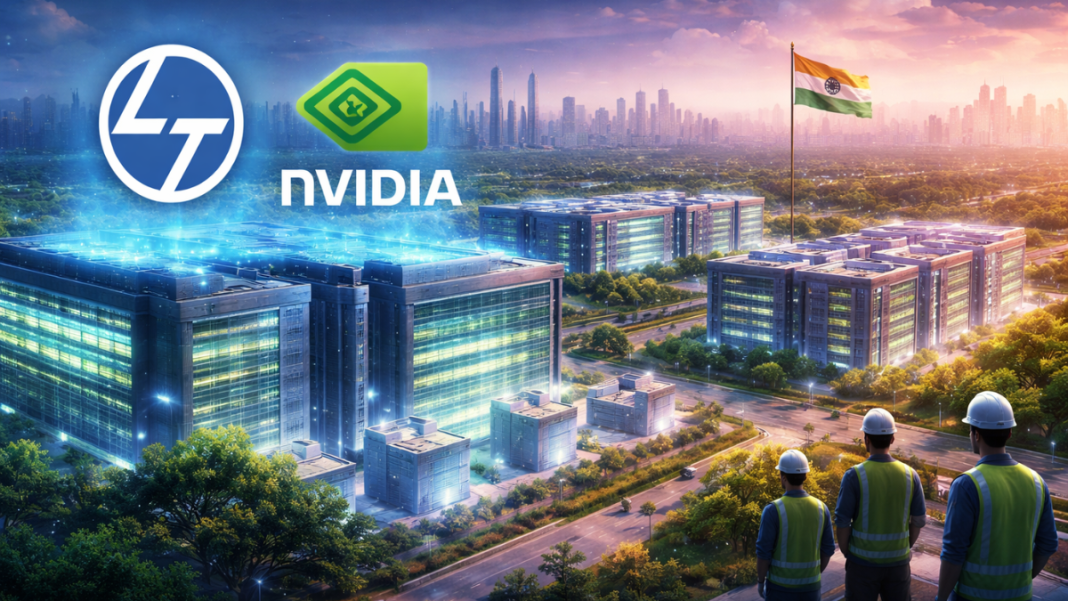
India advances AI ambitions with L&T-NVIDIA gigawatt data center partnership Mor

India’s artificial intelligence journey is expanding with a major infrastructure partnership between Larsen & Toubro (L&T) and NVIDIA. The collaboration focuses on building large AI-ready data centers that can handle complex computing tasks for businesses, governments, and global cloud providers.

The initiative is part of the IndiaAI Mission, which aims to create a strong national ecosystem for artificial intelligence. By combining L&T’s engineering strength with NVIDIA’s advanced computing platforms, the venture is designed to help organizations run large AI workloads securely within India.

Building Gigawatt-Scale AI Data Center Factories

A core feature of the partnership is the development of gigawatt-scale AI data center factories. These facilities are built to support hyperscalers, cloud platforms, and domestic enterprises that require high-performance computing.

Washington warns Nvidia: sell AI chips to China only under non-negotiable national security guardrails

The infrastructure allows companies to scale AI operations quickly without investing in their own large facilities. This helps businesses move from testing AI ideas to running full production systems across industries.

Key deployments include expanding an NVIDIA GPU cluster at L&T’s data center campus in Chennai. The site is expected to scale to around 30 megawatts within a large campus environment designed for high-density computing.

At the same time, another data center with around 40 megawatts capacity is under construction in Mumbai. Together, these facilities aim to deliver advanced AI services to sectors such as finance, manufacturing, energy, healthcare, and public services.

The design focuses on standardized, enterprise-grade systems that provide predictable performance and strong security. This allows organizations to handle heavy AI workloads such as data analytics, automation, simulation, and digital service delivery more efficiently.

The model also supports faster deployment timelines. Companies can expand their computing capacity in India while maintaining control over performance, reliability, and data protection.

Sovereign Cloud, AI Agents, and Industrial Transformation

The collaboration emphasizes sovereign cloud infrastructure. This means sensitive data and AI models can be developed, trained, and used within national boundaries.

Such infrastructure is important for industries handling critical information. It supports regulatory compliance while building trust in AI adoption across public and private sectors.

The venture enables L&T and its group companies to deploy live AI agents on a sovereign cloud. These AI agents can automate routine operations, monitor systems, and support decision-making in real time.

Bill Gates moves to step back from Delhi AI summit speech as new Epstein emails remain unverified

Industrial innovation is also supported through frameworks like the “Lights-Out Factory.” Using NVIDIA Omniverse libraries, companies can simulate production processes in digital environments before applying them in real facilities. This helps reduce errors, improve efficiency, and speed up deployment.

The initiative reflects the growing shift toward agent-driven AI systems that operate continuously with minimal human intervention. These technologies are increasingly becoming part of digital public infrastructure and enterprise operations.

In addition, the infrastructure buildout connects with broader efforts to strengthen domestic semiconductor capabilities and localize key technology components needed for advanced computing.

Supporting India AI Mission and National Digital Infrastructure

The L&T and NVIDIA venture directly contributes to the IndiaAI Mission’s compute pillar, which focuses on making high-end GPUs accessible at affordable costs. Shared AI factories allow multiple organizations to use powerful computing resources without building separate infrastructure.


The wider ecosystem also includes innovation centers that support research and development, along with dataset platforms that improve access to quality training data. These elements help accelerate AI adoption across sectors through initiatives led by L&T and NVIDIA.

Leadership voices from both organizations highlighted the importance of secure and scalable infrastructure. S N Subrahmanyan described the investment as foundational for enabling production-scale AI across manufacturing, energy, financial services, healthcare, and public services.

Chipgate — DOJ charges Chinese nationals in covert scheme to move Nvidia’s A1
tech to Beijing

Similarly, Jensen Huang noted that AI is driving one of the largest infrastructure expansions globally. The collaboration between L&T and NVIDIA aligns with national efforts linked to Prime Minister Modi’s push to expand digital infrastructure and widen AI access across emerging economies.

The infrastructure integrates accelerated computing, networking, and storage technologies into large engineering deployments. This approach supports both domestic demand and international AI workloads requiring high-performance computing environments.

By establishing AI factories at a national scale, the partnership strengthens India’s position as a strategic hub for advanced digital infrastructure, industrial automation, and secure artificial intelligence deployment across sectors.

Samruddhi Kulkarni
Samruddhi Kulkarni
Samruddhi Kulkarni is a cybersecurity and artificial intelligence specialist who reports on emerging cyber threats, advanced AI systems, and data-driven risk trends shaping the digital world.

TOP 10 TRENDING ON NEWSINTERPRETATION

Cyber Attacks on Space Infrastructure: Satellites, GPS and the Ground Systems Behind Them

From the Viasat KA-SAT hack to GPS jamming over the Baltic, a research guide to how attackers target satellites, navigation signals and ground stations, and why it matters on Earth.

How AI Agents Are Used in Cyber Attacks: From Assisted Hacking to AI-Orchestrated Espionage

Attackers now use AI agents to scan networks, write exploits and run extortion campaigns. A research guide to documented cases, including the first reported AI-orchestrated espionage campaign, and what defenders should do.

Cyber Attacks on AI and LLMs: How Attackers Target Large Language Models

Prompt injection, data poisoning, model theft and jailbreaks: a research guide to how attackers target AI systems and large language models, with real cases and defences.

French Supermarket Refrigeration Cyberattack: How Hacking the Cold Chain Can Endanger Lives

In October 2026 attackers heated refrigeration cabinets in hundreds of French supermarkets to as much as 50°C. No one was hurt, but the attack shows how hacking the cold chain can endanger lives through fire, food poisoning and spoiled medicines.

Cyberattacks on Nuclear Facilities: Stuxnet, Kudankulam and the Limits of Air Gaps

Stuxnet, the Davis-Besse worm and malware at India’s Kudankulam plant: what they show about cyber risk at nuclear facilities and the limits of air gaps.

Triton: When Hackers Target the Safety Systems That Prevent Industrial Disasters

The 2017 Triton attack targeted the safety systems that prevent industrial disasters. What happened, who was charged, and how plants protect their last line of defence.

Cybersecurity Risks in Smart Cities: When Connected Infrastructure Fails

How connecting traffic control, emergency alerts and utilities concentrates cyber risk in cities, what the Dallas and Atlanta incidents showed, and what governments recommend.

Weaponized Drones: Hijacking, GPS Spoofing and Emerging Cyber Warfare Risks

How drones can be hijacked, jammed or misled by GPS spoofing, what researchers have demonstrated, and why governments treat drone fleets as a security risk.

Ransomware Attacks on Hospitals: How Healthcare Cyberattacks Put Patients at Risk

How ransomware against hospitals and their suppliers delays care and endangers patients, what the Düsseldorf and WannaCry cases show, and what research says about deaths.

Operational blunder exposes massive Russian cyber espionage attack on Ukrainian prosecutors

A major cyberattack has compromised the email accounts of...

Cyber Attacks on Space Infrastructure: Satellites, GPS and the Ground Systems Behind Them

From the Viasat KA-SAT hack to GPS jamming over the Baltic, a research guide to how attackers target satellites, navigation signals and ground stations, and why it matters on Earth.

French Supermarket Refrigeration Cyberattack: How Hacking the Cold Chain Can Endanger Lives

In October 2026 attackers heated refrigeration cabinets in hundreds of French supermarkets to as much as 50°C. No one was hurt, but the attack shows how hacking the cold chain can endanger lives through fire, food poisoning and spoiled medicines.

Cyberattacks on Nuclear Facilities: Stuxnet, Kudankulam and the Limits of Air Gaps

Stuxnet, the Davis-Besse worm and malware at India’s Kudankulam plant: what they show about cyber risk at nuclear facilities and the limits of air gaps.

Triton: When Hackers Target the Safety Systems That Prevent Industrial Disasters

The 2017 Triton attack targeted the safety systems that prevent industrial disasters. What happened, who was charged, and how plants protect their last line of defence.

Cybersecurity Risks in Smart Cities: When Connected Infrastructure Fails

How connecting traffic control, emergency alerts and utilities concentrates cyber risk in cities, what the Dallas and Atlanta incidents showed, and what governments recommend.

Ransomware Attacks on Hospitals: How Healthcare Cyberattacks Put Patients at Risk

How ransomware against hospitals and their suppliers delays care and endangers patients, what the Düsseldorf and WannaCry cases show, and what research says about deaths.

FBI warns of AVrecon malware targeting outdated routers linked to proxy based cybercrime

A serious cybersecurity warning has been issued regarding commonly...

Related Articles

Popular Categories
