

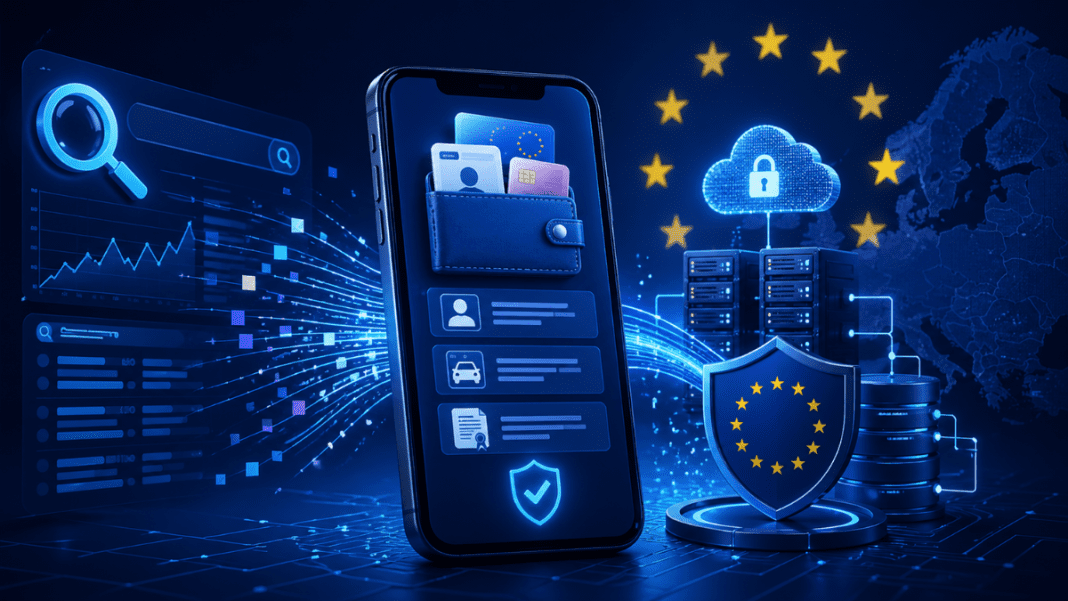
EU develops data sharing rules for Google alongside digital identity wallet rollout

The European Union has launched a formal procedure through the European Commission to require Google, owned by Alphabet Inc., to share detailed search data. This action is part of the Digital Markets Act (DMA), a law designed to make digital markets more competitive.

The case began on April 16, 2026. Its purpose is to define how Google must share its data with other companies. A final decision is expected before July 27.

The data involved includes search queries, rankings, clicks, and views. This type of information is essential for how search engines function. It also plays a major role in shaping the broader digital ecosystem.

The European Commission is focusing on five key elements. These include who can access the data, how much will be shared, how it will be anonymised, the economic terms, and the technical systems used for distribution.

The official aim is to boost competition. By giving other companies access to this data, the EU hopes to reduce Google’s dominance and allow new players to grow. At the same time, this approach places data sharing under regulatory supervision, increasing oversight of how digital information flows.

Google named in a massive legal complaint for failing to remove leaked Epstein survivor information

Questions Around Data Privacy and Anonymisation

Privacy is a central concern in this plan. The EU has stated that all shared data will be anonymised so that individuals cannot be directly identified.

However, the process is complex. The European Commission has acknowledged the difficulty of keeping data useful while ensuring privacy is protected.

To address this, companies and stakeholders have been asked to review the proposed system. They are evaluating whether the balance between data usefulness and privacy protection is appropriate.

There are also concerns about re-identification. Even when data is anonymised, combining it with other datasets could make it possible to identify individuals indirectly.

Because of these risks, the effectiveness of anonymisation will depend on how the system is designed. The current procedure shows that the model is still being refined and is not yet fully finalised.

This stage highlights the technical challenges involved. It also shows that further adjustments may be made before the system is fully implemented.

EU Digital Wallet to Store Identity on Phones

Alongside the data-sharing plan, the EU is developing the European Digital Identity Wallet, known as the EUDI Wallet. This is a separate initiative but is progressing at the same time.

Google blocks 100,000-prompt campaign attempting to clone Gemini AI system

The digital wallet will allow people to store official documents on their smartphones. These include ID cards, driving licences, and other certificates.

Deployment is set to begin in 2026, with wider use expected by 2027 across all EU member states. The wallet will support identification, electronic signatures, and access to public and private services.

A key feature is interoperability. The same system will work across all 27 EU countries, removing the need for multiple national systems.

At the same time, this approach centralises standards and validation at the European level. The EU will define how the system operates across all member states.

Together, these two initiatives reflect a broader shift. One focuses on access to digital behaviour data, while the other focuses on verifying identity.

Each serves a different function, but both contribute to structuring the digital environment. The data-sharing system creates a layer of information, while the digital wallet creates a layer of identity verification.

These developments show how the EU is shaping the systems that support digital activity. Both initiatives are based on different legal frameworks but are advancing in parallel, influencing how the digital space in Europe is organised and managed.


T U Deshmukh
T U Deshmukh
T U Deshmukh is the leading voice on the subject of Jobs, AI, Data and layoffs and she regularly contributes a column on Jobs for Newsinterpretation.

TOP 10 TRENDING ON NEWSINTERPRETATION

Cyber Attacks on Space Infrastructure: Satellites, GPS and the Ground Systems Behind Them

From the Viasat KA-SAT hack to GPS jamming over the Baltic, a research guide to how attackers target satellites, navigation signals and ground stations, and why it matters on Earth.

How AI Agents Are Used in Cyber Attacks: From Assisted Hacking to AI-Orchestrated Espionage

Attackers now use AI agents to scan networks, write exploits and run extortion campaigns. A research guide to documented cases, including the first reported AI-orchestrated espionage campaign, and what defenders should do.

Cyber Attacks on AI and LLMs: How Attackers Target Large Language Models

Prompt injection, data poisoning, model theft and jailbreaks: a research guide to how attackers target AI systems and large language models, with real cases and defences.

French Supermarket Refrigeration Cyberattack: How Hacking the Cold Chain Can Endanger Lives

In October 2026 attackers heated refrigeration cabinets in hundreds of French supermarkets to as much as 50°C. No one was hurt, but the attack shows how hacking the cold chain can endanger lives through fire, food poisoning and spoiled medicines.

Cyberattacks on Nuclear Facilities: Stuxnet, Kudankulam and the Limits of Air Gaps

Stuxnet, the Davis-Besse worm and malware at India’s Kudankulam plant: what they show about cyber risk at nuclear facilities and the limits of air gaps.

Triton: When Hackers Target the Safety Systems That Prevent Industrial Disasters

The 2017 Triton attack targeted the safety systems that prevent industrial disasters. What happened, who was charged, and how plants protect their last line of defence.

Cybersecurity Risks in Smart Cities: When Connected Infrastructure Fails

How connecting traffic control, emergency alerts and utilities concentrates cyber risk in cities, what the Dallas and Atlanta incidents showed, and what governments recommend.

Weaponized Drones: Hijacking, GPS Spoofing and Emerging Cyber Warfare Risks

How drones can be hijacked, jammed or misled by GPS spoofing, what researchers have demonstrated, and why governments treat drone fleets as a security risk.

Ransomware Attacks on Hospitals: How Healthcare Cyberattacks Put Patients at Risk

How ransomware against hospitals and their suppliers delays care and endangers patients, what the Düsseldorf and WannaCry cases show, and what research says about deaths.

Operational blunder exposes massive Russian cyber espionage attack on Ukrainian prosecutors

A major cyberattack has compromised the email accounts of...

Cyber Attacks on Space Infrastructure: Satellites, GPS and the Ground Systems Behind Them

From the Viasat KA-SAT hack to GPS jamming over the Baltic, a research guide to how attackers target satellites, navigation signals and ground stations, and why it matters on Earth.

French Supermarket Refrigeration Cyberattack: How Hacking the Cold Chain Can Endanger Lives

In October 2026 attackers heated refrigeration cabinets in hundreds of French supermarkets to as much as 50°C. No one was hurt, but the attack shows how hacking the cold chain can endanger lives through fire, food poisoning and spoiled medicines.

Cyberattacks on Nuclear Facilities: Stuxnet, Kudankulam and the Limits of Air Gaps

Stuxnet, the Davis-Besse worm and malware at India’s Kudankulam plant: what they show about cyber risk at nuclear facilities and the limits of air gaps.

Triton: When Hackers Target the Safety Systems That Prevent Industrial Disasters

The 2017 Triton attack targeted the safety systems that prevent industrial disasters. What happened, who was charged, and how plants protect their last line of defence.

Cybersecurity Risks in Smart Cities: When Connected Infrastructure Fails

How connecting traffic control, emergency alerts and utilities concentrates cyber risk in cities, what the Dallas and Atlanta incidents showed, and what governments recommend.

Ransomware Attacks on Hospitals: How Healthcare Cyberattacks Put Patients at Risk

How ransomware against hospitals and their suppliers delays care and endangers patients, what the Düsseldorf and WannaCry cases show, and what research says about deaths.

FBI warns of AVrecon malware targeting outdated routers linked to proxy based cybercrime

A serious cybersecurity warning has been issued regarding commonly...

Related Articles

Popular Categories